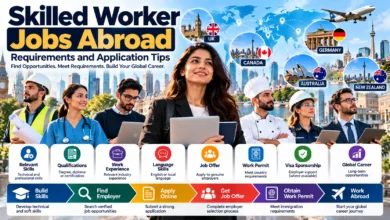
Entry-Level International Jobs for Recent Graduates: How to Start a Global Career


Graduating from university can feel like the beginning of two searches at once: finding your first serious job and deciding where you want your career to take you. For some graduates, that search extends beyond their home country.
Entry-level international jobs can provide exposure to different industries, workplace cultures, technologies, languages, and professional networks. But finding your first job abroad is different from applying for an experienced professional position. Recent graduates may have limited work history, while employers hiring internationally may also need to consider work authorization, relocation, professional registration, and immigration requirements.
The good news is that “entry level” does not mean “no value.” Employers also look at academic projects, internships, technical abilities, language skills, volunteering, portfolios, student leadership, and evidence that a candidate can learn quickly.
This guide explains the types of international jobs recent graduates can explore, which career fields commonly offer early-career positions, how internships and traineeships can help, where to search, and how to approach visa and work-permit requirements realistically.
Quick Overview
| Area | What Recent Graduates Should Know |
|---|---|
| Experience | Some roles accept little professional experience |
| Qualifications | Degree, diploma, vocational training or job-specific skills may be required |
| Job types | Graduate roles, junior jobs, traineeships, internships and apprenticeships |
| Locations | Opportunities vary across Europe, Asia, North America, the Middle East and elsewhere |
| Visa sponsorship | Depends on the country, employer and position |
| Language | English may be enough for some roles; others require the local language |
| Applications | Employer career sites and official job portals are useful starting points |
| Salary | Varies substantially by country, occupation and employer |
| Relocation | May or may not be provided |
| Best strategy | Target jobs that genuinely match your education and skills |
What Is an Entry-Level International Job?
An entry-level international job is generally a position intended for candidates who are at the beginning of their careers and may have limited full-time professional experience.
These positions can appear under many names:
- Graduate programme
- Graduate trainee
- Junior analyst
- Junior engineer
- Associate
- Assistant
- Trainee
- Entry-level developer
- Research assistant
- Project assistant
- Operations associate
- Marketing assistant
- Finance graduate
- Management trainee
There is no universal definition of “entry level.”
One employer may accept candidates with no previous full-time experience, while another may describe a position requiring one or two years of relevant experience as entry level.
For international applicants, another important distinction exists: a job can be entry level without being eligible for overseas recruitment.
Always investigate both the employment requirements and the work-authorization requirements.
Entry-Level Job vs Internship vs Traineeship
Recent graduates should not limit themselves to vacancies containing the words “entry-level job.”
Internships and structured traineeships can also provide routes into international careers.
An internship generally provides short-term practical exposure to an occupation or industry. Some internships target students, while others accept recent graduates.
A traineeship is often more structured around developing professional skills and preparing participants for particular types of work.
A regular entry-level job normally involves defined employee responsibilities and standard employment arrangements.
EURES, the European employment network, describes internships as particularly relevant to students and recent graduates and traineeships as structured opportunities for graduates or people with limited experience to develop career-specific skills.
This means a graduate searching internationally should consider several opportunity types instead of searching only for permanent junior jobs.
Entry-Level International Career Fields to Explore
International opportunities exist across many industries, but the availability of junior roles varies considerably by country.
The following fields can be useful starting points for research.
1. Information Technology and Software
Technology can be accessible to recent graduates who can demonstrate practical technical ability.
Possible junior roles include:
- Junior software developer
- Web developer
- QA tester
- IT support specialist
- Junior data analyst
- Cloud support associate
- Cybersecurity analyst
- Technical support engineer
- Business systems analyst
A computer science degree can help, but employers may also evaluate coding projects, Git repositories, internships, certifications and technical assessments.
Recent graduates should build a portfolio that demonstrates what they can actually do.
A software graduate, for example, might include several well-documented projects rather than relying entirely on academic grades.
2. Engineering
Engineering graduates can explore junior positions in industries such as manufacturing, construction, energy, automotive technology, infrastructure and industrial services.
Potential positions include:
- Graduate civil engineer
- Junior mechanical engineer
- Electrical engineering graduate
- Graduate process engineer
- Junior project engineer
- Quality engineer
- Engineering technician
- Design engineer
Engineering requirements vary significantly between countries.
Some positions or professional titles may involve formal recognition, licensing or registration. Research this before assuming your qualification will automatically be accepted abroad.
Employers may also value knowledge of CAD tools, engineering software, project work, laboratory experience and industry placements.
3. Business and Finance
Business graduates can investigate international companies, financial institutions, professional services firms, logistics businesses and multinational corporations.
Entry-level titles may include:
- Junior financial analyst
- Accounts assistant
- Audit associate
- Operations analyst
- Business analyst
- Graduate management trainee
- Procurement assistant
- Sales operations associate
- Risk analyst
- Junior consultant
Some graduate programmes recruit candidates from several academic backgrounds rather than requiring one narrowly defined degree.
Read each programme’s eligibility requirements carefully.
4. Marketing and Communications
Marketing is another field where practical evidence of ability can strengthen a graduate application.
Possible positions include:
- Marketing assistant
- Digital marketing associate
- Social media coordinator
- Content assistant
- Junior SEO specialist
- Communications assistant
- Market research assistant
- Junior account executive
Graduates can strengthen their profiles through portfolios containing campaign concepts, university projects, writing samples, analytics work, website projects or other genuine examples.
Language ability can be particularly valuable in international marketing positions.
5. Supply Chain and Logistics
International trade and global supply chains create early-career opportunities in logistics, procurement, warehousing, transportation and operations.
Potential roles include:
- Logistics coordinator
- Supply chain graduate
- Procurement assistant
- Inventory analyst
- Operations associate
- Shipping coordinator
- Junior demand planner
Employers may value spreadsheet skills, data analysis, enterprise software familiarity, communication ability and knowledge of supply-chain processes.
6. Hospitality and Tourism
International hotels, resorts, travel businesses and hospitality groups may operate graduate programmes or junior management pathways.
Potential positions include:
- Front office trainee
- Guest services associate
- Food and beverage trainee
- Hotel operations trainee
- Reservations agent
- Hospitality graduate trainee
- Events assistant
Language skills and previous customer-service experience can be particularly useful.
However, applicants should not assume that every hospitality vacancy qualifies for a work visa. Immigration eligibility must be checked separately.
7. Research and Laboratory Work
Graduates from scientific disciplines can investigate universities, research institutes, laboratories, biotechnology organizations and research-focused companies.
Potential positions include:
- Research assistant
- Laboratory assistant
- Junior research technician
- Clinical research assistant
- Data assistant
- Research project coordinator
Some research positions require postgraduate education, while others accept bachelor’s-level graduates.
Read the academic requirements carefully rather than assuming all research roles require a master’s degree or PhD.
8. International Organizations and Public-Sector Programmes
Recent graduates interested in international development, policy, administration or public service can research graduate programmes, internships and traineeships offered by international institutions.
These opportunities can be highly competitive and frequently have specific nationality, education, language or age requirements.
Never assume that an international organization automatically accepts applicants from every country.
Check each programme’s official eligibility rules.
International Traineeships for Recent Graduates
Structured traineeships deserve particular attention because they can help bridge the gap between education and professional employment.
One example is the European Commission’s Blue Book Traineeship programme.
The European Commission describes Blue Book as a five-month paid traineeship providing professional experience in an international environment. Its current programme includes administrative traineeships for university graduates, a vocational education and training graduate strand, and translation traineeships.
Most placements are in Brussels, with opportunities also available in Luxembourg and other locations.
Eligibility depends on the particular traineeship strand and session. The Commission states that only a limited number of places are allocated to eligible non-EU nationals, so international applicants should carefully check the nationality and other requirements before applying.
This is a good example of why graduates should verify opportunities directly instead of assuming that every international programme is open worldwide.
Where Can Recent Graduates Find International Jobs?
A successful search usually combines several sources.
Employer Career Websites
Start with companies operating internationally in your field.
Search:
Company name + graduate careers
Company name + early careers
Company name + graduate programme
Company name + entry level jobs
Company name + internships
Large organizations often have dedicated student and graduate recruitment sections.
Official Employment Portals
Government and regional employment services can help graduates research vacancies and employment conditions.
For European opportunities, EURES provides employment and mobility resources covering participating countries and has specifically promoted support for students, graduates, trainees and young job seekers.
University Career Services
Your university may continue providing career support after graduation.
Possible services include:
- Employer directories
- Graduate job boards
- Career fairs
- Alumni networking
- CV reviews
- Interview preparation
- International employer events
Check how long graduate access remains available after completing your studies.
Professional Associations
Professional associations can provide industry-specific job boards, career events and networking opportunities.
These can be especially valuable in engineering, finance, research, technology and regulated professions.
Professional Networking
Professional networking platforms can help you identify employers and discover vacancies.
Follow companies rather than simply searching for generic posts promising overseas employment.
Pay attention to:
- Official company vacancy announcements
- Graduate recruitment campaigns
- Early-career recruiters
- Career fairs
- Industry events
Always apply through a verified recruitment channel.
How to Search for Graduate Jobs More Effectively
Search terminology matters.
Instead of searching only:
International jobs for graduates
try occupation-specific searches such as:
- Graduate software engineer Germany
- Junior data analyst international applicants
- Engineering graduate programme Europe
- Entry-level finance jobs Dubai
- Graduate supply chain programme
- Junior marketing jobs international applicants
- Research assistant jobs for graduates
- Graduate trainee multinational company
Also search alternative job titles.
A company may not use “entry level” anywhere in its advertisement even though the position is suitable for graduates.
Useful terms include:
Graduate
Junior
Associate
Assistant
Trainee
Early Careers
New Graduate
Analyst
Apprentice
Intern
Can Recent Graduates Get Visa Sponsorship?
Sometimes, but sponsorship should never be assumed.
Whether an employer can support an international graduate depends on:
- Destination country
- Immigration programme
- Occupation
- Salary
- Employer status
- Applicant’s nationality
- Qualifications
- Language ability
- Other visa requirements
Some immigration systems make it easier to recruit foreign workers into certain skilled occupations than into general entry-level positions.
This creates an important challenge for graduates.
A company may be willing to employ you, but the proposed position must still satisfy the relevant immigration rules.
When reading a vacancy, look for phrases such as:
- Visa sponsorship available
- Work permit support
- International applicants welcome
- Global mobility support
- Relocation assistance
- Must already have right to work
- Sponsorship not available
Remember that relocation assistance is not necessarily the same as visa sponsorship.
How to Build a Strong Graduate CV Without Much Experience
A graduate CV should not look empty simply because you have not held several full-time jobs.
Your education can provide evidence of relevant skills.
Consider including:
Academic Projects
Include projects directly relevant to the position.
Explain:
- What you worked on
- Which tools you used
- Your contribution
- What you produced or learned
Internships
Even short internships can demonstrate workplace exposure.
Focus on your responsibilities and skills rather than simply listing the company name.
Final-Year Project or Thesis
Your dissertation or capstone project can be valuable when it relates to the job.
A data science graduate, for example, could mention the dataset, methodology and technical tools used.
Volunteer Experience
Relevant volunteering can demonstrate teamwork, leadership, communication or organizational ability.
Technical Skills
List genuine skills such as:
- Programming languages
- Data-analysis software
- CAD tools
- Laboratory techniques
- Accounting software
- CRM systems
- Design software
- Languages
Avoid rating yourself as “expert” unless your experience genuinely supports that description.
Certifications
Relevant certifications can strengthen a graduate profile, particularly in technology, finance, project management and technical fields.
Do not collect certificates simply to make the CV longer. Prioritize credentials relevant to your target occupation.
Create a Portfolio When Your Field Allows It
A portfolio can help compensate for limited professional experience.
This is especially useful for:
- Software development
- Data analytics
- Graphic design
- UX/UI
- Architecture
- Marketing
- Writing
- Photography
- Engineering design
A portfolio should demonstrate actual work rather than simply repeat your CV.
For example, a junior data analyst could include a few well-presented projects showing data cleaning, analysis and visualization.
A marketing graduate might include a campaign plan, content strategy or university research project.
Should You Apply If the Job Asks for One Year of Experience?
Use judgment.
Job descriptions often describe the employer’s preferred candidate rather than a perfect checklist.
If you meet most of the important requirements and have relevant internships, placements, projects or other practical experience, the position may still be worth considering.
However, do not misrepresent your experience.
There is an important difference between applying despite being slightly below a preferred experience level and claiming professional experience you do not have.
Prepare a Graduate-Focused Cover Letter
Your cover letter should explain what you can contribute despite being early in your career.
A strong structure is:
Opening
State the exact position and why it interests you.
Academic relevance
Connect your degree or training to the role.
Evidence
Mention a project, internship, placement or achievement demonstrating relevant skills.
Employer fit
Explain why this particular organization interests you.
International status
Where appropriate, clearly state your current location and work-authorization situation.
Avoid sending the same cover letter to every employer.
Skills That Can Strengthen an International Graduate Application
Employers assess more than academic qualifications.
Depending on the occupation, useful abilities can include:
- Communication
- Problem solving
- Data analysis
- Digital skills
- Teamwork
- Research
- Project coordination
- Adaptability
- Professional writing
- Technical software
- Foreign languages
- Presentation skills
International employers may also value evidence that you can work effectively with colleagues from different cultural and professional backgrounds.
Avoid simply listing soft skills.
Demonstrate them through examples.
Instead of writing:
Excellent teamwork skills
you might explain how you coordinated a university project with several team members and delivered a specific result.
Countries and Regions to Research
There is no single country that is suitable for every recent graduate.
Your options depend on your degree, nationality, occupation, language skills and immigration eligibility.
Potential regions to investigate include:
Europe
European countries offer graduate employment, internships and traineeships across industries including engineering, technology, finance, manufacturing, research and business services.
EURES can be useful for researching employment mobility within participating European countries.
Non-EU applicants must separately check the immigration requirements of their intended destination.
Canada
Graduates can research employers in technology, business, engineering, healthcare and other industries.
International applicants should distinguish between vacancies open to foreign candidates and positions requiring existing Canadian work authorization.
Australia and New Zealand
Graduate programmes exist across engineering, accounting, technology, construction, professional services and other sectors.
Applicants outside these countries should verify visa eligibility and employer sponsorship arrangements before assuming that a graduate programme accepts overseas candidates.
Gulf Countries
The UAE and other Gulf employment markets contain international companies operating in finance, hospitality, technology, logistics, construction and professional services.
Employment conditions, visa arrangements and benefits vary significantly between employers.
Review contracts carefully.
Asia
Markets such as Singapore and Japan can provide opportunities in technology, engineering, finance, research and other sectors.
Work-pass requirements and language expectations can substantially affect eligibility.
A Practical Graduate Job-Search Plan
Recent graduates often make the mistake of applying randomly because they feel pressure to find their first job quickly.
A structured approach is more sustainable.
Phase 1: Choose Your Direction
Select:
- 1–2 career fields
- 2–4 job titles
- 2–3 target countries
Phase 2: Build Your Profile
Prepare:
- Professional CV
- Basic cover-letter framework
- Professional networking profile
- Portfolio where relevant
- Academic documents
- References
Phase 3: Create an Employer List
Identify approximately 20–30 employers relevant to your target field.
Bookmark their career pages.
Phase 4: Search Consistently
Check new vacancies regularly.
Focus on quality rather than submitting applications to every available position.
Phase 5: Track Everything
Maintain a spreadsheet containing:
| Information | What to Record |
|---|---|
| Employer | Company or organization |
| Position | Exact job title |
| Country | Job location |
| Source | Where you found it |
| Deadline | If applicable |
| Visa status | Available / unclear / unavailable |
| Application date | When submitted |
| Result | Pending / interview / unsuccessful / offer |
| Follow-up | Notes and dates |
Common Mistakes Recent Graduates Should Avoid
Waiting for the “Perfect” Job
Your first role does not have to define your entire career.
A position that develops valuable skills can become a stepping stone to more specialized opportunities.
Applying Only to Jobs With “Graduate” in the Title
Junior, assistant, associate and trainee positions may also suit recent graduates.
Using Academic Grades as the Entire Application
Strong grades can help, but employers also want evidence that you can apply your knowledge.
Use projects, internships and practical skills to strengthen your profile.
Ignoring Visa Requirements
A job may match your qualifications but not provide a viable work-authorization pathway.
Check both.
Applying to Unverified Social-Media Offers
Use social media for discovery, not blind trust.
Verify vacancies through the employer or authoritative source.
Paying for Guaranteed Employment
Be cautious of anyone promising guaranteed international employment or visa approval in exchange for payment.
Employers make recruitment decisions, while immigration authorities decide visa or permit applications.
How to Verify a Graduate Job Offer
Before accepting an overseas position:
- Confirm the employer’s official website
- Verify the recruiter’s email domain
- Research the organization independently
- Confirm the job location
- Read the complete contract
- Check salary and working hours
- Understand probation conditions
- Verify visa or work-permit arrangements
- Confirm which relocation costs are covered
- Investigate unexpected payment requests
Do not allow excitement about your first international opportunity to replace basic verification.
Frequently Asked Questions
Can a recent graduate get an international job without experience?
Yes, some positions are specifically intended for graduates or candidates with limited professional experience.
Academic projects, internships, placements, volunteering and relevant technical skills can help demonstrate your suitability.
Eligibility still depends on the individual vacancy.
Which jobs are suitable for graduates who want to work abroad?
Potential areas include technology, engineering, finance, business operations, marketing, logistics, hospitality and research.
The most appropriate field depends on your education and skills.
Are internships useful after graduation?
Yes. Some internships specifically accept recent graduates.
A relevant internship can provide professional experience, references and industry exposure.
Check whether the programme accepts graduates rather than only currently enrolled students.
What is the difference between a graduate programme and a normal entry-level job?
Graduate programmes are often structured development programmes with training, mentoring or rotations.
A regular entry-level job usually places the employee directly into a defined position.
The exact structure varies by employer.
Can entry-level international jobs provide visa sponsorship?
Some can, but not every entry-level job qualifies.
Sponsorship depends on the employer and the immigration rules applying to the position and applicant.
Always verify sponsorship before making relocation plans.
Should I apply abroad immediately after graduating?
You can, provided you meet the vacancy requirements.
However, gaining relevant local experience, completing an internship or strengthening technical skills can also improve your competitiveness if international applications are initially unsuccessful.
Where can I find legitimate international graduate opportunities?
Start with official employer career pages, government employment portals, university career services, professional associations and established international employment resources.
For European opportunities, EURES is one official resource worth researching.
Final Takeaway
Entry-level international jobs can give recent graduates an opportunity to begin their careers in a global environment, but the process requires more than searching for “jobs abroad.”
Start with your profession.
Identify the skills you already have, the experience you can demonstrate through academic or practical work, and the countries where those qualifications are relevant.
Then expand your search beyond conventional job titles. Graduate programmes, junior roles, assistant positions, internships and structured traineeships can all provide useful starting points.
At the same time, keep employment and immigration requirements separate in your planning. A vacancy being suitable for graduates does not automatically mean that an employer can sponsor an overseas applicant.
Build a strong CV, create a portfolio where appropriate, target genuine employers and verify every opportunity before sharing sensitive information or making financial commitments.
Your first international position does not need to be your final destination. The most valuable early-career opportunity is often one that gives you credible experience, useful skills and a foundation from which your career can continue to develop.