NGO Internships for Students: International Opportunities, Requirements and How to Apply

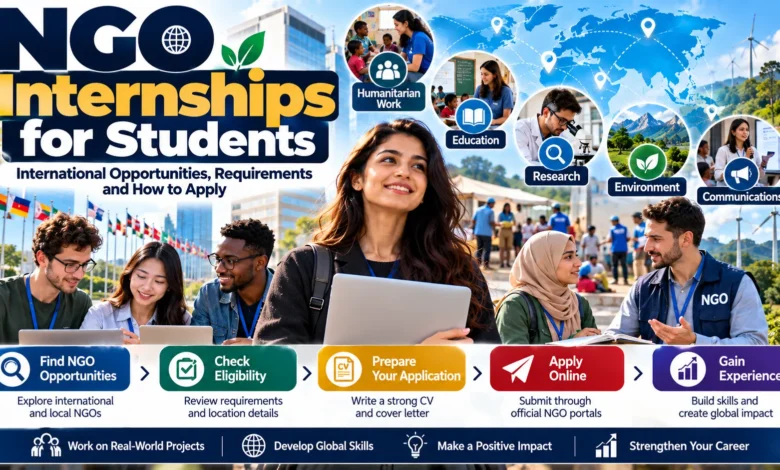
Working with a nonprofit or nongovernmental organization can be a valuable way for students to gain practical experience while contributing to projects that address real-world challenges. Whether your interests lie in education, humanitarian assistance, public health, environmental protection or international development, NGO internships can introduce you to professional work that goes beyond the classroom.
However, finding a suitable internship requires more than searching for a well-known organization’s name. Some opportunities are paid, others are unpaid, and certain positions are restricted to applicants who already have permission to work in the host country.
International applicants also need to understand the difference between an internship, a volunteer assignment and an entry-level job.
This guide explains where students can find NGO internships, which organizations are worth exploring, what qualifications may be required and how to prepare an application that demonstrates genuine potential.
What Are NGO Internships?
An NGO internship is a structured learning or work-experience opportunity offered by a nongovernmental organization.
NGOs operate in many areas, including humanitarian relief, education, healthcare, environmental conservation, human rights and community development.
Interns may support everyday organizational activities, assist experienced professionals or contribute to specific projects.
For example, an intern working with an education-focused NGO might help organize training materials, analyze survey responses or prepare progress reports.
Someone interested in environmental protection could assist with research, public awareness campaigns or project documentation.
The exact responsibilities depend on the organization and position.
NGO internships can take place at headquarters, regional offices, country offices or remotely, depending on the programme.
NGO Internships at a Glance
| Category | General Information |
|---|---|
| Opportunity type | Internship or structured learning placement |
| Main applicants | University students and eligible recent graduates |
| Fields | Development, humanitarian work, health, education, research and more |
| Locations | International, regional, local or remote |
| Experience | Some entry-level internships require little professional experience |
| Duration | Often several weeks to several months |
| Compensation | Paid, stipend-supported or unpaid |
| Language | Depends on position and location |
| Visa support | Not guaranteed |
| Application method | Usually official organization career portals |
| Availability | Depends on current vacancies |
These are general characteristics, not conditions that apply to every NGO.
Why NGO Internships Can Be Valuable for Students
An NGO internship is not simply an opportunity to add an organization’s name to your CV.
Its value comes from the skills, responsibilities and professional understanding you develop.
Practical Experience Beyond the Classroom
University courses introduce theories and academic concepts.
Internships allow students to see how organizations apply those concepts to practical problems.
A public health student might learn how health education projects are organized.
An economics student might help review programme data or expenditure reports.
A communications student could gain experience preparing public information materials.
Exposure to International Development
Many NGOs work with governments, local communities, universities, donors and international institutions.
An internship can help students understand how these organizations coordinate activities, measure progress and manage resources.
Professional Skill Development
Depending on the assignment, students may develop skills involving:
- Research and data analysis
- Professional communication
- Project coordination
- Report writing
- Monitoring and evaluation
- Digital content development
- Teamwork
- Problem-solving
- Administrative support
Career Exploration
An internship can also help students decide whether a particular career path suits them.
For example, someone interested in humanitarian work might discover a stronger preference for research, logistics, programme management or communications.
That insight can be valuable before committing to postgraduate study or a specialized career.
International NGOs Offering Internship Opportunities
Students can investigate several established organizations. However, the organizations below do not necessarily have open internships at the time you read this article.
Some also operate different recruitment systems across headquarters and country offices.
1. Amnesty International
Amnesty International works on human rights issues through research, advocacy and campaigning.
Students interested in human rights, law, communications, international relations or nonprofit operations may find its work relevant.
Depending on vacancies and office arrangements, opportunities may involve research assistance, campaign support, communications or administration.
Applicants should check the organization’s official careers information and individual vacancy requirements.
Official website: https://www.amnesty.org/
2. Save the Children
Save the Children works on issues affecting children, including education, health, protection and humanitarian assistance.
Students studying education, public health, social sciences, international development or communications may find relevant career and internship opportunities.
Possible assignments depend on the employing office and can involve programme support, research, communications or operations.
Official website: https://www.savethechildren.net/
3. Oxfam
Oxfam is an international confederation working on poverty, inequality and humanitarian issues.
Students interested in development, public policy, economics, communications or humanitarian work can investigate opportunities across its network.
Recruitment may be managed by individual Oxfam affiliates, meaning opportunities and eligibility requirements can differ.
Official website: https://www.oxfam.org/
4. World Wildlife Fund (WWF)
WWF focuses on nature conservation and environmental sustainability.
Its work may interest students studying:
- Environmental science
- Conservation biology
- Geography
- Sustainability
- Communications
- Public policy
Internships, student programmes and early-career opportunities differ across WWF’s national offices.
Official website: https://www.worldwildlife.org/
5. CARE
CARE is an international humanitarian and development organization whose work includes poverty reduction, emergency response and gender equality.
Students interested in humanitarian programmes, social development, economics or public health can explore its careers resources.
Not every country office offers internships, and opportunities may have local employment or work-authorization requirements.
Official website: https://www.care.org/
6. International Rescue Committee (IRC)
The International Rescue Committee works with people affected by humanitarian crises and displacement.
Its activities include humanitarian response, resettlement support and related services.
Students interested in refugee support, social work, international development, communications or administration may find suitable opportunities.
The IRC’s recruitment website is a useful starting point for checking internships and other early-career roles.
Official website: https://www.rescue.org/
7. Transparency International
Transparency International works on issues relating to corruption, transparency and accountability.
Its activities may interest students in:
- Political science
- Law
- Economics
- Public policy
- International relations
- Research
- Communications
Opportunities can exist through the international secretariat or national chapters, subject to their recruitment policies.
Official website: https://www.transparency.org/
8. Médecins Sans Frontières (Doctors Without Borders)
Médecins Sans Frontières (MSF) provides medical humanitarian assistance.
Although its fieldwork frequently requires experienced professionals, students can explore suitable administrative, communications, fundraising or support opportunities when advertised by individual MSF offices.
Applicants should not assume that an internship offers clinical fieldwork or international deployment.
Official website: https://www.msf.org/
Which Students Can Apply for NGO Internships?
NGO internships attract applicants from many academic backgrounds.
An international development organization does not necessarily recruit only international relations graduates.
International Relations and Political Science Students
Potentially relevant work includes:
- Policy research
- Advocacy
- Humanitarian coordination support
- Governance research
- Programme reporting
Public Health and Medical Students
Possible areas include:
- Health education
- Community health research
- Public health communication
- Health programme support
- Data collection
Clinical responsibilities may require professional authorization or additional training.
Business, Finance and Economics Students
NGOs also need people who understand financial and organizational operations.
Relevant departments may include:
- Finance
- Accounting
- Procurement
- Human resources
- Administration
- Project budgeting
Computer Science and IT Students
Technology-related opportunities may involve:
- Data management
- Website support
- Software development
- Information systems
- Digital security
- Data visualization
Journalism and Communications Students
NGOs frequently communicate with donors, communities, partners and the public.
Internship responsibilities could include:
- Writing articles
- Preparing newsletters
- Supporting campaigns
- Social media content
- Editing reports
- Visual communication
Environmental Science Students
Environmental NGOs may provide opportunities involving conservation, sustainability, climate research and community environmental programmes.
Paid vs Unpaid NGO Internships
One of the most important questions students should ask is whether an internship provides compensation.
There is no universal payment policy covering all NGOs.
Paid Internships
Some organizations offer internships with an hourly wage, salary or fixed payment.
The amount can depend on the country, organization and role.
Stipend-Supported Internships
Other programmes provide a stipend or allowance.
This may help cover living expenses but may not meet the full cost of accommodation, transportation and other necessities.
Unpaid Internships
Some NGOs advertise unpaid placements.
Before accepting, students should consider:
- Local employment laws
- Living costs
- Transportation
- Accommodation
- Insurance
- Visa requirements
- Expected working hours
- Educational value
Students should not assume that an unpaid internship is automatically legal or appropriate in every country.
Important: A paid NGO internship is not necessarily fully funded. International flights, housing and visa expenses may remain the applicant’s responsibility.
Can International Students Apply for NGO Internships Abroad?
Yes, international students may qualify for certain NGO internships abroad.
However, eligibility depends on the vacancy.
An internship advertised in another country may require applicants to already possess:
- Citizenship
- Permanent residency
- Student status in that country
- Valid work authorization
- Another qualifying immigration status
Other programmes may consider international applicants from outside the host country.
Does an NGO Provide Visa Sponsorship?
Not necessarily.
NGO internships should not be confused with employer-sponsored jobs.
Some organizations may provide immigration-related documentation or assistance for specific programmes, but this is not universal.
Applicants should confirm:
- Whether international candidates are eligible.
- Whether the internship requires work authorization.
- Whether the organization provides immigration assistance.
- Who pays visa and travel expenses.
- Whether the placement can legally be completed under the relevant immigration category.
Never assume that receiving an internship offer guarantees visa approval.
Remote NGO Internships for Students
Remote internships can be particularly useful for students who cannot relocate internationally.
Some organizations may advertise remote or hybrid assignments in areas such as:
- Research
- Communications
- Digital marketing
- Data analysis
- Graphic design
- Fundraising support
- Policy research
- Administrative assistance
However, remote does not automatically mean worldwide.
An organization may restrict remote internships to applicants living in certain countries because of employment, tax, legal or operational requirements.
Students should read the location and eligibility information carefully.
Benefits of Remote Internships
Remote opportunities may reduce relocation costs and provide experience collaborating with international teams.
They can also help students develop:
- Written communication
- Virtual collaboration
- Time management
- Digital research
- Online project coordination
The quality of the experience still depends on supervision, meaningful responsibilities and opportunities to learn.
Where to Find Legitimate NGO Internships
A strong search strategy begins with official recruitment sources.
Official NGO Career Websites
Visit the career pages of organizations whose missions align with your interests.
Look for categories such as:
- Internships
- Students
- Early Careers
- Graduate Opportunities
- Research Opportunities
- Temporary Assignments
University Career Services
University career offices sometimes maintain partnerships with nonprofits and community organizations.
These opportunities may be less visible through public search engines.
Students can also ask academic departments about research placements or NGO partnerships.
Professional Networks
LinkedIn and professional networks can help students discover internships.
However, an opportunity found through social media should be verified through the organization’s official website before submitting personal information.
Local NGOs
Students should not overlook reputable local or national NGOs.
A well-supervised local internship can provide more substantial experience than a poorly structured placement at a famous international organization.
Search Terms for Finding NGO Internships
Use targeted searches rather than relying only on “NGO jobs abroad.”
Examples include:
- NGO internships for university students
- International development internships for graduates
- Human rights NGO internships
- Environmental NGO internships for students
- Paid nonprofit internships
- Remote NGO research internships
- Humanitarian organization internships
- NGO communications internship
- Public health nonprofit internships
- NGO internships for international applicants
Add your field, preferred country or organization to narrow the results.
Requirements for NGO Internships
Requirements vary, but several qualifications are commonly relevant.
Educational Background
Some internships require current university enrolment.
Others accept recent graduates or students at a particular degree level.
Certain specialized positions may require study in a relevant discipline.
Language Skills
English is useful for many international organizations, but individual offices may require additional languages.
For example, an internship involving community engagement may require fluency in the language spoken by the communities served.
Technical Skills
Depending on the position, relevant abilities may include:
- Microsoft Excel
- Word processing
- Presentation software
- Research methods
- Data analysis
- Report writing
- Social media management
- Graphic design
- Database management
Communication and Teamwork
NGOs often collaborate with different stakeholders.
Strong communication, professionalism and the ability to work respectfully with people from different backgrounds can be important.
Interest in the Organization’s Mission
Applicants should understand what the organization does.
An application that shows familiarity with the NGO’s actual work is generally more convincing than one based only on its international reputation.
How to Prepare an NGO Internship CV
Students do not necessarily need extensive professional experience to prepare a useful CV.
A strong student CV can emphasize education, projects and relevant skills.
Recommended CV Sections
Contact Information
Include your name, professional email address and appropriate contact details.
Professional Summary
Write a short introduction explaining your academic background and relevant interests.
Education
Include your university, degree, field of study and relevant academic information.
Relevant Projects
Describe university assignments, research or community projects connected with the internship.
Skills
Include skills that match the vacancy.
Experience
Add employment, volunteering, student organizations or other relevant activities.
Example Student CV Summary
“International relations undergraduate with experience in academic research, report writing and student-led community projects. Interested in humanitarian programmes and development research, with strong written communication, spreadsheet and organizational skills.”
Only use such wording if it accurately reflects your background.
How to Write an NGO Internship Cover Letter
A strong cover letter should explain why you are applying and what you can contribute.
Avoid sending the same generic letter to every NGO.
Start With the Specific Opportunity
Identify the internship and explain your interest in the organization’s work.
Connect Your Education With the Role
Explain how your academic background relates to the responsibilities.
Provide Evidence
Describe a relevant project, volunteering experience or skill.
Explain Your Learning Goals
Show what you hope to develop during the internship.
Close Professionally
Express your interest in discussing your suitability and thank the recruitment team for considering your application.
Avoid exaggerated statements such as claiming you can transform an entire humanitarian programme without relevant experience.
How to Apply for NGO Internships: Step-by-Step
Step 1: Identify Your Career Interests
Decide whether you want experience in humanitarian work, research, public health, communications, environmental protection or another field.
Step 2: Shortlist Suitable Organizations
Choose organizations whose missions and available positions align with your interests.
Step 3: Review Eligibility
Check academic requirements, location restrictions, languages and work authorization.
Step 4: Verify Compensation
Determine whether the position is paid, stipend-supported or unpaid.
Step 5: Prepare Your CV
Highlight relevant education, projects, volunteering and skills.
Step 6: Write a Tailored Cover Letter
Explain why the specific organization and internship are relevant to your goals.
Step 7: Submit Through the Official Channel
Use the organization’s designated application portal or verified recruitment instructions.
Step 8: Prepare for Assessments
Some organizations may request writing samples, practical tasks or interviews.
Step 9: Review the Offer Carefully
Before accepting, confirm the internship’s duties, duration, compensation, supervision and legal requirements.
NGO Internship Interview Preparation
Interview questions depend on the organization and role.
Common themes may include:
- Why do you want to work with this NGO?
- What do you know about our mission?
- Which skills can you contribute?
- Describe a time you worked in a team.
- How would you manage competing deadlines?
- What would you do if you encountered a workplace problem?
- What do you hope to learn?
Prepare examples from university projects, volunteering, part-time employment or student organizations.
You do not need to pretend that you already have years of humanitarian experience.
For an entry-level internship, the ability to learn, communicate and work responsibly can be important.
NGO Internships vs UN Internships
Students sometimes assume that all international development internships are NGO internships.
That is not correct.
The United Nations is an intergovernmental system, not an NGO.
Organizations such as UNICEF, UNDP and the UN Secretariat operate under their own institutional frameworks and internship policies.
NGOs are separate nongovernmental organizations.
| Feature | NGO Internships | UN System Internships |
|---|---|---|
| Organization type | Nongovernmental organization | Intergovernmental organization or UN entity |
| Recruitment | Individual NGO policies | Relevant UN organization’s policies |
| Payment | Varies | Varies by UN entity |
| Eligibility | Position-specific | Programme-specific |
| Locations | Local, international or remote | Depends on UN entity and vacancy |
| Career focus | Nonprofit, humanitarian and development work | International public service and UN-related fields |
For more information about UN-specific opportunities, read UN Internships for International Students.
Can NGO Internships Lead to Full-Time Jobs?
An internship can help students build experience and professional relationships.
It may also help them become stronger applicants for future roles.
However, an internship does not guarantee employment.
Organizations may have separate recruitment processes for permanent positions.
Funding limitations, vacancies and work-authorization requirements can also affect hiring decisions.
Students should treat an internship as a learning and career-development opportunity rather than an assured route to a job.
Common Mistakes Students Should Avoid
Applying to Every Organization Without Research
A targeted application usually makes better use of your time than applying indiscriminately.
Ignoring Location Restrictions
An internship based abroad may not accept applicants who lack local work authorization.
Assuming Every NGO Internship Is Paid
Compensation must be verified individually.
Using the Same Cover Letter Everywhere
A generic application may fail to demonstrate a meaningful connection with the organization.
Overlooking Local NGOs
Smaller organizations can provide valuable experience and substantial responsibilities.
Confusing Volunteering With Internships
A volunteer opportunity may be useful, but it is not necessarily a structured internship with supervision and learning objectives.
Applying Through Suspicious Websites
Fake recruitment advertisements can misuse the names of legitimate organizations.
Always verify opportunities through official channels.
How to Avoid NGO Internship Scams
Students should be cautious if a supposed recruiter:
- Guarantees selection without reviewing qualifications
- Requests payment for an internship offer
- Uses an email address unrelated to the organization
- Refuses to provide a written description of duties
- Promises guaranteed immigration approval
- Requests sensitive financial information prematurely
- Provides unverifiable office or contact details
Some legitimate educational or volunteer programmes may have participation costs, but those should not be confused with ordinary NGO recruitment. Always verify the nature of the programme, who operates it and exactly what any payment covers.
For a genuine NGO vacancy, independently visit the organization’s official website and confirm the position exists.
A Four-Week NGO Internship Search Plan
| Week | Main Activities | Goal |
|---|---|---|
| Week 1 | Choose fields, research NGOs and review eligibility | Build a shortlist |
| Week 2 | Prepare CV, cover-letter drafts and work samples | Create application materials |
| Week 3 | Submit tailored applications to suitable vacancies | Apply consistently |
| Week 4 | Follow up where appropriate, prepare for interviews and expand the search | Improve results |
Continue reviewing new opportunities because internship recruitment schedules differ.
Frequently Asked Questions
Can international students apply for NGO internships?
Yes, some NGO internships accept international students. However, eligibility depends on the organization, position, location and immigration requirements.
Are NGO internships paid?
Some are paid, some offer stipends and others are unpaid. Compensation should be confirmed from the individual vacancy.
Can I get an NGO internship without experience?
Some entry-level internships are suitable for students with limited professional experience. Academic projects, volunteering and relevant skills can help demonstrate suitability.
Are remote NGO internships available?
Yes, some NGOs advertise remote internships, but applicants should verify geographic restrictions and legal eligibility.
Do NGO internships provide visa sponsorship?
Not automatically. Immigration assistance varies, and many opportunities require existing work authorization.
Which degree is best for NGO internships?
There is no single best degree. NGOs recruit people with backgrounds in international relations, health, education, business, technology, communications, environmental science and other disciplines.
Can an NGO internship help me get a UN job?
NGO experience can help develop relevant professional skills, but it does not guarantee employment with the United Nations.
How long do NGO internships last?
Duration depends on the organization and position. Some last a few weeks, while others continue for several months.
Final Thoughts
NGO internships can help students understand how humanitarian, development, environmental and nonprofit organizations operate.
They also provide opportunities to develop practical skills, explore career interests and contribute to meaningful projects.
The most suitable internship is not necessarily the one offered by the most famous organization.
Students should prioritize relevant responsibilities, appropriate supervision, legitimate recruitment practices and realistic financial arrangements.
A practical approach is to identify your interests, research reputable NGOs, verify eligibility, prepare tailored applications and apply through official recruitment channels.
Whether your long-term goal involves international development, public health, research, nonprofit management or humanitarian work, carefully chosen internship experience can become a useful part of your professional development.