Working abroad can offer skilled professionals access to new industries, international experience and long-term career opportunities. But finding a skilled job overseas usually requires more than sending the same CV to employers in different countries.
International applicants often need to satisfy two separate sets of requirements:
- The employer’s requirements for the job.
- The destination country’s immigration or work-permit requirements.
A candidate may be professionally qualified for a position but still need employer sponsorship, professional recognition, a work permit, language evidence or other documentation before being allowed to work.
The rules also vary considerably between countries.
The United Kingdom has a formal Skilled Worker visa route. Canada uses several work-permit and immigration pathways, including employer-specific permits. Germany has routes for qualified professionals and other skilled workers. Australia and New Zealand operate their own skilled migration and employer-supported systems.
For this reason, applicants should avoid treating “skilled worker jobs abroad” as a single worldwide programme.
This guide explains what skilled work generally means, which occupations international applicants can research, common requirements, how employer sponsorship works and how to apply strategically without falling for misleading job advertisements.
Skilled Worker Jobs Abroad at a Glance
| Area | What Applicants Should Know |
|---|---|
| Main requirement | Relevant skills, qualifications or professional experience |
| Job offer | Required for many employer-sponsored routes |
| Sponsorship | Depends on country, employer and immigration route |
| Education | Degree, diploma, vocational qualification or other credentials may be required |
| Experience | Depends on occupation and seniority |
| Language | English or local-language requirements may apply |
| Licensing | Essential for some regulated professions |
| Salary | May need to satisfy immigration and employment rules |
| Work permit | Usually required unless the applicant already has work authorization |
| Documents | CV, qualifications, references and immigration documents may be required |
| Application | Usually job application first, followed by immigration procedures where necessary |
A job offer does not automatically guarantee that a work visa will be approved.
What Is a Skilled Worker?
There is no single global definition of a skilled worker.
Different countries classify occupations according to their own immigration systems.
In general, skilled employment involves a role requiring a particular combination of:
- Education
- Vocational training
- Technical knowledge
- Professional qualifications
- Work experience
- Licensing
- Specialized abilities
A skilled worker does not necessarily need a university degree.
Many skilled trades rely primarily on vocational training, apprenticeships, certification and practical experience.
Potential examples include:
- Software engineers
- Nurses
- Electricians
- Engineers
- Accountants
- Welders
- Data analysts
- Plumbers
- Cybersecurity specialists
- Construction professionals
- Technicians
- Researchers
- Chefs
- Healthcare professionals
- Mechanics
Whether a particular occupation qualifies for a specific immigration route depends on the destination country’s current rules.
Skilled Job vs Skilled Worker Visa
These terms should not be confused.
A skilled job describes employment requiring particular capabilities or qualifications.
A Skilled Worker visa is the name of a specific immigration route in some countries, most notably the United Kingdom.
Someone searching for a skilled job in Canada, Germany or Australia will not necessarily apply for something officially called a “Skilled Worker visa.”
This distinction is important when researching opportunities.
Search using the terminology used by the destination country’s official immigration authorities.
Which Skilled Workers Can Find Jobs Abroad?
International demand changes over time, and no occupation guarantees overseas employment.
However, skilled international recruitment occurs across several broad fields.
Information Technology
Potential occupations include:
- Software Developer
- Software Engineer
- Cloud Engineer
- Cybersecurity Specialist
- Data Engineer
- Data Scientist
- Systems Administrator
- DevOps Engineer
- Network Engineer
Technology employers may place substantial emphasis on demonstrable technical ability.
A degree can be useful, but depending on the employer and immigration route, practical experience and technical expertise may also be important.
Engineering
International opportunities can exist for:
- Civil Engineers
- Mechanical Engineers
- Electrical Engineers
- Chemical Engineers
- Structural Engineers
- Environmental Engineers
- Industrial Engineers
Some engineering roles are regulated.
Applicants may therefore need professional recognition or registration in addition to academic qualifications.
Healthcare
Potential occupations include:
- Doctors
- Nurses
- Medical Laboratory Professionals
- Physiotherapists
- Radiographers
- Pharmacists
- Other allied health professionals
Healthcare deserves particular caution.
A foreign qualification does not automatically permit someone to practise in another country.
Professional registration, qualification recognition, language testing and other licensing procedures may be required.
Skilled Trades
International opportunities may exist for workers such as:
- Electricians
- Plumbers
- Welders
- Carpenters
- HVAC technicians
- Automotive technicians
- Industrial mechanics
- Construction tradespeople
Trade qualification recognition can vary by destination.
Finance and Accounting
Possible roles include:
- Accountant
- Auditor
- Financial Analyst
- Risk Analyst
- Tax Professional
- Management Accountant
Professional certifications may help in some roles, but recognition differs between jurisdictions.
Science and Research
Potential careers include:
- Research Scientist
- Laboratory Specialist
- Biotechnologist
- Chemist
- Environmental Scientist
- Research Engineer
Universities and research institutes may use employment and immigration arrangements different from standard private-sector recruitment.
Construction and Infrastructure
Large infrastructure projects can require:
- Engineers
- Quantity Surveyors
- Construction Managers
- Project Managers
- Surveyors
- Technical specialists
- Skilled tradespeople
Applicants should verify whether their qualifications or professional registrations are recognized locally.
What Do Employers Usually Require?
Requirements vary by occupation.
A skilled international applicant may need to demonstrate several elements.
Relevant Qualifications
These might include:
- University degree
- College diploma
- Vocational qualification
- Apprenticeship
- Trade certification
- Professional certification
Do not assume that having a degree automatically qualifies you.
The qualification should generally be relevant to the occupation or satisfy the employer and immigration requirements.
Professional Experience
Employers may ask for previous experience performing similar work.
Instead of simply writing:
“5 years of experience”
your application should demonstrate what you actually did.
For example:
- Systems managed
- Projects completed
- Equipment operated
- Teams supervised
- Software used
- Technical responsibilities
- Problems solved
Experience should be genuine and verifiable.
Technical Skills
Technical requirements can determine whether you are competitive.
For example, a software vacancy may request:
- Java
- Python
- SQL
- AWS
- Docker
An engineering vacancy might require:
- AutoCAD
- Revit
- Project planning
- Specific engineering standards
An accountant might need:
- Financial reporting
- ERP systems
- Excel
- Relevant accounting standards
Read current vacancies in your target market to identify recurring requirements.
Language Ability
Language requirements depend on:
- Country
- Occupation
- Employer
- Immigration programme
- Professional regulator
For example, the UK’s Skilled Worker route has formal English-language requirements. Current UK guidance generally requires new Skilled Worker applicants to demonstrate English at CEFR B2, subject to the route’s rules and permitted methods of proving knowledge of English.
Other countries use different standards.
A multinational company operating in English does not necessarily remove immigration or professional language requirements.
Professional Licensing
Some professions are regulated.
Examples can include:
- Medicine
- Nursing
- Pharmacy
- Teaching
- Engineering in certain jurisdictions
- Electrical trades
- Other licensed trades
If your occupation is regulated, investigate the relevant professional authority before applying extensively.
You may need:
- Qualification assessment
- Registration
- Examination
- Language test
- Supervised practice
- Additional training
The process can take time.
Countries Skilled Workers Commonly Research
United Kingdom
The UK operates a formal Skilled Worker visa route.
Applicants generally need an eligible job with an approved sponsor and must satisfy applicable occupation, salary, English-language and other requirements.
Current UK rules state that the standard salary requirement is generally at least £41,700 per year or the occupation’s going rate, whichever is higher, although different rules and lower thresholds can apply in qualifying circumstances.
Healthcare and education roles can also use different salary rules.
Because UK salary and occupation rules can change, applicants should verify the current requirements immediately before applying.
Canada
Canada’s system differs from the UK model.
Foreign workers may qualify for different types of work permits.
For an employer-specific work permit, an applicant generally needs an eligible job offer, and the employer may need a Labour Market Impact Assessment (LMIA) unless an exemption applies.
For LMIA-exempt employer-specific permits, the employer may instead need to submit employment information through the Employer Portal and provide the worker with an offer-of-employment number.
Canada also has economic immigration pathways separate from temporary work permits.
Applicants should identify which route actually applies to their situation rather than assuming every Canadian foreign-worker job requires an LMIA.
Germany
Germany offers immigration routes for qualified professionals and other eligible workers.
Depending on the route and occupation, factors may include:
- Recognized qualifications
- Comparable foreign qualifications
- Job offer
- Professional authorization for regulated occupations
- Employment conditions
Germany also has additional immigration options beyond a traditional employer-sponsored work visa.
Applicants should use official German immigration information to determine which route matches their qualifications.
Australia
Australia has several employer-sponsored and skilled migration pathways.
Requirements can involve:
- Eligible occupation
- Skills assessment
- Work experience
- English ability
- Employer nomination for employer-sponsored routes
- Health and character requirements
The appropriate route depends on the occupation and circumstances.
New Zealand
New Zealand also has employer-linked and skilled residence pathways.
Applicants should verify:
- Employer requirements
- Job conditions
- Occupation requirements
- Qualification recognition
- Immigration eligibility
Do not assume that eligibility in Australia automatically means eligibility in New Zealand.
What Is Visa Sponsorship?
The phrase “visa sponsorship” is widely used online but can oversimplify the actual process.
Generally, employer sponsorship means that an employer performs required immigration-related steps so an eligible foreign worker can apply for permission to work.
The exact employer responsibility depends on the country.
It may involve:
- Holding sponsor authorization
- Issuing sponsorship documentation
- Obtaining labour-market approval
- Submitting employment details
- Nominating the worker
- Providing an employment contract
The worker normally still needs to complete their own immigration application and satisfy the applicable requirements.
Employer sponsorship does not mean automatic visa approval.
How to Find Skilled Worker Jobs Abroad
1. Choose an Occupation First
Do not begin with:
“I want any job abroad.”
A more effective starting point is:
“I am an electrical engineer with four years of industrial experience.”
or:
“I am a qualified welder specializing in TIG welding.”
or:
“I am a software developer working with Java and cloud infrastructure.”
A defined professional identity makes job searching much more focused.
2. Choose Target Countries
Compare countries based on:
- Demand for your occupation
- Immigration pathway
- Qualification recognition
- Language
- Salary
- Cost of living
- Licensing
- Long-term career potential
Do not choose a country only because social media says it is “easy.”
3. Check Immigration Eligibility
Before sending hundreds of applications, determine whether there is a realistic work route for your occupation.
Questions to research include:
- Is my occupation eligible?
- Do I need employer sponsorship?
- Is there a salary threshold?
- Does my qualification need recognition?
- Do I need a language test?
- Is professional licensing required?
- Is there a minimum experience requirement?
Use official government immigration sources.
4. Identify Employers That Hire Internationally
Look for companies that:
- Operate internationally
- Have previously recruited foreign workers
- Explicitly mention sponsorship
- Appear on official sponsor lists where available
- Recruit for difficult-to-fill specialist positions
However, appearing on a sponsor list does not mean an employer will sponsor every vacancy.
Always check the specific job.
5. Search Employer Career Pages
Direct employer websites can be particularly valuable.
Search:
[Company name] careers
Then filter by:
- Location
- Department
- Occupation
- Experience level
Read the complete vacancy before applying.
Useful Search Terms
Try searches such as:
Software engineer visa sponsorship UK
Civil engineer international applicants Germany
Registered nurse overseas recruitment
Welder foreign worker Canada
Cybersecurity engineer relocation Europe
Mechanical engineer employer sponsorship Australia
Also try:
- Relocation assistance
- International applicants
- Global mobility
- Work permit support
- Visa sponsorship
- Skilled worker sponsorship
Do not assume that “relocation assistance” automatically includes immigration sponsorship.
How to Read a Job Advertisement Properly
Before applying, identify five things.
1. Required Qualifications
Do you actually meet them?
2. Experience
Is it essential or preferred?
3. Work Authorization
Look for phrases such as:
- Must already have right to work
- Sponsorship available
- Sponsorship not available
- International applicants welcome
4. Salary
If the immigration route has a salary threshold, confirm whether the offered salary is potentially compatible with it.
5. Licensing
Determine whether professional registration is mandatory before starting work.
This five-minute check can prevent wasted applications.
How to Prepare an International CV
Do not automatically send the same CV to every country.
CV expectations differ.
However, several principles are broadly useful.
Keep It Relevant
Prioritize experience connected to the vacancy.
Show Results
Instead of:
Responsible for electrical maintenance
consider a genuine achievement such as:
Performed preventive and corrective maintenance on industrial electrical systems across three production lines.
Do not invent percentages or results.
Include Technical Skills
List tools, technologies and methods relevant to the job.
Use Recognizable Job Titles
If your local job title is unusual internationally, you can clarify the function without falsely changing your role.
Avoid Unnecessary Personal Information
Some countries and employers discourage details such as:
- Religion
- Marital status
- National identification numbers
Follow local application conventions.
Cover Letter for Skilled Jobs Abroad
A cover letter should answer three questions:
Why this position?
Why are you qualified?
Why does hiring you internationally make sense?
Do not make the entire letter about needing sponsorship.
Start with professional value.
Explain:
- Relevant experience
- Technical skills
- Major responsibilities
- Why the employer interests you
- Relocation/work-authorization situation accurately
Keep the immigration statement factual.
For example:
“I am currently based outside the UK and would require Skilled Worker sponsorship to take up employment.”
That is clearer than hiding your status.
Documents to Prepare
International skilled workers may eventually need documents such as:
- Passport
- CV
- Employment references
- Degree certificates
- Academic transcripts
- Trade qualifications
- Professional licences
- Language-test results
- Police certificates
- Medical documentation
- Employment contract
- Work-permit documents
Do not send highly sensitive documents to an unverified recruiter merely because they ask.
First establish that the employer and vacancy are genuine.
Proving Your Work Experience
Immigration authorities or employers may request evidence.
Depending on the process, this could include:
- Employer reference letters
- Employment contracts
- Payslips
- Tax records
- Experience certificates
Canada, for example, may request employment documents and proof that an applicant meets the job requirements for an employer-specific work permit.
Keep employment records organized.
How to Apply for Skilled Worker Jobs Abroad
Step 1: Define Your Professional Profile
Write down:
- Occupation
- Qualifications
- Years of experience
- Specialization
- Technical skills
- Languages
- Professional licences
Step 2: Select Two or Three Countries
Avoid targeting the entire world simultaneously.
Research a small number properly.
Step 3: Verify Immigration Requirements
Use official government websites.
Step 4: Check Qualification Recognition
Do this early if your profession is regulated.
Step 5: Build a Target Employer List
Start with 30–50 employers relevant to your field.
Step 6: Tailor Your CV
Match the terminology and essential requirements of the vacancy honestly.
Step 7: Apply Through Official Channels
Prefer:
- Employer career websites
- Government job portals
- Recognized recruitment platforms
Step 8: Track Applications
Record:
| Employer | Position | Country | Sponsorship | Applied | Status |
|---|---|---|---|---|---|
| Employer A | Engineer | UK | Available | Date | Submitted |
| Employer B | Developer | Germany | Verify | Date | Interview |
| Employer C | Technician | Canada | Employer-specific route | Date | Reviewing |
Step 9: Prepare for Interviews
Be ready to explain:
- Technical experience
- Major projects
- Problem-solving examples
- Why you want the role
- Relocation readiness
- Work-authorization requirements
Step 10: Handle Immigration After a Genuine Offer
Follow the official process relevant to the country and route.
Do not let an unofficial agent substitute their own process for government requirements.
Interview Tips for International Applicants
Understand the Job
Study the responsibilities before the interview.
Prepare Technical Examples
Be ready to discuss real projects.
Use the STAR Method
For behavioural questions:
Situation → Task → Action → Result
Explain Relocation Clearly
Employers may ask:
- When can you relocate?
- Do you require sponsorship?
- Do you already have work authorization?
Answer accurately.
Research the Employer
Understand:
- Products or services
- Industry
- Main operations
- Position requirements
Generic answers are easy to recognize.
Salary: Look Beyond the Headline Number
A higher overseas salary does not automatically mean a better financial outcome.
Compare:
- Income tax
- Rent
- Transport
- Health insurance
- Pension deductions
- Utilities
- Food
- Childcare
- Relocation expenses
A salary should also be checked against immigration requirements where applicable.
For example, the UK Skilled Worker route uses occupation-specific going rates in addition to its general salary framework.
Regulated Professions Need Extra Planning
Suppose you are a nurse.
You may have:
- A nursing degree
- Five years of experience
- Strong references
But the destination may still require:
- Registration with the professional regulator
- Qualification assessment
- English or local-language evidence
- Professional examination
- Background checks
The same principle can apply to doctors, pharmacists, teachers, engineers and trades.
Begin recognition research before receiving an offer where possible.
Skilled Worker Job Scams
International job seekers can be attractive targets for fraud.
Warning Sign 1: Guaranteed Visa
No legitimate recruiter can guarantee government approval.
Warning Sign 2: Paying for a Job Offer
Be extremely cautious if someone asks you to purchase an employment contract or sponsorship document.
Warning Sign 3: Fake Company Email
A recruiter claiming to represent a major company while using an unrelated free email account deserves verification.
Warning Sign 4: No Interview
An immediate high-paying offer without meaningful recruitment should raise questions.
Warning Sign 5: Unrealistic Salary
Compare the offer with typical salaries for the occupation and location.
Warning Sign 6: Payment to a Personal Account
Do not transfer supposed visa or government fees to an individual’s private bank account without independently verifying the official process.
Verify the Employer
Before providing sensitive documents:
- Find the company’s official website independently.
- Check whether the vacancy appears on its careers page.
- Verify the recruiter’s email domain.
- Search the official company registration where appropriate.
- Check official sponsor information where available.
- Contact the company directly if necessary.
Never rely entirely on contact information supplied in a suspicious message.
Should You Use a Recruitment Agency?
Recruitment agencies can be useful in some sectors.
However, you do not necessarily need an agency to find skilled work abroad.
You can apply directly through:
- Employer career pages
- Government job portals
- Professional networks
- Industry job boards
If using an agency, verify whether it is legitimate and understand who is responsible for any fees.
Never assume that paying an agent improves your chance of visa approval.
A Practical 90-Day International Job Search Plan
Days 1–15: Research
Choose:
- Occupation
- Two or three countries
- Immigration routes
Investigate qualification recognition.
Days 16–30: Prepare
Improve:
- CV
- Professional profile
- Portfolio where relevant
- References
- Qualification documents
Build your employer list.
Days 31–60: Apply
Submit targeted applications.
Focus on quality rather than sending hundreds of identical CVs.
Track every application.
Days 61–90: Improve
Analyze your results.
If you receive no interviews, review:
- CV
- Target roles
- Experience fit
- Skills gaps
- Sponsorship availability
If you receive interviews but no offers, improve interview preparation.
Treat the job search as a process that can be measured and adjusted.
Common Mistakes to Avoid
Applying for Every Job
Focus on roles matching your qualifications.
Ignoring Visa Requirements
Professional eligibility and immigration eligibility are separate.
Using One CV Everywhere
Tailor applications to the occupation and market.
Applying Only Through Job Boards
Use employer career pages too.
Assuming “Skilled” Means Sponsorship
A skilled vacancy may still require applicants to already have work authorization.
Ignoring Professional Recognition
This can be critical in regulated occupations.
Paying for Guaranteed Employment
Legitimate recruitment does not make government approval guaranteed.
Exaggerating Experience
International employers and immigration authorities may verify employment history.
Frequently Asked Questions
What are skilled worker jobs abroad?
They are jobs requiring specific professional, technical, vocational or other recognized skills. The exact definition depends on the employer and destination country’s rules.
Do I need a university degree?
Not always. Some skilled occupations require university education, while skilled trades may rely on vocational qualifications, apprenticeships and experience.
Can skilled workers get visa sponsorship?
Some employers sponsor eligible foreign workers, but sponsorship depends on the employer, occupation, country and immigration route. It is never guaranteed simply because a job is skilled.
Which countries hire skilled foreign workers?
Countries including the UK, Canada, Germany, Australia and New Zealand have pathways through which eligible foreign workers may work, but their systems and requirements differ substantially.
Do I need work experience?
Many skilled positions require experience, but the amount depends on the job and immigration route. Entry-level skilled positions also exist.
Can I apply directly to foreign employers?
Yes. Many employers accept applications through their official career websites. Applicants should check whether the particular vacancy accepts candidates requiring immigration support.
Does a job offer guarantee a work visa?
No. Immigration authorities make the final decision, and applicants must meet the requirements of the relevant route.
Should I pay an employer for sponsorship?
Be very cautious about requests to buy a job offer or sponsorship. Verify the legal process through official government sources before paying anyone.
Final Takeaway
Finding skilled worker jobs abroad becomes easier to understand when you separate the process into two questions:
Can I qualify for the job?
and
Can I qualify to work legally in that country?
You need to investigate both.
Start with your occupation and skills rather than simply searching for “visa sponsorship jobs.”
Then:
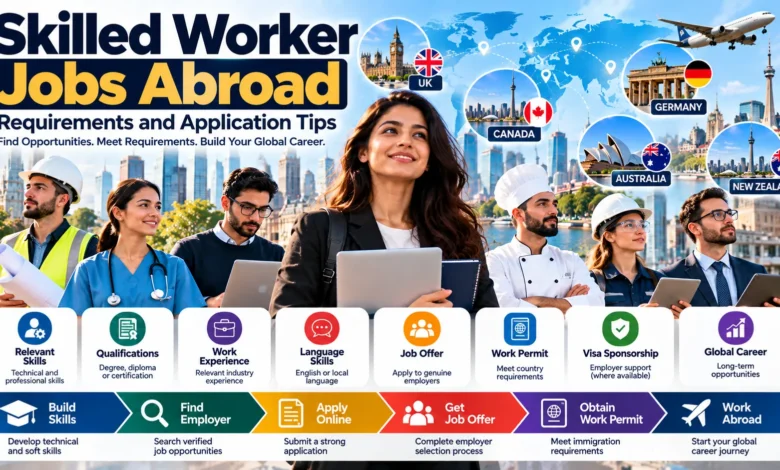
Choose target countries → Check immigration rules → Verify qualification recognition → Identify suitable employers → Tailor your CV → Apply directly → Prepare for interviews → Complete the official immigration process after a genuine offer.
Countries such as the UK, Canada, Germany, Australia and New Zealand can offer opportunities for foreign professionals, but their systems are different.
There is no universal international Skilled Worker visa, no employer can guarantee immigration approval, and no occupation automatically guarantees sponsorship.
A focused job search based on genuine professional skills, accurate immigration research and verified employers gives you a much stronger foundation for building an international career.