Professional Fellowships Abroad: International Opportunities, Eligibility and How to Apply

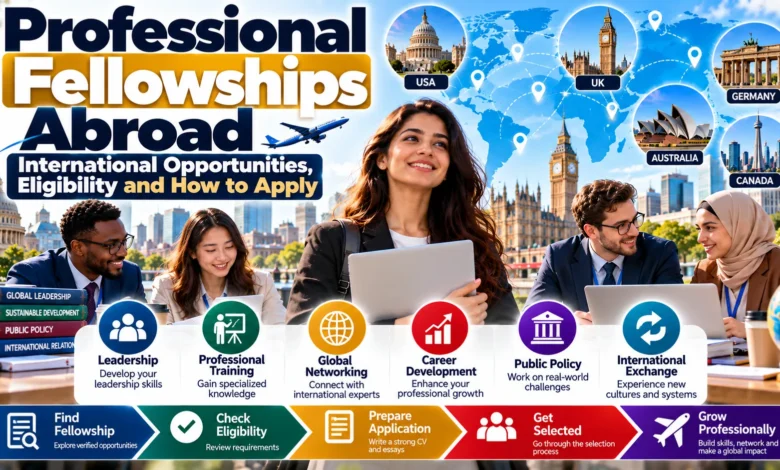
Professional fellowships abroad provide opportunities for working professionals to develop specialized skills, strengthen leadership abilities and gain international experience without necessarily enrolling in a traditional university degree programme.
These programmes can bring together professionals from different countries to exchange knowledge, participate in training, collaborate with host organizations and explore solutions to challenges in their fields.
For professionals working in public administration, education, journalism, business, healthcare, technology, environmental policy or nonprofit organizations, an international fellowship can be a valuable career-development opportunity.
However, professional fellowships differ significantly in their requirements.
Some programmes target emerging leaders with a few years of experience, while others are designed for mid-career professionals with established achievements. Certain fellowships offer comprehensive financial support, while others provide only partial funding.
This guide explains the types of professional fellowships available abroad, examples of established international programmes, eligibility requirements, funding arrangements and practical strategies for preparing competitive applications.
What Are Professional Fellowships Abroad?
A professional fellowship is a structured development programme that supports participants in strengthening their knowledge, professional capabilities and leadership potential.
Unlike conventional employment, a fellowship generally has a defined duration and learning objectives.
Participants may engage in:
- Professional training
- Leadership development
- International exchange
- Workplace placements
- Academic enrichment
- Research
- Mentorship
- Policy discussions
- Networking
- Collaborative projects
Some programmes involve temporary placements with businesses, government agencies, universities or nonprofit organizations.
Others combine academic learning with professional activities.
A fellowship does not necessarily result in an academic qualification or permanent employment.
Professional Fellowships at a Glance
| Category | General Information |
|---|---|
| Opportunity type | Professional development or international exchange |
| Main applicants | Emerging leaders and experienced professionals |
| Education | Varies by programme |
| Experience | Often required |
| Destinations | United States, Europe and other international locations |
| Duration | Several weeks to a year or longer |
| Funding | Comprehensive, partial or self-funded |
| English proficiency | Required by some programmes |
| Leadership | Important for many fellowships |
| Application process | Official programme or authorized partner |
| Employment guarantee | No |
| Visa arrangements | Programme-specific |
Requirements should always be confirmed through the official fellowship provider.
Why Consider an International Professional Fellowship?
A professional fellowship can offer benefits beyond conventional classroom training.
International Professional Experience
Working alongside professionals from another country can expose participants to different organizational practices, management approaches and professional standards.
For example, a public policy professional may observe how another institution designs and evaluates public programmes.
A journalist may learn new reporting methods or newsroom practices.
Leadership Development
Many professional fellowships include leadership training.
Participants may learn how to:
- Manage projects
- Lead teams
- Communicate effectively
- Build partnerships
- Address organizational challenges
- Make evidence-based decisions
Professional Networking
International fellowships can create connections with:
- Industry specialists
- Government professionals
- Researchers
- Nonprofit leaders
- Mentors
- Other fellowship participants
These relationships may support future collaboration, although they do not guarantee employment.
Career Development
A relevant fellowship can strengthen a professional profile by demonstrating international exposure, continued learning and experience with complex projects.
The career value depends on the fellowship’s quality and how the participant applies the experience afterward.
Major Professional Fellowships Abroad
Several established international programmes illustrate the different forms professional fellowships can take.
These are examples for research, not a list of confirmed currently open application rounds.
1. Hubert H. Humphrey Fellowship Program — United States
The Hubert H. Humphrey Fellowship Program is a non-degree professional development programme for eligible mid-career professionals.
It combines academic enrichment with professional development activities in the United States.
The programme is designed for individuals with leadership potential and a commitment to public service.
Relevant fields include:
- Public policy and administration
- Economic development
- Finance and banking
- Public health
- Journalism and communications
- Law and human rights
- Environmental policy
- Education administration
- Technology policy
According to its official eligibility guidance, applicants generally need:
- Citizenship of an eligible country
- A completed undergraduate degree
- At least five years of full-time professional experience
- Demonstrated leadership
- A record of public service
- Relevant English-language ability
- Limited previous experience in the United States, subject to programme rules
The programme is approximately ten months long and does not award an academic degree.
Its official funding package includes university fees, a living allowance, applicable travel and professional development support, and other specified benefits.
Applications are managed through participating U.S. embassies or Fulbright commissions, and country-specific deadlines vary.
Official website: https://www.humphreyfellowship.org/
2. Professional Fellows Program — United States
The Professional Fellows Program (PFP) is an international exchange initiative designed for emerging professional leaders.
It provides opportunities to develop leadership skills and professional connections through placements in the United States.
Participants may work with:
- Nonprofit organizations
- Private businesses
- Government offices
- Other relevant host institutions
The U.S. Department of State describes the programme as involving intensive fellowships generally lasting five to six weeks.
Its published general eligibility includes applicants who:
- Are aged 25–40
- Are currently employed
- Have at least two years of professional experience
- Demonstrate leadership and community impact
- Meet English proficiency requirements
- Are citizens and current residents of eligible participating countries
Individual programme tracks may have additional requirements or different eligible-country lists.
The programme focuses on professional development rather than permanent overseas employment.
Official website: https://exchanges.state.gov/non-us/program/professional-fellows-program
3. YSEALI Professional Fellows Program
The Young Southeast Asian Leaders Initiative (YSEALI) Professional Fellows Program supports eligible emerging leaders from participating Southeast Asian countries.
It provides professional exchange opportunities in the United States.
The programme focuses on areas connected with leadership, governance, civil society and other professional themes.
Its published requirements include:
- Citizenship and current residence in an eligible YSEALI country
- Relevant professional experience
- Leadership potential
- English-language ability
- Programme-specific age requirements
The official programme information describes a general age range of 25–35 and at least two years of relevant professional experience.
This programme is not open to every nationality.
Official website: https://exchanges.state.gov/
4. Chevening Fellowships — United Kingdom
Chevening Fellowships are professional development opportunities associated with the UK’s Chevening programme.
They are distinct from Chevening Scholarships, which generally support postgraduate degree study.
Chevening fellowship opportunities may focus on specific professional areas or themes.
Depending on the programme, participants may undertake:
- Professional training
- Research
- Academic enrichment
- Networking
- Leadership development
Eligibility and funding differ between individual Chevening fellowships.
Some are available only to applicants from particular countries or professional backgrounds.
Applicants should check the official Chevening website for the current list of fellowships and their requirements.
Official website: https://www.chevening.org/
5. University and Research Institution Fellowships
Some universities and research institutes offer professional development opportunities for experienced practitioners.
These may involve:
- Visiting fellowships
- Policy fellowships
- Journalism fellowships
- Leadership programmes
- Professional research placements
- Executive development opportunities
Eligibility can depend on professional achievement, research interests or institutional affiliation.
Students should distinguish these opportunities from ordinary academic fellowships, which may have different selection criteria.
Professional Fellowship vs Scholarship vs Internship
Although these opportunities can overlap, they generally serve different purposes.
| Feature | Professional Fellowship | Scholarship | Internship |
|---|---|---|---|
| Primary purpose | Professional development | Education funding | Practical work experience |
| Typical applicants | Working professionals | Students or researchers | Students and early-career applicants |
| Work experience | Often required | Depends on award | Sometimes not required |
| Duration | Programme-specific | Linked to study or research | Usually limited placement |
| Academic degree | Usually not | May support a degree | Generally not |
| Funding | Varies | Varies | Paid, stipend or unpaid |
| Main outcome | Skills, networks and professional growth | Education or research support | Workplace learning |
The actual programme description takes priority over these general distinctions.
Who Can Apply for Professional Fellowships Abroad?
International professional fellowships often target applicants who have already demonstrated ability in their careers.
Early-Career Professionals
Some fellowships accept applicants with approximately two or more years of relevant professional experience.
These programmes may emphasize emerging leadership and professional potential.
Mid-Career Professionals
Other programmes target professionals with substantial experience.
For example, the Humphrey Fellowship requires at least five years of full-time professional experience.
Mid-career fellowships may place greater emphasis on professional achievements and public-service impact.
Senior Professionals
Certain executive or specialized fellowships are intended for established professionals.
These may require management experience, policy responsibility or significant contributions to a professional field.
Self-Employed Professionals and Entrepreneurs
Some fellowships consider applicants who operate businesses, lead organizations or manage independent professional initiatives.
Eligibility depends on whether the programme recognizes that experience and how it defines employment.
Professional Fields With Fellowship Opportunities
Professional fellowships are not limited to one industry.
Public Policy and Government
Opportunities may focus on:
- Public administration
- Governance
- Policy development
- Public finance
- Institutional leadership
- Community development
Journalism and Media
Professional exchanges can help journalists develop skills in:
- Investigative reporting
- Digital journalism
- Media management
- Public-interest reporting
- Editorial leadership
Business and Entrepreneurship
Relevant programmes may address:
- Entrepreneurship
- Business development
- Economic empowerment
- Innovation
- Organizational leadership
Public Health
Professional fellowships may support practitioners involved in:
- Health policy
- Public health management
- Community health
- Health systems
- Disease prevention
Education
Opportunities may focus on:
- Educational leadership
- School administration
- Education policy
- Institutional management
- Curriculum development
Technology
Some programmes support professionals in:
- Technology policy
- Digital transformation
- Innovation
- Information systems
- Technology management
Environmental Policy
Potential fields include:
- Sustainability
- Climate policy
- Natural resource management
- Environmental governance
- Urban development
Are Professional Fellowships Abroad Fully Funded?
Some established programmes provide comprehensive financial support.
Others provide partial funding or require participants to cover certain costs.
Funding can include:
- International travel
- Accommodation
- Living allowance
- Programme fees
- Training expenses
- Health coverage
- Local transportation
- Professional development expenses
However, applicants should never assume all expenses are covered.
Questions to Ask Before Applying
- Does the fellowship cover international flights?
- Is accommodation provided?
- Is there a living allowance?
- Does funding cover the entire programme?
- Is health coverage included?
- Are visa-related expenses covered?
- Can dependents accompany participants?
- Are there any required personal contributions?
A fellowship described as funded may still leave participants responsible for some expenses.
Do Professional Fellowships Provide Salaries?
A fellowship allowance is not necessarily an employment salary.
Some programmes provide a stipend intended to support living expenses during the exchange.
Others may provide accommodation and direct support instead of a regular payment.
The distinction matters because fellowship participants may not have the same employment status, benefits or rights as salaried employees.
Applicants should review the official programme terms carefully.
English-Language Requirements
Many international fellowships require participants to communicate effectively in English.
Some programmes request formal language-test results.
Others assess language proficiency through applications, interviews or programme-specific procedures.
For example, the Humphrey Fellowship requires demonstrated English ability, with the relevant embassy or Fulbright commission providing guidance on accepted testing arrangements.
Applicants should not assume that IELTS is mandatory for every professional fellowship.
Check the individual programme’s language policy.
How to Find Professional Fellowships Abroad
Searching effectively requires more than entering “fully funded fellowship” into a search engine.
Start With Your Professional Field
Identify the area in which you want to develop expertise.
For example:
- Public health
- Journalism
- Education
- Public policy
- Business
- Technology
- Environmental management
Identify Your Career Stage
Determine whether you qualify as:
- Early-career
- Mid-career
- Senior professional
This can eliminate programmes that do not match your experience.
Search Official Fellowship Websites
Use programme websites and authorized implementing organizations.
Useful searches include:
- Professional fellowships for international applicants
- Leadership fellowships abroad
- Mid-career professional fellowships
- Fully funded professional exchange programmes
- International journalism fellowships
- Public policy fellowships abroad
- Professional development fellowships
- Fellowships for nonprofit professionals
Review Nationality Requirements
Some programmes accept applicants from many countries.
Others are limited to particular regions or nationalities.
Check the official eligible-country list before preparing an application.
Documents Commonly Required
Requirements vary, but applicants may need:
- Professional CV
- University degree certificates
- Academic transcripts
- Personal statement
- Fellowship essays
- Employment verification
- Recommendation letters
- English-language evidence
- Passport information
- Professional portfolio
- Project proposal
- Leadership statement
Certain programmes require recommendations from employers or supervisors.
Applicants should begin collecting documents well before the deadline.
How to Write a Strong Professional Fellowship Application
Professional fellowship applications should demonstrate more than interest in international travel.
Selection committees generally want to understand what you have accomplished and how the programme will help you create further value.
Explain Your Professional Background
Introduce your field and current responsibilities.
Avoid repeating your entire CV.
Demonstrate Real Achievements
Use specific examples.
For instance, instead of writing:
“I have excellent leadership skills.”
Explain a project you managed, the challenge involved and the outcome.
Show Why the Fellowship Fits
Describe the specific professional knowledge or skills you want to develop.
Your goals should align with the programme’s purpose.
Explain the Expected Impact
Many leadership fellowships are interested in how participants will apply their learning after returning to their organizations or communities.
Explain realistic plans rather than making exaggerated promises.
Connect Your Goals With the Programme
A strong application answers:
- Why this fellowship?
- Why now?
- Why are you suitable?
- What will you contribute?
- How will you use the experience afterward?
How to Apply for Professional Fellowships Abroad
Step 1: Identify Suitable Programmes
Research programmes that match your experience, professional field and nationality.
Step 2: Verify Eligibility
Review education, work experience, age, language and residency requirements.
Step 3: Confirm Funding and Duration
Understand the financial package and time commitment.
Step 4: Prepare Your CV
Highlight professional achievements, responsibilities and leadership experience.
Step 5: Write Tailored Essays
Address each question directly with specific evidence.
Step 6: Request Recommendations
Choose people who can accurately discuss your work and professional potential.
Step 7: Submit Through Official Channels
Use the designated application portal, embassy or authorized programme partner.
Step 8: Prepare for Interviews
If shortlisted, review your application and prepare to discuss your professional achievements and future goals.
Step 9: Complete Required Documentation
Selected candidates may need to complete additional administrative, immigration or programme requirements.
Selection does not automatically guarantee visa approval.
Professional Fellowship Interview Questions
Interviews may explore leadership, professional achievements and future plans.
Common questions include:
- Why are you applying for this fellowship?
- What is your most important professional achievement?
- Describe a difficult leadership situation.
- How have you contributed to your organization or community?
- What challenges exist in your professional field?
- How would international experience help you address those challenges?
- What do you plan to do after the fellowship?
- How would you collaborate with professionals from different backgrounds?
Use specific, truthful examples.
The STAR method can help:
Situation: Describe the circumstances.
Task: Explain your responsibility.
Action: Describe what you did.
Result: Explain the outcome.
Can Professional Fellowships Lead to International Jobs?
Professional fellowships can strengthen a candidate’s experience and professional network.
However, they do not automatically provide employment or immigration rights.
A fellowship participant may develop connections that lead to future collaborations or job opportunities.
But permanent employment usually requires a separate recruitment process.
Applicants should not treat a short professional exchange as guaranteed relocation.
Common Mistakes Applicants Should Avoid
Applying Without Sufficient Experience
Some fellowships have strict minimum professional experience requirements.
Ignoring Nationality Restrictions
A programme advertised internationally may still accept applicants only from selected countries.
Using Generic Essays
Selection committees need evidence that you understand the programme.
Focusing Only on Travel
Professional fellowships are primarily designed for development, exchange and impact.
Exaggerating Leadership Achievements
Claims should be accurate and supportable.
Missing Employer Recommendations
Some programmes require a recommendation from a current employer.
Assuming Every Fellowship Is Open
Application periods change, and programmes may pause or revise recruitment.
Always verify the current cycle.
How to Avoid Fellowship Scams
Be cautious of organizations promising:
- Guaranteed fellowship selection
- Guaranteed international employment
- Guaranteed immigration approval
- Fellowship awards in exchange for payment
- Unverified acceptance letters
- Unrealistic financial benefits
Check that the programme is operated by a legitimate organization and that the application process matches its official website.
Never pay someone who claims to have special influence over a fellowship selection committee.
A Three-Month Fellowship Preparation Plan
| Period | Main Activity |
|---|---|
| Weeks 1–2 | Identify programmes and eligibility |
| Weeks 3–4 | Research programme objectives and funding |
| Weeks 5–6 | Update professional CV and document achievements |
| Weeks 7–8 | Prepare essays and request recommendations |
| Weeks 9–10 | Review applications and prepare required evidence |
| Weeks 11–12 | Submit eligible applications and prepare for interviews |
This is a general preparation framework. Some programmes require substantially more advance planning.
Frequently Asked Questions
What are professional fellowships abroad?
They are structured programmes that help eligible professionals gain international experience, leadership training, specialized knowledge or professional connections.
Are professional fellowships fully funded?
Some are comprehensively funded, while others offer partial support. Funding must be verified individually.
Can fresh graduates apply?
Some programmes accept early-career applicants, but many require professional experience. The Humphrey Fellowship, for example, requires at least five years of full-time professional experience.
Do I need IELTS for a professional fellowship?
Not always. English-language requirements vary by programme.
Can I apply without a master’s degree?
Some programmes accept applicants with a bachelor’s degree. Others require advanced qualifications or specific professional credentials.
Do fellowships provide visa sponsorship?
Some programmes assist selected participants with immigration documentation, but arrangements vary. Selection does not guarantee visa approval.
Can I apply for several fellowships?
Often yes, provided each programme permits it and you meet its requirements.
Do professional fellowships guarantee jobs abroad?
No. They are generally professional development opportunities rather than guaranteed employment pathways.
Final Thoughts
Professional fellowships abroad can help working professionals strengthen their expertise, develop leadership skills and build international relationships.
However, successful applicants usually need more than academic qualifications.
Many programmes assess professional achievements, leadership potential, communication skills and the applicant’s ability to use the fellowship experience meaningfully.
A practical strategy is to identify your career stage, research suitable programmes, verify eligibility, document your achievements, prepare tailored essays and apply through official channels.
For early-career professionals, international exchanges can provide valuable exposure to new approaches.
For mid-career professionals, specialized fellowships may offer opportunities to deepen expertise and develop professional partnerships.
The best fellowship is not necessarily the most famous programme. It is the one whose purpose, requirements and professional development opportunities align with your experience and long-term goals.