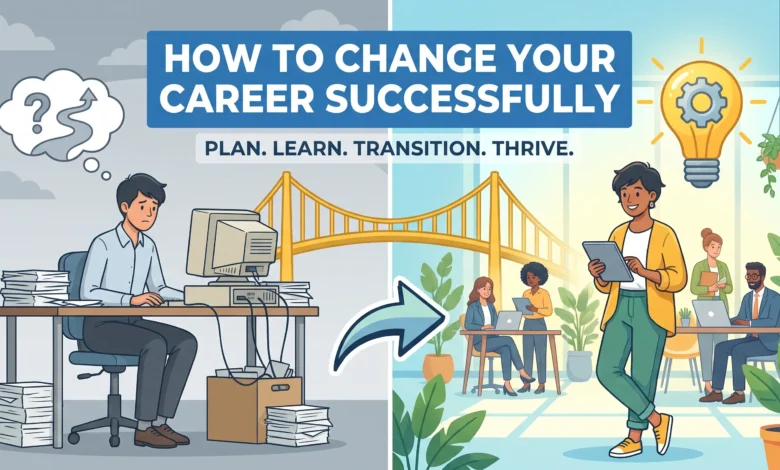
Changing careers can be both exciting and difficult. You may have spent several years building qualifications and experience in one profession only to realize that you want to move into a completely different field.
Sometimes the reason is dissatisfaction with the current work. In other cases, a person discovers a new interest, wants better career opportunities, needs greater flexibility, or sees their industry changing.
A career change does not necessarily mean starting from zero.
Your existing experience may contain valuable skills that can transfer into another occupation. The challenge is identifying those skills, understanding what the new career requires, filling important gaps and presenting your background in a way that makes sense to employers.
The International Labour Organization recognizes that people may need to change jobs or professions at different stages of their working lives and emphasizes continuing to develop skills and remain aware of new opportunities. The OECD likewise identifies career transitions, lifelong learning and skills development as important parts of navigating a changing labour market.
This guide explains how to plan and manage a career change carefully.
What Is a Career Change?
A career change happens when you move from your current professional direction into a substantially different role, occupation or field.
For example:
- An accountant moving into data analytics
- A teacher moving into instructional design
- A journalist moving into corporate communications
- A customer-service professional moving into human resources
- A software developer moving into product management
- A marketing professional moving into sales
- An engineer moving into project management
The size of the transition can vary.
Moving from one job to another in the same occupation is usually a job change.
Moving into a substantially different occupation is more accurately described as a career change.
Why People Change Careers
There is no single reason for changing careers.
Common motivations include:
- Lack of career progression
- Limited opportunities in the current field
- Desire for higher income
- Interest in another profession
- Changes in personal circumstances
- Burnout or dissatisfaction
- Desire for greater flexibility
- Technological changes
- Relocation
- Interest in remote work
- A desire to use different skills
- Discovering a new professional direction
Before making a major decision, identify your actual reason.
If your problem is a poor manager, changing industries may not solve it.
If your problem is long working hours, another occupation may have similar demands.
If your industry has limited opportunities, however, retraining for a related field might make sense.
Understanding the problem is the first step toward choosing an appropriate solution.
Decide Whether You Need a Career Change
Not every professional problem requires a completely new career.
Before resigning, ask yourself:
- Do I dislike my occupation or just my current employer?
- Would changing teams improve my situation?
- Do I dislike the industry or the specific job?
- Am I bored because I have stopped learning?
- Do I need a different working environment?
- Would a new specialization solve the problem?
- Have I explored internal opportunities?
- Is the problem temporary or persistent?
For example, someone who dislikes working for a particular company may not need to leave their profession.
Someone who has become interested in a completely different type of work may need a more substantial transition.
Give yourself time to distinguish between temporary dissatisfaction and a genuine desire for change.
Start With a Career Audit
Before choosing your next career, examine what you already have.
Create four lists.
Your Qualifications
Include:
- Degrees
- Diplomas
- Professional certifications
- Training
- Licenses
- Industry-specific education
Your Experience
Include:
- Current and previous jobs
- Projects
- Leadership responsibilities
- Client work
- Research
- Volunteer activities
- Freelance work
Your Skills
Separate them into technical and transferable skills.
Technical skills might include:
- Programming
- Accounting
- Data analysis
- Design
- Project management
- Laboratory techniques
- Digital marketing
Transferable skills might include:
- Communication
- Teamwork
- Problem-solving
- Leadership
- Research
- Negotiation
- Organization
- Time management
Your Achievements
Do not only list responsibilities.
Identify what you achieved.
For example:
Responsibility: Managed customer inquiries.
Achievement: Improved the process for handling customer requests and reduced response delays.
This distinction will become important when you rewrite your CV for your new career.
Choose a Direction, Not Just an Escape
One of the biggest career-change mistakes is leaving your current profession without knowing what you are moving toward.
Do not make the plan:
“I want to leave my current job.”
Make it:
“I want to move into this specific type of work because…”
Research two or three possible directions.
For each one, investigate:
- Typical responsibilities
- Entry-level roles
- Required qualifications
- Technical skills
- Transferable skills
- Industry expectations
- Salary information from reliable sources
- Work environment
- Career progression
- Location
- Professional licensing
- Further education requirements
A career change becomes much easier to evaluate when the destination is specific.
Test the New Career Before Leaving the Old One
You do not necessarily need to resign immediately.
One of the safest approaches is to test your interest first.
Depending on the field, you could:
- Take an introductory course
- Complete a small project
- Volunteer
- Freelance
- Join an industry community
- Attend professional events
- Speak with professionals
- Shadow someone where possible
- Take on related responsibilities at your current employer
For example, if you want to move into data analysis, try working with a public dataset and creating a small analysis project.
If you want to move into digital marketing, develop a sample campaign.
If you want to enter project management, volunteer to coordinate a real project.
The goal is to discover whether you actually enjoy the work rather than simply liking the idea of the career.
Identify Your Transferable Skills
A career change becomes less intimidating when you stop thinking about yourself only through your current job title.
Suppose you currently work in customer service.
You may already have:
- Communication
- Conflict resolution
- Customer relationship management
- Problem-solving
- Documentation
- Time management
- Teamwork
Those skills could potentially support transitions into areas such as sales, account management, customer success, recruitment or other people-focused roles.
A teacher may have:
- Presentation
- Training
- Communication
- Planning
- Assessment
- Leadership
Those skills may be relevant to training, learning and development, instructional design or other education-related roles.
The exact transfer depends on the occupation, but the principle is important:
Your previous career may have given you building blocks for your next one.
The OECD has highlighted skills-first approaches, skills recognition and flexible learning pathways as ways to support mobility between jobs and sectors.
Find the Skills Gap
After identifying your transferable skills, determine what you are missing.
Suppose your target is a junior data analyst role.
You might already have:
- Business knowledge
- Communication
- Excel
- Research
But the job descriptions you review may repeatedly request:
- SQL
- Data visualization
- Statistics
- Database knowledge
Those become your priority gaps.
Create a simple plan:
| Skill | Current Level | Required Level | Action |
|---|---|---|---|
| Excel | Strong | Strong | Maintain |
| Communication | Strong | Strong | Maintain |
| SQL | Beginner | Intermediate | Structured course + project |
| Statistics | Basic | Intermediate | Practice |
| Data visualization | Beginner | Intermediate | Build portfolio project |
This is much more effective than randomly collecting courses.
Do Not Assume You Need Another Degree
A career change does not automatically require a new university degree.
Depending on the occupation, employers may value:
- Transferable experience
- Short professional courses
- Industry certifications
- Portfolio projects
- Practical experience
- Apprenticeships
- Vocational education
- Demonstrated skills
However, some careers do require specific degrees, licenses or regulated qualifications.
For example, changing into a regulated profession may involve formal education and registration requirements.
Research the actual entry requirements before spending significant money on education.
The OECD’s recent skills work emphasizes flexible learning pathways and recognition of prior learning as useful tools for mobility between education and employment.
Build a Learning Plan
Once you know the skills gap, create a focused learning plan.
Avoid trying to learn everything at once.
Use three categories:
Essential Skills
Skills that repeatedly appear in your target job descriptions.
Supporting Skills
Skills that improve your effectiveness but are not always required.
Future Skills
Skills that may become useful after entering the field.
Focus primarily on the first category.
Your goal is not to become an expert before applying.
Your goal is to become credible enough to enter the field and continue developing professionally.
Gain Experience Before You Have the New Job
This is one of the hardest parts of a career change.
Employers may ask:
“If you have never worked in this field, why should we hire you?”
Your answer should come from evidence.
Build experience through:
- Projects
- Freelance assignments
- Volunteer work
- Internships
- Part-time work
- Contract work
- Research
- Professional communities
- Internal projects at your existing company
Even a small relevant project can help demonstrate that your interest is more than theoretical.
Try an Internal Career Change First
If your current employer is reasonably supportive, an internal move can sometimes be easier than starting with an entirely new employer.
For example:
- Finance → business analysis
- Customer service → customer success
- Marketing → sales
- IT support → cybersecurity
- Administration → project coordination
Your employer already knows your work ethic and organizational experience.
You may also have access to internal training or opportunities to work with another department.
Before resigning, investigate whether your current organization offers a realistic route into your target area.
Rebuild Your CV Around the New Career
A common mistake is sending a CV that tells employers everything about your old career but very little about the new one.
Your CV should be repositioned.
Instead of emphasizing every responsibility from your previous occupation, highlight experiences that demonstrate relevant skills for your target role.
Old approach
Customer Service Representative
- Answered customer calls
- Responded to emails
- Managed customer complaints
Career-change approach
Customer Service Representative
- Managed high-volume customer interactions across multiple communication channels
- Resolved complex customer issues through structured problem-solving
- Maintained accurate records and coordinated with internal teams
- Identified recurring customer issues and contributed to process improvements
The second version makes transferable skills easier to recognize.
Do not exaggerate or invent experience.
Your objective is to reframe genuine experience, not manufacture a new background.
Create a Career-Change Story
Employers may ask:
“Why are you changing careers?”
Prepare a positive and honest explanation.
Avoid spending the entire answer criticizing your previous profession or employer.
Instead, explain:
- What you learned in your previous career.
- What attracted you to the new field.
- What you have done to prepare.
- How your existing skills transfer.
- Why the new role makes sense.
For example:
“My background in customer operations gave me strong experience in communication, problem-solving and working with business processes. Over time, I became increasingly interested in data-driven decision-making. I have since developed my skills in Excel, SQL and data visualization and completed several practical projects. I am now looking for an entry-level analytics role where I can combine my business experience with these new technical skills.”
This gives the employer a logical story.
Build a Portfolio for Your New Field
A portfolio can be especially valuable when you are changing careers.
It gives employers evidence of what you can do now rather than asking them to judge you entirely on your previous job.
Depending on the field, include:
- Case studies
- Data projects
- Design work
- Writing samples
- Marketing campaigns
- Software projects
- Research
- Presentations
- Business analyses
Keep the portfolio focused on the type of work you want to be hired to perform.
Network With People in the New Industry
Career changers often need to rebuild their professional network.
Start with:
- Alumni
- Former colleagues
- Professional associations
- Industry events
- Online professional communities
- Recruiters
- People you meet through courses
- Professionals introduced through your existing network
Do not approach networking as:
“Can you give me a job?”
Instead, ask informed questions.
For example:
“I’m transitioning from operations into data analytics. What skills do you think are most important for someone entering the field?”
Professional conversations can reveal practical information about hiring expectations, useful skills and possible entry routes.
Consider a Bridge Role
You do not always have to jump directly from your current occupation to your final career goal.
A bridge role can connect the two.
For example:
Customer service → Customer success → Account management
or:
Marketing assistant → Marketing analyst → Data-focused marketing role
or:
Teacher → Corporate trainer → Learning and development
A bridge role can allow you to gain relevant experience while reducing the size of the transition.
Manage Your Finances Before Changing Careers
Career changes can temporarily affect your income.
You may need:
- Training expenses
- Certification fees
- Reduced working hours
- A period of unemployment
- Relocation costs
- Equipment
- Transportation
- Professional membership fees
Before resigning, understand your financial situation.
Ask:
- How long can I manage without my current income?
- Do I need to study full-time?
- Can I transition while employed?
- Can I reduce expenses?
- Is there a lower-risk way to test the new career?
You do not need a perfect financial plan, but you should understand the consequences of the transition.
Decide Whether to Change Careers Gradually or Quickly
There are two broad approaches.
Gradual Transition
Keep your current job while developing the new career.
This may involve:
- Evening courses
- Weekend projects
- Freelance work
- Networking
- Internal opportunities
- Portfolio development
This approach can reduce financial risk.
Full Transition
Leave your current occupation and focus on retraining or searching for the new career.
This may make sense when:
- Your current employment is ending
- The new profession requires full-time study
- You have sufficient financial support
- The current job prevents meaningful transition
- You have already tested the new direction
Neither approach is automatically better.
The right choice depends on your circumstances and the requirements of the target career.
Expect Your First New Role to Be Different From Your Previous Level
One difficult reality of career changes is that your previous seniority may not transfer completely.
Someone with ten years of experience in one occupation may enter another field at a junior or intermediate level.
That does not mean the previous experience has no value.
It may still provide:
- Professional maturity
- Communication skills
- Industry knowledge
- Leadership experience
- Project management
- Business understanding
- Professional networks
Think of the transition as changing your professional direction, not erasing your career history.
Use Skills-Based Job Searching
Do not search only by your new desired job title.
Search for combinations of:
Role + transferable skill
Role + industry knowledge
Role + previous experience
For example, instead of searching only for “junior data analyst,” someone with a finance background might also investigate:
- Financial data analyst
- Business analyst
- Reporting analyst
- Operations analyst
- Finance systems roles
This can reveal bridge opportunities that a narrow job search misses.
The ILO has highlighted the role of employment services in improving job matching by considering skills rather than qualifications alone and supporting reskilling during labour-market transitions.
Be Patient With the Transition
A career change can take longer than a normal job search because you are changing how employers perceive your professional profile.
You may need time to:
- Learn new skills
- Build evidence
- Develop contacts
- Understand the industry
- Apply for appropriate roles
- Gain initial experience
Do not measure progress only by whether you have already obtained the new job.
Other signs of progress include:
- Completing relevant training
- Building a portfolio
- Conducting professional interviews
- Receiving interviews
- Expanding your network
- Getting freelance projects
- Moving into a bridge role
What If You Are Older Than Other Career Changers?
Age does not eliminate the possibility of changing careers.
In fact, experienced professionals can bring valuable transferable skills.
The challenge may be explaining why your previous experience is relevant to the new role.
Focus on:
- What you can already do
- What you have learned
- What you have recently developed
- Why you are making the transition
- How your previous experience adds value
Avoid presenting yourself as someone who is starting completely from scratch if you are not.
You are changing direction, but you are also bringing years of accumulated experience.
What If You Need to Change Careers Because Your Industry Is Declining?
Sometimes a career change is not primarily about personal preference.
Technology, economic conditions, environmental changes or other structural developments can alter demand for particular skills.
In such situations, investigate adjacent occupations before abandoning your accumulated expertise.
Ask:
What parts of my current experience remain valuable?
For example, an industry-specific professional may be able to move into:
- Compliance
- Training
- Operations
- Project management
- Consulting
- Quality assurance
- Technical support
- Sales
- Analysis
The answer depends on the occupation, but existing knowledge can sometimes provide a bridge into a new sector.
Recent ILO research notes that digitalization, AI and other transitions are reshaping the skills demanded across occupations, reinforcing the importance of adaptability, digital skills and broader cognitive and socio-emotional capabilities.
Avoid These Career-Change Mistakes
Quitting Before Researching
Leaving your job without understanding the destination can create unnecessary financial pressure.
Choosing a New Career Because It Looks Easy
Every profession has difficult parts.
Starting a Degree Without Checking Requirements
You may spend significant time and money on a qualification that employers do not actually require.
Ignoring Transferable Skills
Your previous experience may be more useful than you realize.
Applying Only to Senior Positions
A new field may require you to enter through a junior or bridge role.
Hiding Your Career Change
Trying to make your previous career disappear can create confusion.
Explain the transition clearly and honestly.
Learning Forever Without Applying
Courses are useful, but eventually you need to create evidence and enter the market.
Expecting an Immediate Salary Increase
A career change can temporarily reduce income, particularly if you are entering a new profession at a lower level.
Comparing Your Transition With Someone Else’s
Career changes depend on education, finances, industry, location and personal circumstances.
A 90-Day Career Change Plan
Days 1–30: Research
- Identify why you want to change
- Review your existing skills
- Choose two or three target careers
- Research job descriptions
- Identify skills gaps
- Speak with professionals
- Determine education requirements
Your goal is clarity.
Days 31–60: Prepare
- Start targeted learning
- Complete a practical project
- Update your CV
- Build or improve your portfolio
- Create a career-change explanation
- Begin networking
- Explore internal opportunities
Your goal is evidence.
Days 61–90: Enter the Market
- Search for bridge and entry-level roles
- Tailor applications
- Contact professional connections
- Apply for suitable positions
- Practice interviews
- Continue developing skills
- Track results
Your goal is transition.
A Career Change Checklist
Before making the move, ask yourself:
- I understand why I want to change careers.
- I have researched the target occupation.
- I understand the education requirements.
- I know which skills employers expect.
- I have identified my transferable skills.
- I know my major skills gaps.
- I have started developing those skills.
- I have tested the new career in some practical way.
- I have created relevant evidence or portfolio work.
- I have updated my CV.
- I can explain my career transition clearly.
- I have researched entry-level and bridge roles.
- I understand the financial implications.
- I have a realistic timeline.
- I have a backup plan.
If several boxes remain unchecked, you may need more preparation before making the transition.
Frequently Asked Questions
Is it too late to change careers?
There is no universal age at which a career change becomes impossible. The practical difficulty depends on the new occupation, qualifications, financial situation, existing experience and labour market. Experienced professionals may also have transferable skills that can support a transition.
Do I need another degree to change careers?
Not always. Some occupations require formal qualifications, while others may value skills, certifications, portfolios and practical experience. Research the specific requirements of your target occupation before enrolling in a new degree.
Can I change careers without quitting my current job?
Yes. Many people begin gradually through courses, projects, volunteering, freelancing, networking or internal opportunities while maintaining their current employment.
How long does a career change take?
There is no standard timeframe. A transition may take several months or considerably longer depending on the distance between your current and target occupations, education requirements and available opportunities.
How do I explain a career change during an interview?
Explain what you learned from your previous career, what attracted you to the new field, what you have done to prepare and how your existing skills transfer to the new role. Keep the explanation positive and evidence-based.
Will I have to accept a lower salary?
Possibly. Entering a new profession may mean starting at a lower level than your previous occupation. However, transferable skills, relevant experience and bridge roles can sometimes reduce the gap.
How can I gain experience in a field where I have never worked?
Use projects, internships, freelance assignments, volunteering, research, internal projects and other practical opportunities to create evidence of relevant ability.
Should I change careers because I am unhappy at work?
Not necessarily. First determine whether the problem is your employer, manager, workload, industry, role or occupation. A job change may solve a problem that does not require a complete career change.
Final Thoughts
A successful career change is usually not an overnight decision.
It is a transition.
Start by understanding why you want to leave your current path. Research the destination carefully. Identify which parts of your existing experience can transfer. Develop the skills you are missing. Test the new field before making major commitments. Build evidence through projects or practical experience, then reposition your CV and professional network around your new direction.
Most importantly, do not think of your previous career as wasted time.
The communication skills, industry knowledge, professional discipline, problem-solving ability and experience you developed can continue to have value—even when your job title changes.
The modern labour market makes continuous learning increasingly important. The OECD’s recent skills research highlights lifelong learning, flexible pathways and skills recognition as important tools for adapting to changing labour-market needs. The ILO similarly emphasizes continued skills development and awareness of new opportunities when people navigate professional changes.
You do not need to erase your professional past to create a different future.
A successful career change is about building on what you already know while deliberately developing what you need next.