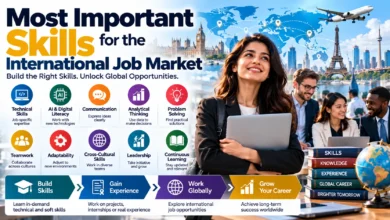
Building an international career can seem difficult when you are starting with no overseas experience, limited professional connections or an unclear career direction.
The good news is that an international career does not have to begin with moving abroad. It can start with developing useful skills, gaining experience locally, working with international clients, building a professional online presence, completing relevant projects and gradually applying for international opportunities.
The most effective approach is to think of an international career as a career-building process rather than a single job application.
You first need something valuable to offer. Then you need evidence that you can use it. After that, you need to learn how to present your skills to employers in different markets.
The OECD’s recent work on skills and career development also emphasizes the importance of continuous learning, career guidance, transferable skills and adapting to changing labour-market needs.
What Is an International Career?
An international career is a professional path that involves working across countries, international organizations, global companies or internationally connected industries.
It can take several forms.
You could:
- Work for a multinational company
- Move abroad for employment
- Work remotely for an overseas employer
- Work with international clients
- Become an international researcher
- Join an international organization
- Build a career in international development
- Work in global consulting
- Participate in international internships
- Pursue fellowships or academic opportunities abroad
- Develop a career that involves regular international travel
Importantly, you do not need to leave your home country to begin building an international career.
Someone working remotely for international clients may already be developing international professional experience.
Step 1: Choose a Career Direction
The first mistake many beginners make is trying to become “international” without deciding what they actually want to do.
Start with a profession, not a country.
For example:
- Software development
- Data analysis
- Engineering
- Digital marketing
- Accounting
- Graphic design
- Nursing
- Research
- Finance
- Project management
- Cybersecurity
- Education
- International development
Once you know your professional direction, you can identify countries and employers where those skills are in demand.
Ask Yourself Three Questions
What am I interested in?
Choose something you can realistically spend years learning.
What am I good at or capable of becoming good at?
Your interests are important, but they should eventually connect with useful skills.
Where are the opportunities?
Research employers, industries and labour-market requirements rather than choosing a career solely because it sounds attractive.
Career planning works better when personal interests are combined with information about actual education, skills and employment pathways.
Step 2: Build One Strong Skill
You don’t need 20 skills when starting.
You need one marketable core skill.
For example:
| Career Direction | Possible Core Skill |
|---|---|
| Software | Programming |
| Data | Data analysis |
| Marketing | Digital marketing |
| Design | UI/UX design |
| Finance | Financial analysis |
| Engineering | Technical engineering skills |
| Writing | Professional content writing |
| Research | Research methodology |
| Business | Business analysis |
| Cybersecurity | Security operations |
Your first objective should be to become useful, not simply collect certificates.
The OECD’s 2026 work on skills-first labour markets highlights a growing emphasis on identifying and communicating actual skills alongside traditional qualifications.
Step 3: Learn the Skills Employers Actually Need
Once you choose your field, investigate real job descriptions.
Search international vacancies for your target occupation.
Look at 20–30 job advertisements and record recurring requirements.
For example, software positions might repeatedly mention:
- Programming languages
- Git
- Databases
- APIs
- Cloud technologies
- Problem solving
- Communication
Don’t immediately try to learn everything.
Identify the most common skills at the level you are targeting and build them progressively.
This prevents a common problem: spending months completing random courses without developing the abilities employers actually ask for.
Step 4: Build Proof of Your Skills
Knowing something is different from proving that you can do it.
If you are starting from scratch, create evidence.
For example:
Software Developer
Build:
- A website
- A small application
- An API project
- An open-source contribution
Data Analyst
Create:
- Data dashboards
- Analysis projects
- Reports
- Data visualizations
Designer
Build:
- Website designs
- Mobile app concepts
- Branding projects
- UI case studies
Writer
Create:
- Published articles
- Research-based guides
- Portfolio samples
- Industry-specific writing
Digital Marketer
Build:
- Campaign examples
- Content strategies
- Analytics reports
- Sample marketing plans
Your portfolio doesn’t need to be enormous.
A few well-executed projects can be more useful than a long list of unfinished courses.
Step 5: Don’t Depend Entirely on Certificates
Certificates can demonstrate learning, but they are not a substitute for ability.
Suppose two candidates apply for a junior data position.
Candidate A has completed ten online courses but has no practical examples.
Candidate B has completed three relevant courses and built several detailed data projects.
The second candidate may have a stronger way of demonstrating practical ability.
This is consistent with the broader shift toward skills-first approaches, where employers and labour-market systems are increasingly interested in what people can actually do as well as what qualifications they hold.
Certificates are useful when they support your career strategy.
They become less useful when collecting them becomes the strategy itself.
Step 6: Improve Your English and Professional Communication
For many international careers, professional communication matters almost as much as technical ability.
Work on:
- Business writing
- Email communication
- Presentations
- Interviews
- Professional vocabulary
- Meetings
- Written explanations
- Cross-cultural communication
You don’t need to speak perfect English.
You need to communicate clearly and professionally.
If your target industry operates primarily in another language, learning that language can also expand your options.
Foreign-language skills can be particularly valuable in international work, and the OECD identifies language learning among the types of transferable skills people develop through adult training.
Step 7: Get Your First Experience Anywhere You Can
Your first experience doesn’t necessarily need to be abroad.
You can start with:
- Local employment
- Freelancing
- Internships
- University projects
- Volunteering
- Research
- Part-time work
- Student organizations
- Remote projects
- Small businesses
- Personal projects
The goal is to create a record showing that you can work responsibly and produce results.
For someone with no experience, even a small genuine project can be a starting point.
Step 8: Work With International Clients
One of the easiest ways to gain international exposure without immediately relocating is to work with clients from other countries.
Depending on your profession, you might provide:
- Web development
- Graphic design
- Writing
- Video editing
- Virtual assistance
- Digital marketing
- Consulting
- Translation
- Data services
This can help you learn:
- International communication
- Different expectations
- Remote collaboration
- Professional invoicing
- Time-zone management
- Project delivery
Do not exaggerate your experience.
If you completed a small project for an overseas client, describe exactly what you did.
Step 9: Build a Professional Online Presence
An international employer should be able to understand your professional profile quickly.
At minimum, consider having:
Your profile should clearly communicate:
- What you do
- Your skills
- Your experience
- Your projects
- Your education
- Your career direction
Portfolio
Create a portfolio if your profession benefits from showing work.
Professional Email
Use an email address that looks appropriate for job applications.
GitHub or Relevant Platform
For technical careers, use platforms where employers can inspect your projects.
For creative professions, consider a professional portfolio platform.
The objective isn’t to be famous online.
It is to make your professional evidence easy to verify.
Step 10: Create an International-Standard CV
Your CV should be easy for an employer in another country to understand.
Include:
- Name
- Professional summary
- Relevant skills
- Experience
- Projects
- Education
- Certifications where relevant
- Languages
- Portfolio links
Focus on achievements and responsibilities rather than simply listing duties.
Instead of:
Responsible for social media.
Use something more specific when supported by your actual experience:
Planned and published social media content for a small business across multiple platforms.
Never invent numbers or achievements just to make a CV appear stronger.
Step 11: Choose Countries Strategically
Don’t start by asking:
“Which country should I move to?”
Start with:
“Where are employers looking for my skills?”
Research:
- Job demand
- Language
- Salary ranges
- Cost of living
- Immigration requirements
- Professional licensing
- Qualifications
- Industry concentration
- Career progression
A country that looks attractive on social media may not be the best destination for your particular profession.
Step 12: Understand Professional Licensing
Some careers can be pursued internationally with relatively straightforward qualification recognition.
Others are regulated.
Examples can include:
- Medicine
- Nursing
- Law
- Teaching
- Certain engineering professions
- Some healthcare occupations
- Other regulated professions
Before planning an international move, check whether your qualification is recognized in the destination country.
A strong professional background doesn’t automatically provide permission to practice a regulated occupation elsewhere.
Step 13: Learn How International Recruitment Works
International recruitment can involve additional considerations beyond a normal local application.
Employers may ask about:
- Current location
- Work authorization
- Visa status
- Willingness to relocate
- Language ability
- Availability
- Qualification recognition
Read the vacancy carefully.
If an employer specifically says applicants must already have work authorization, don’t assume that applying will automatically lead to sponsorship.
If the employer states that international applications are considered, investigate the actual immigration process separately.
Step 14: Start With Internships and Fellowships
Students and recent graduates don’t necessarily need to wait for a full-time international job.
International internships can provide an intermediate step.
Look for:
- Research internships
- Company internships
- International development placements
- University programs
- Summer internships
- Professional training programs
Fellowships can also be useful for:
- Research
- Leadership
- Policy
- Academic development
- Professional development
These opportunities can provide international exposure while you continue developing your long-term career.
Step 15: Network Before You Need a Job
Networking shouldn’t begin the day you need employment.
Start building professional relationships while you are learning.
You can:
- Follow professionals in your field
- Join professional communities
- Attend online events
- Participate in conferences
- Contact researchers
- Join industry groups
- Contribute to professional discussions
- Connect with alumni
Don’t immediately ask strangers for a job.
Instead, learn from their work and develop genuine professional relationships.
Step 16: Learn to Introduce Yourself
You should be able to explain your career direction in a few sentences.
For example:
“I’m a computer science graduate focusing on backend development. I’ve been building projects with Python and databases, and I’m currently looking for junior opportunities where I can work on production software and continue developing my skills.”
This is more useful than saying:
“I’m looking for an international job.”
Your professional identity should communicate what you can do, not simply where you want to go.
Step 17: Apply for Jobs Before You Feel 100% Ready
Many beginners wait until they believe they meet every requirement.
That’s rarely necessary.
If a position matches most of your relevant skills and you meet its essential requirements, consider applying.
However, don’t apply indiscriminately.
A better approach is:
Relevant job → tailored CV → specific application → track result.
Quality matters more than sending hundreds of applications without learning from the results.
Step 18: Learn From Rejections
Rejection is part of building an international career.
If you repeatedly apply without success, investigate where the problem might be.
No interviews?
Your CV or target jobs may need improvement.
Interviews but no offers?
Work on:
- Interview answers
- Communication
- Technical preparation
- Examples of your experience
Getting interviews only for low-quality jobs?
Your targeting may need adjustment.
Use applications as feedback rather than treating every rejection as proof that you aren’t qualified.
Step 19: Develop Cultural Awareness
International careers involve more than technical skills.
Workplaces can differ in:
- Communication style
- Meeting etiquette
- Hierarchy
- Feedback
- Punctuality
- Negotiation
- Workplace boundaries
- Decision-making
Learning about the professional culture of your target market can help you adapt.
You don’t need to abandon your own identity.
You need to understand how to work effectively with people who may have different expectations.
Step 20: Keep Learning Throughout Your Career
Your first international position is not the finish line.
Industries change.
Technology changes.
Employer requirements change.
Your skills therefore need to evolve as well.
The OECD’s recent skills research emphasizes lifelong learning and continuous adaptation as labour-market skill needs change.
A sustainable international career might involve repeatedly moving through this cycle:
Learn → Build → Work → Improve → Specialize → Reposition.
A Simple International Career Roadmap
If you’re starting from zero, don’t try to do everything at once.
Months 1–3: Foundation
Choose one career direction.
Learn the fundamentals.
Improve communication.
Research international job requirements.
Months 4–6: Evidence
Build several relevant projects.
Create your CV.
Create or improve your LinkedIn profile.
Build a portfolio.
Start networking.
Months 7–12: Experience
Apply for:
- Internships
- Freelance work
- Entry-level jobs
- Remote positions
- Research opportunities
- Fellowships where eligible
Begin applying internationally when your profile is ready.
Year 2 and Beyond: Specialization
Develop deeper expertise.
Target better employers.
Consider international relocation if it makes sense.
Develop leadership and specialist skills.
Build a professional network across countries.
What If You Have No Degree?
A degree can be important for many international careers, but it isn’t the only route in every profession.
Some fields place greater emphasis on demonstrated skills and portfolios.
Examples can include:
- Web development
- Graphic design
- Digital marketing
- Content creation
- Some technology roles
- Certain freelance professions
However, regulated professions and many specialized roles have formal education requirements.
Don’t assume that one career path applies to every occupation.
What If You Have No Experience?
Start with evidence rather than waiting for an employer to give you experience.
Create projects.
Volunteer.
Complete practical assignments.
Work with small organizations.
Take internships.
Build a portfolio.
Document what you actually accomplished.
Your objective is to gradually replace:
“I have no experience.”
with:
“Here is what I have built, here is what I have worked on, and here is what I can contribute.”
Common Mistakes to Avoid
Choosing a Country Before Choosing a Career
Your career should influence your destination, not the other way around.
Collecting Certificates Without Practice
Learning without applying your knowledge creates a weak portfolio.
Applying to Every International Job
Target positions where your skills actually match.
Paying for Guaranteed Jobs
Legitimate employers do not need to guarantee you an overseas career through questionable payment arrangements.
Using the Same CV Everywhere
Tailor your application to the position.
Ignoring Visa Requirements
A job offer and legal work authorization are separate matters.
Expecting Immediate Results
An international career can take months or years to build.
Comparing Your Beginning With Someone Else’s Career
Someone else’s overseas job may be the result of years of education, networking and experience you cannot see from their social media profile.
Your International Career Checklist
Before seriously applying abroad, ask:
- Do I know what profession I am targeting?
- Do I have at least one marketable core skill?
- Can I demonstrate that skill through real work?
- Do I have a professional CV?
- Do I have a professional online presence?
- Do I have examples of my work?
- Can I communicate professionally?
- Have I researched international employers?
- Do I understand the requirements of my target countries?
- Have I checked visa or licensing requirements?
- Am I gaining experience continuously?
- Am I building professional relationships?
- Do I have a realistic application strategy?
If most answers are “yes,” you’re moving in the right direction.
Frequently Asked Questions
Can I build an international career without moving abroad?
Yes. Remote work, freelancing, international clients, research collaborations and multinational employers can provide international experience without immediate relocation.
What is the best career for working internationally?
There is no single best career. International opportunities exist across technology, healthcare, engineering, finance, research, education, business, design, communications and many other fields. The better question is which career matches your skills and has opportunities in your target markets.
Can I start an international career without experience?
Yes. Start by developing a useful skill, creating practical projects and gaining local, remote or freelance experience. Internships and entry-level roles can then provide a pathway toward larger international opportunities.
Do I need a master’s degree to work internationally?
Not always. Requirements depend on the profession and employer. Some careers emphasize practical skills and experience, while others require advanced academic or professional qualifications.
How long does it take to build an international career?
There is no fixed timeline. Your progress depends on your profession, education, skills, experience, language ability, target market and opportunities available to you.
Can international work experience help me get a job abroad?
It can strengthen your profile, particularly when the experience is relevant to the position. However, it does not automatically provide a visa or guarantee employment.
Should I apply for international jobs while working locally?
Yes. In many cases, local experience can help you develop the skills and evidence needed for international applications. You don’t necessarily have to wait for an overseas opportunity before starting your career.
How to Start Building an International Career
If you’re genuinely starting from scratch, keep the first stage simple.
Step 1: Choose one career direction.
Step 2: Research what employers in that field actually require.
Step 3: Learn the core skills.
Step 4: Build practical projects.
Step 5: Create a professional CV and online profile.
Step 6: Gain your first experience locally, remotely or through internships.
Step 7: Begin networking internationally.
Step 8: Research target countries and employers.
Step 9: Apply for internships, entry-level jobs, fellowships or remote international opportunities.
Step 10: Continue improving based on feedback.
This process is much more realistic than trying to jump directly from having no experience to a senior international position.
Final Thoughts
Building an international career from scratch is possible, but it is usually a gradual process.
You don’t need to begin with a foreign job offer. Begin with skills.
Then build evidence.
Then gain experience.
Then develop professional relationships.
Finally, use those foundations to pursue international employers, remote opportunities, internships, fellowships or relocation.
The global labour market continues to change, making continuous skill development increasingly important. The OECD’s current research emphasizes that formal qualifications remain valuable, but skills development, recognition and the ability to demonstrate what you can do are becoming increasingly important parts of career progression.
Your first goal should therefore not be simply to “get a job abroad.”
Your first goal should be to become good enough at something valuable that employers have a reason to consider you.
Once you achieve that, international opportunities become much easier to pursue.