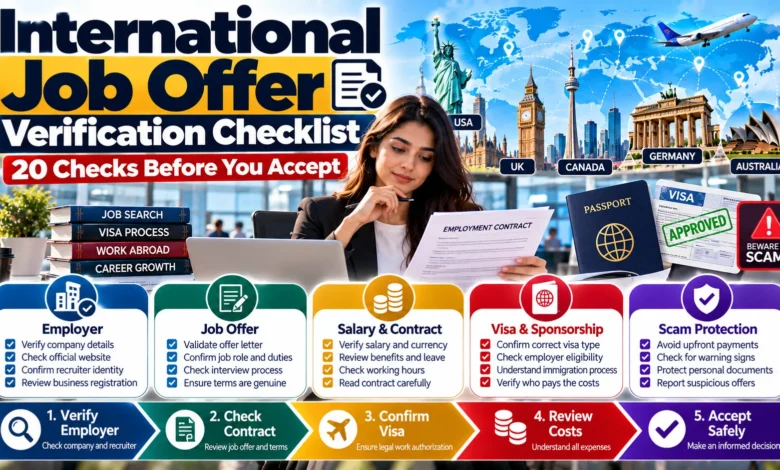
Receiving an international job offer can be exciting, particularly after weeks or months of searching, preparing applications and attending interviews. However, accepting an overseas position without verifying its legitimacy can expose applicants to financial loss, immigration problems, unsuitable working conditions or employment fraud.
A professional-looking offer letter is not proof that a job is genuine.
Scammers can copy company logos, create convincing recruitment websites, impersonate hiring managers and produce documents that resemble official employment contracts. Even when an employer is legitimate, the proposed salary, immigration arrangements or employment conditions may not be suitable.
International job seekers should therefore evaluate two separate questions:
Is the job offer genuine?
Is the job legally and financially suitable for me?
Both questions matter.
This guide provides 20 practical checks to complete before accepting an international employment offer, along with country-specific verification resources, warning signs and a checklist you can use during your job search.
Why Verifying an International Job Offer Matters
Overseas recruitment can involve several parties:
- The employer
- Human resources personnel
- Recruitment agencies
- Immigration advisers
- Government immigration authorities
- Relocation providers
This creates opportunities for confusion and, unfortunately, fraud.
A candidate may receive a genuine offer from an employer but misunderstand the immigration requirements. Another applicant may receive a completely fabricated offer from someone impersonating a legitimate company.
A third candidate may receive a real job offer with conditions that are financially unattractive or inconsistent with local employment law.
Verification helps identify these problems before applicants make expensive or irreversible decisions.
International Job Offer Verification: Quick Overview
| Area | What to Verify |
|---|---|
| Employer | Business identity, registration and operating history |
| Recruiter | Identity and authority to recruit |
| Vacancy | Whether the position genuinely exists |
| Offer letter | Authenticity and accurate details |
| Salary | Amount, currency, payment terms and deductions |
| Working conditions | Hours, leave, overtime and employment protections |
| Immigration | Appropriate visa or work authorization |
| Sponsorship | Employer eligibility and actual commitments |
| Costs | Recruitment, relocation and government fees |
| Safety | Personal documents, privacy and warning signs |
No single check guarantees legitimacy. The strongest approach combines independent verification of the employer, the position, the contract and the immigration process.
The 20 Checks Before Accepting an International Job Offer
1. Verify That the Employer Exists
Begin by confirming that the company is a real operating business.
Search for its official website, legal business name, registered address and public contact information.
Where possible, consult the destination country’s official business register.
Do not rely only on a website provided by the recruiter. Fraudsters can create convincing copies of legitimate business websites.
What to check: Does the company’s legal identity match the organization offering employment?
2. Confirm the Company’s Registration Details
A legitimate employer should generally have an identifiable legal entity.
Depending on the country, business registration records may show:
- Registered company name
- Registration number
- Legal status
- Registered address
- Incorporation information
A business registration record is useful evidence, but it does not automatically prove that the person contacting you works for that business.
What to check: Does the legal entity named in the contract match the registered employer?
3. Check the Official Company Website
Visit the employer’s website independently.
Review its business activities, services, locations and recruitment information.
Look for inconsistencies between the website and the offer letter.
For example, a supposed engineering employer that has no evidence of engineering operations deserves closer investigation.
New or small businesses may have limited websites, so an incomplete online presence is not proof of fraud. It is a reason to conduct additional checks.
What to check: Does the employer’s public business activity make sense for the advertised role?
4. Verify the Recruiter’s Identity
Fraudsters frequently impersonate real employees.
A recruiter may use the name and photograph of an actual HR manager while communicating through an unrelated email address.
Find the company’s official telephone number or HR contact details independently and ask whether the recruiter is authorized to represent the organization.
Do not rely exclusively on the contact number printed in the suspicious offer letter.
What to check: Can the employer independently confirm the recruiter’s identity and authority?
5. Examine the Email Address and Domain
Check the full sender address carefully.
A legitimate-looking display name can hide an unrelated email account.
Watch for:
- Misspelled company domains
- Extra words or characters
- Lookalike letters
- Unusual domain extensions
- Personal email accounts used without a credible explanation
Small employers may legitimately use third-party email services, so a personal address alone does not prove fraud.
However, it increases the importance of independent confirmation.
What to check: Does the sender’s identity match a communication channel verified by the employer?
6. Confirm That the Job Vacancy Is Genuine
Search the employer’s official careers website for the position.
If the vacancy is no longer listed, ask the employer directly whether recruitment is underway.
Some genuine positions are filled through private recruitment or external agencies, so an absent public listing is not automatically suspicious.
Nevertheless, the employer should be able to confirm the role.
What to check: Does the company acknowledge that the vacancy exists and that you are being considered for it?
7. Review the Interview and Selection Process
Consider how the employer evaluated your qualifications.
A genuine recruitment process may involve interviews, assessments, reference checks or professional discussions.
Be cautious if you receive a highly attractive offer without any meaningful evaluation.
An interview conducted entirely through text messages, combined with an urgent payment request, is particularly concerning.
What to check: Has the employer followed a credible selection process appropriate to the position?
8. Verify the Offer Letter Directly
A signed letter with a company logo can still be fabricated.
Contact the employer through independently verified channels and ask whether the offer was issued.
Check that the letter accurately identifies:
- Your name
- Employer
- Job title
- Duty station
- Salary
- Employment terms
- Authorized signatory
Do not assume a stamp, signature or reference number proves authenticity.
What to check: Can the employer confirm the offer and its key terms?
9. Confirm the Job Title and Responsibilities
Review the position’s actual duties.
The work described in the contract should reasonably match the job you applied for.
Be cautious if a recruiter advertises an accounting position but the contract requires unrelated manual work.
A substantial change in responsibilities should be explained before acceptance.
What to check: Are the duties clearly documented and consistent with the advertised position?
10. Verify the Salary and Currency
Confirm the exact compensation.
Important details include:
- Gross salary
- Net salary, if estimated
- Currency
- Payment frequency
- Guaranteed versus discretionary compensation
- Commission arrangements
- Bonuses
- Allowances
A headline salary can be misleading when taxes, deductions or living expenses are ignored.
For example, an annual salary of $50,000 is not equivalent to $50,000 in take-home pay.
What to check: Is the salary clearly stated, lawful and financially realistic?
11. Understand Working Hours and Overtime
Check the expected working schedule.
Ask about:
- Weekly working hours
- Shift patterns
- Weekend work
- Overtime arrangements
- Rest periods
- Public holidays
- On-call duties
Some countries regulate overtime and working hours differently.
Do not assume that overtime will always be paid at a higher rate.
What to check: Are the working hours and overtime conditions clearly explained and consistent with applicable law?
12. Check Employment Benefits and Leave
Benefits can significantly affect the value of an international job offer.
Depending on the country and contract, these may include:
- Paid annual leave
- Sick leave
- Health insurance
- Retirement contributions
- Family benefits
- Transportation
- Accommodation
- Relocation assistance
Separate legally required benefits from optional employer benefits.
What to check: Which benefits are guaranteed, which are conditional and which are not provided?
13. Review the Employment Contract Carefully
The employment contract deserves more attention than the promotional job advertisement.
Check:
- Employer’s legal name
- Position and duties
- Salary
- Work location
- Contract duration
- Probation
- Termination
- Notice period
- Confidentiality
- Restrictive covenants
- Applicable law
Request clarification about terms you do not understand.
Where the financial or legal consequences are substantial, consider independent professional advice.
What to check: Does the written contract reflect the offer you believe you are accepting?
14. Confirm the Correct Work Visa or Immigration Route
A job offer does not automatically authorize employment abroad.
The required immigration permission depends on the destination country, nationality, job and circumstances.
Some routes require employer sponsorship.
Others involve employer-specific permits or separate authorization.
Do not assume that a visitor visa permits employment.
What to check: Which immigration category would legally authorize you to perform the proposed work?
15. Verify Employer Sponsorship Eligibility
If the offer depends on employer sponsorship, determine whether the employer is eligible to sponsor workers under the relevant immigration system.
For example, the United Kingdom publishes a register of organizations licensed to sponsor workers.
However, appearing on a sponsor register does not prove that a particular offer is genuine or that the employer will sponsor your specific position.
Other countries operate different systems.
What to check: Is the employer eligible to complete the required immigration steps, and has it confirmed what it will actually do?
16. Investigate Recruitment and Immigration Fees
Payment requests are among the most important warning signs.
Be cautious if someone asks you to pay for:
- A guaranteed job
- A sponsorship slot
- Release of an offer letter
- An interview appointment
- A fabricated work permit
- A supposed immigration shortcut
Legitimate government application fees may exist, and lawful applicant-paid expenses vary by jurisdiction.
However, these should be verified through official government sources and paid only through authorized channels.
In Australia, paying for visa sponsorship arrangements is prohibited.
What to check: Is every requested payment lawful, documented, necessary and directed to an authorized recipient?
17. Verify Accommodation and Relocation Promises
If the employer promises accommodation or relocation assistance, request the details in writing.
Confirm:
- Whether accommodation is free
- Whether it is shared
- Who pays utilities
- Whether deductions apply
- How long accommodation is available
- Whether family members can stay
- Who pays travel costs
- Whether relocation expenses must be repaid if you leave
Do not rely on vague statements such as “everything is provided.”
What to check: Are relocation benefits clearly defined, affordable and consistent with the contract?
18. Investigate the Employer’s Reputation
Look beyond promotional material.
Research the employer through credible sources, professional networks and relevant public records.
You may investigate:
- Employee experiences
- Labour disputes
- Regulatory enforcement
- Financial or operational concerns
- Repeated recruitment complaints
Online reviews can be incomplete, outdated or manipulated.
Use them as supporting evidence rather than conclusive proof.
What to check: Is there credible evidence of serious unresolved employment or business concerns?
19. Protect Your Passport and Personal Information
International recruitment may legitimately require identity documents at certain stages.
However, sensitive information should only be shared when necessary and through secure, verified channels.
Avoid sending passport copies, bank details or other sensitive records to an unverified recruiter.
Be particularly cautious if someone requests your original passport as a condition of employment.
In Australia, employers cannot lawfully keep a worker’s passport as a condition of employment.
What to check: Is the recipient verified, is the information genuinely required and is the submission method secure?
20. Confirm the Final Offer Before Resigning or Travelling
The final check brings everything together.
Before making irreversible decisions, confirm:
- The employer is genuine
- The offer is authentic
- The contract is acceptable
- Compensation is understood
- The immigration pathway is appropriate
- Required permissions are approved when necessary
- Travel arrangements are confirmed
- Accommodation arrangements are understood
- Emergency funds are available
A genuine job offer is not a guarantee that immigration approval will be granted.
Do not resign from your existing job, purchase non-refundable tickets or relocate based only on a recruiter’s promise.
What to check: Have all essential legal, financial and practical conditions been satisfied?
Printable International Job Offer Verification Checklist
Use this checklist before accepting an overseas employment offer.
- 1. Employer’s existence verified
- 2. Business registration checked
- 3. Official website independently reviewed
- 4. Recruiter’s identity confirmed
- 5. Email and domain verified
- 6. Vacancy confirmed with employer
- 7. Recruitment process reviewed
- 8. Offer letter authenticated
- 9. Job duties confirmed
- 10. Salary and currency verified
- 11. Working hours and overtime reviewed
- 12. Benefits and leave confirmed
- 13. Employment contract reviewed
- 14. Immigration route identified
- 15. Sponsorship eligibility verified
- 16. Recruitment and immigration fees checked
- 17. Accommodation and relocation terms confirmed
- 18. Employer reputation investigated
- 19. Personal information protected
- 20. Final legal and travel conditions confirmed
If you cannot confidently complete a critical check, investigate further before accepting the offer.
How to Verify Job Offers in Different Countries
Verification procedures vary by destination.
The following examples illustrate why country-specific research matters.
United Kingdom
Applicants considering employer-sponsored work should review the relevant visa route and the employer’s sponsorship status.
The UK government publishes a register of licensed Worker and Temporary Worker sponsors.
The register can help establish whether an organization holds the relevant licence.
However, it cannot independently authenticate your personal job offer.
You should still confirm the vacancy directly with the employer.
Official resources:
- https://www.gov.uk/government/publications/register-of-licensed-sponsors-workers
- https://www.gov.uk/skilled-worker-visa
Canada
Canadian employment and immigration procedures depend on the type of job and immigration programme.
Some employer-specific work permit routes involve a Labour Market Impact Assessment (LMIA), while other routes are LMIA-exempt.
Do not assume every legitimate Canadian job requires an LMIA.
Applicants should verify the employer, the offer and the immigration route using official Government of Canada information.
A genuine offer does not guarantee a work permit or permanent residence.
Official resources:
- https://www.canada.ca/en/immigration-refugees-citizenship.html
- https://www.jobbank.gc.ca/
- https://www.canada.ca/en/employment-social-development/services/foreign-workers.html
Australia
Australia has specific rules protecting migrant workers from exploitation.
Applicants should verify the appropriate visa category and understand their workplace rights.
The Australian Government warns about fraudulent visa promises and prohibited payments for sponsorship.
Workers should also verify salary and employment entitlements through official workplace resources.
Official resources:
Germany
Applicants considering employment in Germany should confirm whether their qualifications, proposed employment and immigration circumstances meet the relevant requirements.
Some regulated professions require professional recognition or authorization.
The official Make it in Germany portal provides information about working and immigration pathways.
Official resources:
New Zealand
Applicants should check the relevant immigration route and, where required, the employer’s accreditation status.
Employer accreditation and visa eligibility are separate matters from whether an individual job offer is genuine.
Official resource:
Seven Serious Warning Signs of a Fake International Job Offer
Certain patterns deserve immediate attention.
Guaranteed Employment or Visa Approval
No recruiter can guarantee that an immigration authority will approve your application.
Payment to Secure a Job
Requests to purchase an offer letter, sponsorship or guaranteed placement are serious warning signs.
No Meaningful Interview
A highly paid professional job offered without a credible evaluation process should be independently investigated.
Pressure to Pay Immediately
Scammers may create artificial deadlines to prevent applicants from checking details.
Suspicious Communication Channels
A recruiter who refuses independent company verification or communicates exclusively through an unverifiable messaging account deserves scrutiny.
Unrealistic Compensation
Extremely high salaries for jobs requiring no relevant skills or experience can be a warning sign.
Requests for Sensitive Information Too Early
Unverified recruiters should not receive passport details, bank information or other sensitive records without a legitimate reason.
What to Do If You Suspect a Fake Job Offer
Do not send further payments or sensitive documents until the situation has been independently verified.
Preserve relevant evidence, including:
- Emails
- Messages
- Offer letters
- Payment requests
- Website addresses
- Recruiter contact details
Contact the real employer through independently obtained official details.
If money has already been transferred, contact your bank or payment provider promptly.
If identity documents have been compromised, consult the relevant identity-document authority and appropriate fraud-reporting channels.
You may also report suspected recruitment fraud to the relevant consumer protection, law enforcement or immigration authority.
How to Evaluate Whether a Genuine Job Offer Is Worth Accepting
A genuine job offer can still be a poor financial decision.
Compare the expected income with the actual cost of living.
Consider:
- Rent
- Utilities
- Food
- Transportation
- Taxes
- Health expenses
- Insurance
- Family expenses
- Relocation costs
- Emergency savings
Example: Comparing Two Hypothetical Offers
| Factor | Offer A | Offer B |
|---|---|---|
| Monthly take-home pay | $3,200 | $3,800 |
| Housing | $1,300 | $1,900 |
| Food | $400 | $450 |
| Transportation | $200 | $250 |
| Other expenses | $400 | $450 |
| Estimated remaining income | $900 | $750 |
These figures are hypothetical examples, not actual salaries or cost-of-living estimates for any country.
Offer B provides a higher salary but leaves less money after the listed expenses.
Applicants should therefore evaluate net financial outcomes rather than salary alone.
Questions to Ask the Employer Before Accepting
You can request written clarification on several important issues.
Examples include:
- Can you confirm the legal entity that will employ me?
- What is the complete salary and benefits package?
- What are the normal working hours?
- Is the position permanent or fixed-term?
- Which immigration process applies?
- What immigration assistance will the company provide?
- Who is responsible for government fees and relocation expenses?
- What happens if the visa application is refused?
- Are accommodation benefits included?
- What are the probation and termination conditions?
A legitimate employer should be able to explain the material terms of the proposed employment.
Frequently Asked Questions
How can I verify whether an international job offer is genuine?
Verify the employer through official business records, confirm the recruiter independently, authenticate the offer with the company and review the relevant immigration requirements.
Is an offer letter with a company stamp genuine?
Not necessarily. Stamps, signatures and logos can be copied or fabricated.
Can I verify a UK employer’s sponsorship status?
Yes. The UK government publishes an official register of licensed Worker and Temporary Worker sponsors. However, listing on the register does not authenticate a specific job offer.
Does every Canadian job offer require an LMIA?
No. Requirements depend on the immigration programme and work permit category.
Should I pay a recruiter for visa sponsorship?
Do not pay to purchase sponsorship or a guaranteed job. Payment rules differ by country, and some sponsorship-related charges are prohibited. Verify any legitimate government or professional service fee independently.
Can a genuine job offer guarantee visa approval?
No. Immigration authorities determine whether applicants meet the applicable requirements.
Should I resign after receiving an overseas offer letter?
Avoid resigning solely on the basis of an unverified offer. Confirm the employment terms and understand the immigration approval process before making irreversible decisions.
What if an employer refuses to verify the offer?
Treat refusal to provide reasonable confirmation as a significant warning sign and investigate further before proceeding.
Final Thoughts
Accepting an international job offer is an important professional and financial decision.
A genuine employer, a professional-looking contract and an attractive salary are not enough on their own.
Applicants must also confirm that the position exists, the recruiter is authorized, the employment terms are acceptable and the proposed immigration arrangements are legally workable.
The most effective approach is to verify information independently rather than relying entirely on the person offering the job.
Verify the employer. Authenticate the offer. Review the contract. Confirm immigration eligibility. Understand the costs. Protect your documents.
Completing these checks cannot eliminate every risk, but it can help international job seekers identify warning signs, ask better questions and make more informed decisions before accepting employment abroad.