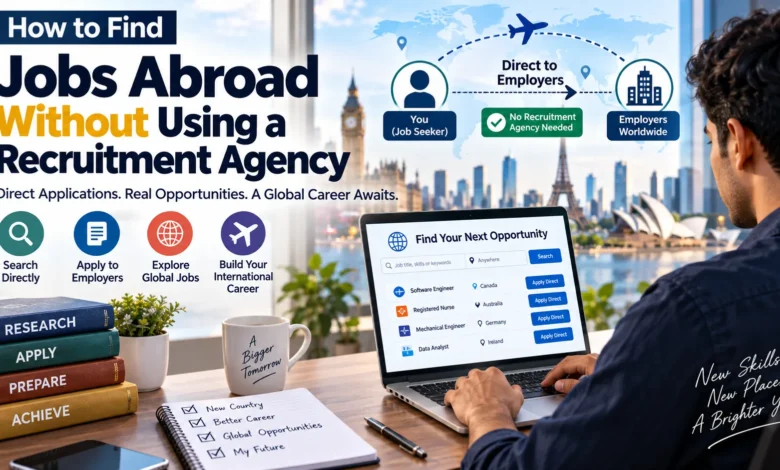
inding a job in another country does not always require a recruitment agency. Many international employers advertise vacancies directly through their own career websites, government job portals, professional networks, and official employment services. For job seekers who are prepared to research employers and immigration requirements carefully, applying directly can provide greater control over the entire process.
The challenge is knowing where to search and how to distinguish a genuine international vacancy from an advertisement that is not open to overseas applicants. A company may be hiring, for example, but only considering people who already have permission to work in that country. In other cases, an employer may actively welcome international applications and be prepared to complete the necessary work-authorisation procedures.
This guide explains how to find jobs abroad without using a recruitment agency, how to approach employers directly, which official resources can help, how to check visa requirements, and how to protect yourself from fraudulent job offers.
The goal is not simply to send more applications. It is to build a focused international job search based on genuine vacancies, suitable employers, and realistic immigration options.
Quick Overview
| Step | What to Do |
|---|---|
| 1 | Choose your target occupation and countries |
| 2 | Check whether your qualifications are suitable |
| 3 | Understand the country’s work-authorisation rules |
| 4 | Search official job portals and employer career pages |
| 5 | Identify vacancies open to international candidates |
| 6 | Tailor your CV and cover letter |
| 7 | Apply directly through verified channels |
| 8 | Prepare for interviews |
| 9 | Verify the employment offer |
| 10 | Complete the official visa or work-permit process |
A recruitment agency can be useful in some situations, but it is not automatically required for an international job search.
Can You Really Find a Job Abroad Without an Agency?
Yes. Direct applications are a normal part of recruitment in many countries.
Companies frequently publish vacancies on their own websites. Governments and public employment services also operate job portals, while professional networking platforms allow candidates to identify employers and vacancies independently.
Germany’s official Make it in Germany portal, for example, explicitly explains that job seekers can organize their job search, visa application, and entry process themselves and that assistance from a service provider is not required.
Canada’s official Job Bank provides a dedicated section for foreign candidates and identifies vacancies from employers recruiting international applicants.
Within Europe, EURES provides job-search and mobility services across participating countries.
The important point is that finding an employer and obtaining permission to work are often separate processes.
Receiving a job offer does not automatically give you the legal right to work in another country. Depending on the destination, the employer may need to sponsor, nominate, support, or otherwise participate in your work-authorisation application.
Why Apply Directly to International Employers?
Applying directly gives you greater visibility into the recruitment process.
Instead of relying on an intermediary to explain the employer’s requirements, you can read the original vacancy, research the organization, and communicate through its official recruitment channels.
There are several practical advantages.
Direct Access to Original Job Information
An employer’s career website usually contains the most authoritative version of its vacancy.
You can see the actual:
- Job title
- Location
- Responsibilities
- Required experience
- Qualifications
- Application deadline, where applicable
- Work-authorisation information, if provided
- Application procedure
This reduces the risk of relying on an outdated advertisement copied by another website.
Better Employer Verification
Applying through an official corporate website makes it easier to confirm that the organization exists and that the vacancy belongs to it.
You can research the company’s business operations, office locations, corporate contact information, and recruitment policies before submitting sensitive documents.
More Control Over Your Applications
Direct applications allow you to decide which employers receive your information.
You can maintain your own application tracker, customize each CV, monitor responses, and follow up through appropriate channels.
You Can Avoid Unnecessary Intermediary Fees
Some private recruitment services charge job seekers for certain services.
By conducting the search yourself, you may avoid paying for assistance you do not need.
However, applicants should understand that legitimate expenses may still exist during an international move, including government application fees, document translations, professional licensing, medical examinations, or other required processes.
Always determine who is legally responsible for each expense.
Step 1: Choose a Specific Occupation
One of the biggest mistakes in an international job search is starting with an extremely broad query such as:
“Any job abroad.”
Employers normally recruit candidates for specific roles, not simply because someone wants to move overseas.
Start by identifying your strongest occupation.
For example:
- Registered nurse
- Civil engineer
- Software developer
- Electrician
- Welder
- Accountant
- Mechanical engineer
- Chef
- Data analyst
- Laboratory technician
- Construction manager
- Cybersecurity specialist
Then assess whether your education and work history match that occupation.
If you have several professional skills, you can create a shortlist of two or three related job titles rather than applying randomly across unrelated industries.
Step 2: Select Countries That Match Your Background
Do not choose a destination solely because you saw a viral post claiming that it is “hiring foreigners.”
Instead, investigate whether your particular occupation has realistic employment pathways there.
Ask:
Is my occupation commonly advertised?
Search actual vacancies rather than relying only on general labour-shortage articles.
Are my qualifications recognized?
Some professions require foreign qualifications to be formally assessed.
Is the occupation regulated?
Healthcare, teaching, engineering and skilled trades can involve licensing or registration requirements depending on the country and occupation.
What language will I need?
An English-language job advertisement does not necessarily mean the workplace operates entirely in English.
Can an employer legally hire me from overseas?
This is critical. Immigration requirements may limit which positions can support foreign workers.
A shortlist of three suitable countries is usually more manageable than trying to apply everywhere.
Step 3: Check Work Visa Requirements Before Applying Heavily
Do some immigration research before sending dozens of applications.
You do not necessarily need to complete a visa application before finding an employer, but you should understand whether there is a realistic work-authorisation route for your circumstances.
Check the destination country’s official immigration website.
Research questions such as:
- Does the visa require an employment offer?
- Does the employer need a sponsor licence or accreditation?
- Is my occupation eligible?
- Is there a salary requirement?
- Is professional registration necessary?
- Is a language test required?
- Does the employer need government approval before I can apply?
- Can I apply from outside the country?
Never rely exclusively on social-media posts or third-party blogs for immigration eligibility.
Rules can change, and small details can determine whether a particular pathway applies to you.
Step 4: Use Official Government Job Portals
Government employment portals are useful starting points because they can provide vacancies alongside labour-market information and job-search guidance.
Canada
Canada’s Job Bank provides a specific resource for foreign candidates outside Canada.
International applicants should pay attention to whether a vacancy is actually open to candidates from outside Canada. The portal warns that people who are not legally authorized to work in Canada cannot apply for every vacancy.
Official resource: Canada Job Bank.
Germany
Germany’s official Make it in Germany portal includes job listings and guidance for qualified professionals from overseas.
Its job exchange includes Federal Employment Agency vacancies where employers welcome applications from abroad.
Official resource: Make it in Germany.
European Countries
EURES, the European Employment Services network, supports people interested in employment and mobility across participating European countries.
It provides job-search services as well as information related to living and working abroad.
Official resource: EURES.
These portals are useful research tools, but inclusion of a vacancy does not automatically mean that you personally qualify for the required work permit.
Always check the individual job and immigration requirements.
Step 5: Search Employer Career Pages Directly
This is one of the most effective strategies for avoiding dependence on recruitment agencies.
Create a list of companies operating in your profession and target countries.
Then search for:
Company Name + Careers
or
Company Name + Jobs
Use the employer’s official website rather than immediately applying through a copied advertisement.
Once on the career page, search by:
- Occupation
- Department
- Country
- City
- Experience level
- Relevant skills
Large international employers may operate separate career portals for different regions.
Read each vacancy carefully.
Look for phrases such as:
- Applicants requiring sponsorship may be considered
- International applications welcome
- Relocation support available
- Visa support available
- Must have existing right to work
- Sponsorship unavailable
These statements can save significant time.
If the vacancy clearly says applicants must already have unrestricted work authorization and you do not have it, applying may not be productive.
Step 6: Build a List of Target Employers
Do not rely on finding one perfect vacancy.
Build an employer database.
A simple spreadsheet can contain:
| Field | Example Information |
|---|---|
| Company | Employer name |
| Country | Target destination |
| Career page | Official recruitment page |
| Position | Job title |
| Date found | When you discovered it |
| International applicants | Yes / No / Unclear |
| Application date | Date submitted |
| Status | Applied / Interview / Rejected / Pending |
| Follow-up | Date or notes |
Over time, this becomes your personal international job-search database.
It also helps prevent duplicate applications and makes it easier to identify employers that repeatedly advertise positions matching your background.
Step 7: Create a CV for the Country and Position
Avoid sending exactly the same generic CV to every employer.
Your core employment history should remain accurate, but the presentation should emphasize experience relevant to each vacancy.
Start with the job description.
Identify important requirements such as:
- Technical skills
- Software knowledge
- Certifications
- Industry experience
- Management responsibilities
- Language skills
- Professional registration
Then make sure your CV clearly shows the relevant qualifications you genuinely possess.
Keep It Accurate
Never change job titles, qualifications, dates, or experience simply to match a vacancy.
International employers may verify employment history and qualifications.
Focus on Achievements
Instead of listing only responsibilities, explain relevant outcomes where possible.
For example, rather than writing:
“Responsible for warehouse inventory.”
A stronger statement could explain the actual scale or result of your work, provided it is accurate:
“Managed inventory records for a high-volume warehouse and supported monthly stock reconciliation.”
Do not invent percentages or performance figures that you cannot substantiate.
Include Your Location Honestly
If you currently live outside the employer’s country, do not pretend to have a local address.
Your international status may be relevant to the employer’s decision about work authorization.
Step 8: Write a Focused Cover Letter
Not every employer requires a cover letter, but when one is requested, use it strategically.
A useful international cover letter should explain:
- Why you are interested in the specific role
- How your experience matches the employer’s requirements
- Your most relevant professional skills
- Your current location
- Your work-authorisation situation where appropriate
- Your willingness to relocate, if applicable
Avoid opening with a long explanation about how much you want to leave your country.
The employer’s main concern is usually whether you can perform the job and whether hiring you is practical.
Lead with professional value.
Step 9: Use Professional Networking Carefully
Professional networking can help you discover companies and vacancies that you might otherwise miss.
Follow employers in your industry and pay attention to their official recruitment announcements.
You can also connect professionally with:
- Recruiters employed directly by companies
- Hiring managers
- Professionals working in your occupation
- Alumni from your university
- Professional associations
- Industry specialists
Networking should not mean sending strangers messages asking:
“Give me a visa sponsorship job.”
A more professional approach is to ask a focused question about a role, department, application process, or the skills commonly required in that industry.
Build genuine professional connections rather than mass-messaging people.
Step 10: Consider Direct or Speculative Applications
Some employers accept expressions of interest even when the exact position you want is not currently advertised.
This is sometimes called a speculative application.
Research the organization first and determine whether it accepts unsolicited applications.
A concise approach can explain:
- Your profession
- Your relevant experience
- Your specialization
- Why the organization interests you
- Whether you are seeking international employment
Do not send the same generic message to hundreds of companies.
Ten carefully researched applications can be more useful than hundreds of irrelevant ones.
How to Search More Effectively
Search terms should be specific.
Instead of:
Jobs abroad
try:
Electrical engineer international applicants Germany
or:
Nurse overseas recruitment UK
or:
Software developer relocation Germany
or:
Civil engineer accredited employer New Zealand
The terminology differs between countries.
Possible terms include:
- Visa sponsorship
- Work permit support
- International applicants
- Overseas recruitment
- Employer sponsorship
- Accredited employer
- Relocation assistance
- Skilled worker
- Global mobility
Remember that “relocation assistance” and “visa sponsorship” are not necessarily the same thing.
How to Tell Whether a Job Is Open to Foreign Applicants
Read the complete advertisement.
Do not rely solely on the job title.
Look at the eligibility section for statements about:
Work authorization
The employer may explicitly require candidates to already possess the right to work.
Sponsorship
The advertisement may state whether sponsorship is available.
Location
Some remote jobs still require employees to live in a particular country.
Professional registration
The employer may require registration before employment can begin.
Language
Language proficiency can be mandatory even when the advertisement itself is written in English.
If sponsorship information is unclear, use the company’s official recruitment contact channel where available.
Documents to Prepare Before Applying Abroad
Creating a secure application folder can save time.
Depending on your profession and destination, useful documents may include:
- Current CV or resume
- Passport
- Academic certificates
- Academic transcripts
- Vocational certificates
- Employment reference letters
- Professional licences
- Language test results, where required
- Portfolio, if relevant
- Professional registration documents
- Credential assessments, where applicable
You usually do not need to send all of these documents with the first application.
Follow the employer’s instructions.
Be particularly careful with passport copies and other sensitive personal information. Submit them only when legitimately required and through verified channels.
How to Verify an Employer Before Accepting a Job
Direct applications reduce some risks, but job scams can still occur.
Fraudsters can impersonate real companies, create fake websites, or contact applicants using addresses that resemble genuine corporate domains.
Before accepting an international job offer, check:
The Official Company Website
Search for the organization independently rather than relying only on a link sent by a recruiter.
The Email Domain
Compare the recruiter’s email address with the company’s official domain.
An unexpected free email account deserves additional verification, particularly when a large organization supposedly issued the offer.
The Vacancy
Check whether the role appears on the employer’s official careers page where possible.
The Interview Process
Be cautious if a supposed employer offers a professional position without conducting a credible selection process.
The Employment Contract
Review:
- Employer’s legal identity
- Job title
- Salary
- Location
- Working hours
- Contract duration
- Benefits
- Probation terms
- Start date
- Work-authorisation conditions
Do not sign documents you do not understand.
Recruitment Scam Warning Signs
Be especially careful when someone:
- Guarantees a job without assessing your qualifications
- Guarantees visa approval
- Pressures you to pay immediately
- Requests payment into an unrelated personal account
- Refuses to identify the actual employer
- Uses an unverifiable email address
- Sends an offer for a job you never applied for
- Requests unnecessary sensitive information immediately
- Asks you to submit false immigration documents
- Claims a tourist visa can automatically be used for employment
Not every unusual recruitment process is fraudulent, but warning signs should trigger further verification.
If money is requested, determine exactly what the payment is for and verify it against official employer or government information.
What If an Employer Asks Whether You Need Sponsorship?
Answer accurately.
If you do not currently have unrestricted permission to work in the destination country and will require employer-supported work authorization, do not claim otherwise simply to pass an application screening question.
You may reach the interview stage only to be rejected later when the employer discovers that sponsorship is required.
Targeting employers genuinely able and willing to consider international candidates is more efficient.
Do You Need to Travel Abroad Before Finding a Job?
Not necessarily.
Many international recruitment processes can begin while the applicant remains in their home country.
Applications, screening calls, interviews, document reviews, and even employment offers can sometimes be handled remotely.
However, the process varies by employer and country.
Some countries also provide specific job-search immigration pathways for eligible applicants. Germany’s Opportunity Card is one example, but it has its own eligibility and financial requirements.
Do not travel on a visitor or tourist status and assume that this automatically permits employment.
Always check the destination country’s official immigration rules.
Should You Completely Avoid Recruitment Agencies?
Not necessarily.
A reputable recruitment agency can sometimes be useful, particularly in sectors where employers routinely outsource international recruitment.
The important point is that an agency is not automatically required.
Whether you apply directly or use an intermediary, you should still understand:
- Who the employer is
- What position you are applying for
- What the contract says
- What visa or work permit is required
- Which fees are legitimate
- Who is responsible for each cost
Using an agency should not mean giving up control over verification.
A Practical Weekly Job-Search Routine
Consistency is more useful than submitting hundreds of random applications in one day.
Monday: Research Employers
Identify five to ten companies relevant to your occupation.
Review their career pages and save suitable vacancies.
Tuesday: Tailor Applications
Adjust your CV for the strongest positions and prepare any required cover letters.
Wednesday: Apply
Submit applications through official employer portals.
Record every application in your tracker.
Thursday: Professional Networking
Follow target companies, identify relevant professionals, and participate appropriately in industry discussions.
Friday: Follow Up and Research
Check existing applications and look for newly advertised positions.
Weekend: Improve Your Profile
Work on skills, language ability, certifications, portfolio projects, or professional knowledge relevant to your target occupation.
This approach creates a sustainable system rather than an exhausting cycle of random applications.
Common Mistakes to Avoid
Applying for Every Job You See
Quantity alone does not make an international job search effective.
Focus on roles where you meet a meaningful proportion of the requirements.
Ignoring Work-Permit Eligibility
An excellent CV cannot overcome an immigration route that does not apply to your circumstances.
Research both employment and immigration requirements.
Using One CV Everywhere
Different countries and employers have different expectations.
Adapt your application while keeping all factual information consistent.
Paying Before Verifying
Never assume that a payment request is legitimate simply because someone sent you an official-looking letter.
Verify the employer, immigration process, and fee through independent sources.
Depending Only on Social Media
Social platforms can help you discover opportunities, but use the employer’s official website or an authoritative job portal to verify important information.
Applying Only to Famous Companies
Large multinational employers receive substantial numbers of applications.
Research established small and medium-sized employers as well, provided they are genuine and able to hire international workers where required.
Frequently Asked Questions
Can I find a job abroad without a recruitment agency?
Yes. Many employers accept direct applications through their official career websites, and government employment portals can also help candidates identify vacancies.
Whether you can obtain the necessary work authorization depends on the country, employer, position, and your individual circumstances.
Where should I search for direct international jobs?
Start with official employer career pages and government employment services. Depending on your target destination, resources may include Canada Job Bank, Make it in Germany, EURES, or equivalent official services in other countries.
Professional networking platforms can also help you discover employers, but important details should be verified independently.
Can I get visa sponsorship when applying directly?
Potentially, yes.
An employer does not need to be introduced by a recruitment agency in order to support an eligible foreign worker where the country’s immigration system allows it.
However, sponsorship availability depends on the employer, vacancy, and immigration rules.
Should I mention that I need visa sponsorship?
Answer work-authorisation questions truthfully.
Where appropriate, you can explain that you require employer-supported work authorization.
Hiding this information can create problems later in the recruitment process.
Do I have to pay an employer for a job offer?
A genuine job offer should be treated separately from legitimate government, professional, or relocation expenses.
Be extremely cautious if someone asks you to pay simply to obtain an employment offer.
Check the relevant country’s official guidance and verify every requested payment independently.
Can I apply from my home country?
Many employers allow overseas applicants to submit applications remotely.
Whether the employer can proceed with your application depends on the position and applicable immigration rules.
How long does finding a job abroad take?
There is no standard timeline.
It depends on your occupation, qualifications, target country, employer demand, application quality, professional registration requirements, and work-authorisation process.
Avoid anyone promising guaranteed employment within a specific period.
Final Takeaway
Finding jobs abroad without using a recruitment agency is possible, but successful direct applications require organization and careful research.
Start by defining your occupation and selecting countries where your background is relevant. Understand the work-authorisation requirements before investing heavily in applications. Search government employment portals, build a list of legitimate employers, and apply through official career websites whenever possible.
Your goal should not be to send the maximum number of applications.
A stronger strategy is to identify genuine vacancies for which your qualifications are relevant, prepare a targeted application, and clearly understand the immigration requirements associated with the position.
Most importantly, maintain control of the process. Verify employers independently, protect sensitive documents, understand any requested payments, and confirm visa information through official government sources.
Direct international job searching takes patience, but it allows you to build your overseas career search around verified employers and reliable information rather than depending entirely on intermediaries.