Working for the United Nations can offer professionals the opportunity to contribute to international work in areas such as humanitarian affairs, sustainable development, human rights, political affairs, technology, administration, legal affairs, communications, logistics, science, and programme management.
But getting a professional job with the UN is not simply a matter of submitting a standard CV.
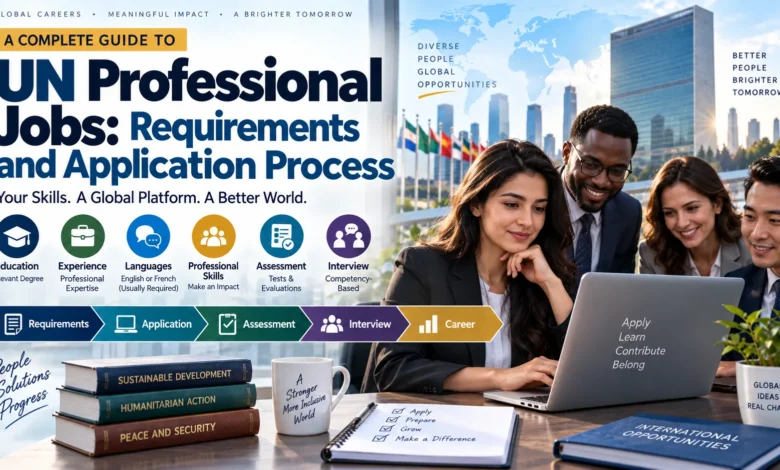
United Nations recruitment is structured around specific staff categories, job levels, educational requirements, relevant professional experience, language skills, competency-based assessment, and a formal online application process.
For international applicants, understanding these requirements before applying can save considerable time. A candidate may have strong qualifications but still be screened out if the required years of experience, degree level, language proficiency, or specialized experience listed in the vacancy are not demonstrated clearly.
This guide explains how UN Professional and higher-category jobs work, what qualifications applicants generally need, how to search for suitable positions, how the application process works, and how to prepare for assessments and competency-based interviews.
UN Professional Jobs at a Glance
| Area | What Applicants Should Know |
|---|---|
| Main category | Professional and Higher Categories |
| Common levels | P-1, P-2, P-3, P-4, P-5 and Director levels |
| Recruitment | Professional posts are normally internationally recruited |
| Education | Advanced university degree is commonly required |
| Alternative education | Some positions accept a first-level degree plus qualifying experience |
| Experience | Depends on the level and individual vacancy |
| Languages | Excellent command of English or French is generally required for UN Secretariat professional jobs |
| Application system | UN Careers / Inspira |
| Selection | Screening, assessment and potentially competency-based interview |
| Fees | The UN does not charge applicants recruitment fees |
| Early-career route | Young Professionals Programme may be relevant for eligible applicants |
Individual job openings always take priority over general guidance because requirements can vary by job family and position.
What Are UN Professional Jobs?
Within the United Nations Secretariat, staff positions are divided into different categories.
The Professional and Higher Categories, commonly associated with P and D levels, include internationally recruited positions requiring professional expertise, analytical ability, specialized knowledge, managerial responsibility, or a combination of these.
Professional staff may work in fields such as:
- Political affairs
- Human rights
- Humanitarian affairs
- Economic affairs
- Social development
- Information technology
- Data and statistics
- Legal affairs
- Public information
- Programme management
- Administration
- Finance and budget
- Procurement
- Logistics and supply chain
- Environmental affairs
- Science
- Security-related professional functions
The exact career fields available change according to organizational needs and current vacancies.
Professional-category staff are normally internationally recruited and may be expected to serve at different duty stations during their UN careers.
Understanding UN Professional Job Levels
You may encounter vacancy levels such as:
P-1
P-2
P-3
P-4
P-5
There are also higher Director-level positions such as D-1 and D-2.
As the level increases, the position normally involves greater professional experience, responsibility, complexity, leadership, or management.
The required qualifications should always be taken directly from the individual vacancy.
For example, the UN Careers guidance indicates that P-3 positions generally require at least five years of work experience, while higher levels require progressively more experience.
This does not mean applicants should choose a level only by counting years.
The experience must also be relevant to the vacancy.
What Education Do You Need for UN Professional Jobs?
Professional and Director-level UN Secretariat positions normally require an advanced university degree.
This could include a master’s degree or equivalent advanced qualification in a field relevant to the position.
However, the UN states that many vacancies may accept a first-level university degree combined with additional qualifying work experience instead of an advanced degree.
This distinction is extremely important.
Suppose a vacancy states:
Advanced university degree in a relevant field. A first-level university degree combined with additional qualifying experience may be accepted in lieu of the advanced degree.
In that situation, an applicant with a bachelor’s-level qualification may potentially meet the education requirement if the specified additional experience condition is satisfied.
However, this substitution is not available for every profession.
Certain specialized positions have different educational standards.
Medical and other highly specialized professions, for example, may require specific advanced qualifications that cannot simply be replaced with additional work experience.
Always follow the wording of the individual job opening.
Does Your Degree Need to Match the Job?
Usually, your academic background should fall within the field or fields specified in the vacancy.
A professional position might request qualifications in areas such as:
- Economics
- Political science
- International relations
- Public administration
- Law
- Finance
- Accounting
- Business administration
- Computer science
- Information systems
- Engineering
- Environmental science
- Communications
- Journalism
- Development studies
- Statistics
- Data science
Some vacancies accept several related disciplines.
Others are much more specialized.
Do not assume that having a master’s degree automatically makes you eligible for all Professional-category positions.
The subject of your education and your professional experience both matter.
How Much Work Experience Is Required?
There is no single experience requirement for every UN Professional job.
The required experience depends on:
- Job level
- Job family
- Responsibilities
- Technical specialization
- Duty station
- Individual vacancy
The UN Careers guidance emphasizes that professional experience should be relevant to the job.
Mid-career and senior positions require progressively responsible professional experience.
This means the quality and relevance of your experience can be as important as the number of years.
For example, if a programme-management vacancy asks for experience managing international development programmes, five years of unrelated general office work would not necessarily demonstrate the required background.
Read the Work Experience section of every vacancy carefully.
What Does “Progressively Responsible Experience” Mean?
This phrase appears frequently in international-organization recruitment.
In practical terms, progressively responsible experience generally means that your professional responsibilities have grown over time.
Your career history might show progression through:
- More complex assignments
- Larger projects
- Greater decision-making responsibility
- Team supervision
- Budget responsibility
- Programme management
- Policy development
- Strategic planning
- Technical leadership
- Stakeholder coordination
Simply working for many years does not necessarily demonstrate increasing responsibility.
Your application should make your professional progression clear through accurate descriptions of your achievements and responsibilities.
Language Requirements for UN Professional Jobs
The United Nations has six official languages:
- Arabic
- Chinese
- English
- French
- Russian
- Spanish
For UN Secretariat Professional and Higher Category positions, UN Careers states that applicants generally need an excellent command of either English or French, the Secretariat’s working languages.
Knowledge of another UN language can be an advantage and may be required for particular positions.
Individual vacancies may specify different language requirements depending on the duty station and responsibilities.
For example, a particular role could require English and consider French or Arabic desirable.
Do not claim language proficiency that you cannot demonstrate.
Language ability may be evaluated during the recruitment process.
Are UN Professional Jobs Open to International Applicants?
Professional and Higher Category positions in the UN Secretariat are normally internationally recruited.
This distinguishes them from some other staff categories.
For example, National Professional Officer positions are recruited nationally and generally involve nationals or permanent residents of the country of the duty station, subject to the requirements of the particular opening.
Therefore, applicants should always check the Category field when reviewing a vacancy.
A position being advertised by the United Nations does not automatically mean it is an internationally recruited Professional-category position.
Where Are UN Professional Jobs Located?
UN Professional positions can be based at headquarters offices, regional offices, field missions, and other duty stations around the world.
Potential duty stations may include cities such as:
- New York
- Geneva
- Vienna
- Nairobi
- Bangkok
- Addis Ababa
- Beirut
- Santiago
Professional opportunities can also exist at field duty stations in many other countries.
Applicants should read the location carefully and research the conditions associated with the duty station before applying.
International mobility can be an important aspect of a UN professional career.
UN Secretariat vs the Wider UN System
This distinction is important for job seekers.
The United Nations is part of a much larger UN system containing numerous agencies, funds, programmes, and related organizations.
These may include organizations working in areas such as:
- Development
- Children and youth
- Refugees
- Food security
- Health
- Labour
- Education
- Environment
- Humanitarian assistance
Not every UN-system organization uses exactly the same recruitment platform or employment structure.
The UN itself advises applicants interested in agencies, funds, and programmes to visit those organizations’ respective career websites.
Therefore, do not restrict your search to a single job portal if your goal is a career across the wider UN system.
How to Find UN Professional Jobs
For UN Secretariat positions, begin with the official UN Careers portal.
Vacancies can be filtered using criteria including:
- Job network
- Job family
- Category
- Level
- Duty station
Professional applicants can filter the category to Professional and Higher Categories.
You can then review positions matching your field and level.
The portal currently organizes vacancies across areas such as:
- Economic, Social and Development
- Information and Telecommunication Technology
- Internal Security and Safety
- Legal
- Logistics, Transportation and Supply Chain
- Management and Administration
- Political, Peace and Humanitarian
- Public Information and Conference Management
- Science
Instead of applying broadly, identify vacancies where your background closely matches the published requirements.
Read the Entire Job Opening Before Applying
This is one of the most important parts of the process.
Do not apply based only on the title.
A UN job opening may contain sections covering:
- Organizational setting
- Responsibilities
- Competencies
- Education
- Work experience
- Languages
- Assessment
- Special notice
- Other requirements
Read each section carefully.
Then ask yourself:
Do I meet the education requirement?
Do I have the required number of years of experience?
Is my experience actually relevant?
Do I meet the language requirement?
Do I possess any specifically required technical experience?
Can I demonstrate the listed competencies?
If a requirement says “required,” treat it seriously.
The UN Application Process: Step by Step
The UN Secretariat recruitment process can involve several stages.
Understanding them helps applicants prepare more effectively.
Step 1: Search for a Suitable Job Opening
Start at the official UN Careers portal.
Search according to your:
- Professional field
- Experience
- Education
- Preferred level
- Location interests
UN Careers states that job openings are posted regularly and that applicants with an Inspira account can save searches and create job alerts.
Job alerts can be particularly useful because application deadlines vary.
Step 2: Create Your Inspira Profile
Applications for UN Secretariat job openings are submitted through the UN’s online recruitment system.
You need to create a profile containing personal and professional information.
Your profile may include information such as:
- Name
- Nationality
- Contact information
- Education
- Employment history
- Professional experience
- Skills
- Languages
Give yourself enough time to complete the profile accurately.
Do not wait until shortly before a vacancy closes.
Step 3: Complete the Full Online Application
A standard resume is not a substitute for the completed UN online application for Secretariat positions.
Your application provides detailed information about your:
- Education
- Previous positions
- Responsibilities
- Professional achievements
- Skills
- Experience
Treat every section seriously.
The application is one of the main sources used to evaluate whether you satisfy the eligibility and suitability requirements.
Step 4: Answer Screening Questions Carefully
Depending on the position, the application may include screening questions.
These can relate directly to the essential requirements in the vacancy.
Answer accurately.
Do not select “Yes” simply because you believe you have similar experience.
If asked to explain your experience, provide specific factual examples demonstrating how you meet the criterion.
An unsupported claim is much weaker than a concise explanation of relevant work.
Step 5: Prepare a Targeted Motivation Statement
The UN application includes a motivation statement.
Do not use the same generic statement for every vacancy.
Your statement should connect your background directly to the position.
A useful approach is to cover:
Why This Position?
Explain why the specific responsibilities fit your professional background.
Relevant Experience
Highlight your strongest relevant experience.
Skills and Competencies
Connect your abilities to the requirements in the vacancy.
Contribution
Explain what you can contribute to the work of the office or team.
Keep the statement focused and truthful.
The UN specifically encourages applicants to customize their applications and motivation statements to the individual job opening.
Step 6: Submit Before the Deadline
Review your application before submission.
Check:
- Employment dates
- Education
- Contact information
- Language information
- Screening answers
- Motivation statement
Once an application has been submitted for a specific UN Secretariat opening, UN Careers states that it cannot be changed for that opening.
Successful submission should generate an automated confirmation.
Do not leave submission until the final minutes of the deadline.
What Happens After You Apply?
Submitting an application does not automatically lead to an interview.
Applications go through evaluation and screening.
The official applicant guidance describes stages that can include:
Automatic and manual screening
Applications may first be checked against eligibility and vacancy requirements.
Evaluation
Hiring managers evaluate applicants against the criteria specified in the job opening.
Assessment
Selected applicants may be invited to an assessment.
Competency-based interview
Candidates progressing further may participate in an interview.
Reference checks
Candidates under closer consideration may have their references checked.
The exact process can vary by vacancy.
UN Assessments: What Could You Be Asked to Do?
An assessment is not necessarily a traditional multiple-choice examination.
Depending on the position, candidates may encounter:
- Written exercises
- Technical tests
- Case studies
- Presentations
- Knowledge-based assessments
- Work samples
- Asynchronous video interviews
- Language assessments
- Competency-based interviews
The assessment should relate to the evaluation criteria for the position.
A communications candidate, for example, could face a drafting or writing exercise.
A technical professional could be tested on job-specific knowledge.
A graphic or creative position might require a portfolio or work sample.
Prepare for the actual job rather than trying to memorize generic UN information.
How to Prepare for a Competency-Based UN Interview
Candidates who progress through earlier stages may be invited to a panel interview.
UN Careers recommends preparing examples related to the competencies identified in the vacancy.
A useful answer structure is:
Situation
Briefly explain the context.
Action
Describe what you did.
Result
Explain the outcome.
For example, if asked about teamwork, avoid simply saying:
“I work very well in teams.”
Instead, prepare a real professional example showing:
- The situation
- Your responsibility
- The challenge
- Your actions
- The outcome
- What you learned
Prepare multiple examples because the same professional experience may demonstrate different competencies.
Focus on Achievements, Not Only Duties
A common application mistake is describing only routine responsibilities.
Compare these examples:
Duty-focused:
“Responsible for project reports and stakeholder meetings.”
Achievement-focused:
“Coordinated reporting across project partners, consolidated implementation updates, and prepared briefing materials used during stakeholder review meetings.”
The second version gives the evaluator a clearer picture of the candidate’s contribution.
Keep all achievements accurate and verifiable.
Never invent numbers, responsibilities, or results simply to make an application sound stronger.
Can Recent Graduates Apply for UN Professional Jobs?
Some early-career pathways exist, but recent graduates should not assume that every P-level vacancy is designed for candidates without professional experience.
Applicants with limited experience may want to investigate the Young Professionals Programme (YPP) where eligible.
The YPP is an entrance examination pathway into the UN Secretariat.
For the 2026 YPP cycle, the core eligibility requirements include:
- Nationality of a participating Member State
- A bachelor’s degree or qualifying equivalent relevant to the examination area
- Age 32 or younger under the applicable 2026 eligibility date
- Fluency in English or French
Participating countries and examination areas can change from year to year.
Meeting the basic criteria also does not guarantee selection.
Applicants should check the current YPP announcement rather than relying on requirements from previous cycles.
What Is the Junior Professional Officer Route?
Another early-career pathway found across parts of the UN system is the Junior Professional Officer, or JPO, programme.
JPO arrangements are typically sponsored by participating governments or partner countries and can have nationality and other eligibility restrictions.
The exact requirements vary by sponsoring programme and vacancy.
Candidates interested in JPO opportunities should check the official information associated with the relevant sponsoring country and UN organization.
Do not assume that JPO opportunities are universally open to all nationalities.
Consultants Are Different From Staff Positions
You may also see UN opportunities advertised for consultants or individual contractors.
These should not automatically be treated as equivalent to Professional-category staff appointments.
Consultants are generally engaged for specialized assignments or specific outputs under different contractual arrangements.
When searching, check the employment category carefully.
Understand whether you are applying for:
- Professional staff position
- Temporary staff position
- Consultant assignment
- Individual contractor role
- Internship
- Volunteer opportunity
The conditions can differ substantially.
How to Strengthen Your UN Application
There is no guaranteed formula for getting selected, but applicants can improve the quality of their applications.
Apply at the Appropriate Level
Do not apply only because the organization interests you.
Apply when your qualifications fit the level and requirements.
Match Your Experience to the Vacancy
Use the language of the job description naturally where it accurately describes your experience.
Do not copy entire paragraphs from the vacancy.
Provide Evidence
Use concrete examples of:
- Programme management
- Research
- Analysis
- Policy work
- Budget management
- Technical expertise
- Stakeholder engagement
- Team leadership
- International cooperation
Demonstrate Increasing Responsibility
If applicable, make your professional progression visible.
Customize Every Application
A strong application for a legal position should not look identical to an application for a programme-management role.
Be Concise
More text does not automatically create a stronger application.
Relevant information matters more than filling every available character.
Common Reasons an Application May Not Progress
A candidate can have an impressive professional background and still not meet a particular vacancy’s requirements.
Possible issues include:
- Insufficient years of relevant experience
- Wrong academic field
- Missing required specialization
- Not meeting language requirements
- Applying at an inappropriate level
- Weak evidence supporting screening answers
- Generic motivation statement
- Incomplete application
- Missing the deadline
- Experience that does not match the vacancy
Repeated rejection does not necessarily mean that a candidate is unsuitable for the UN system generally.
It may mean that the particular positions being targeted are not the closest match.
Do You Need Previous UN Experience?
Not every Professional-category vacancy requires previous employment with the United Nations.
External candidates can apply for many openings.
However, individual positions may request experience involving:
- International organizations
- Government institutions
- Development programmes
- Humanitarian operations
- Multilateral environments
- Field operations
Read the actual requirement carefully.
If a vacancy asks for experience in an international organization or similar environment, demonstrate relevant experience accurately rather than assuming that only UN employment counts unless the vacancy explicitly says so.
UN Job Scam Warning
International job seekers should be especially careful about fraudulent employment offers.
The United Nations states that it does not charge a fee at any stage of its recruitment process.
This includes the application and recruitment stages.
Be cautious if someone claiming to represent the UN asks for payment connected with:
- Applications
- Interviews
- Processing
- Recruitment
- Training
- Job placement
Verify vacancies through official UN career channels.
Do not rely on unofficial WhatsApp messages, social-media advertisements, or emails claiming guaranteed UN employment.
A Practical UN Job-Search Strategy
Instead of applying randomly, create a structured system.
First: Identify Your Job Family
Choose the field closest to your professional background.
Second: Determine Your Realistic Level
Compare your education and years of relevant experience with current vacancies.
Third: Create Job Alerts
Use saved searches where available so suitable vacancies are easier to monitor.
Fourth: Build an Experience Library
Prepare detailed notes on your strongest professional examples involving:
- Leadership
- Teamwork
- Planning
- Problem solving
- Communication
- Conflict management
- Technical expertise
- Achievements
These examples can help with both applications and interviews.
Fifth: Apply Selectively
Prioritize vacancies where you meet the essential requirements.
Sixth: Track Applications
Maintain a simple spreadsheet.
| Field | What to Record |
|---|---|
| Job title | Exact vacancy title |
| Level | P-2, P-3, P-4, etc. |
| Duty station | Location |
| Job opening number | Vacancy reference |
| Deadline | Closing date |
| Date applied | Submission date |
| Assessment | If invited |
| Interview | If invited |
| Status | Current application status |
This can become particularly useful when applying over several months.
Frequently Asked Questions
What qualifications do I need for a UN Professional job?
Professional and Higher Category positions normally require an advanced university degree, although some openings accept a first-level university degree combined with qualifying additional experience.
The exact educational requirement is specified in each vacancy.
How many years of experience do I need?
It depends on the position and level.
Higher Professional levels require progressively more relevant professional experience. Always use the individual job opening as the definitive requirement.
Do I need a master’s degree to work for the UN?
Not for every position.
Although an advanced university degree is commonly required for Professional-category roles, some vacancies allow a first-level university degree plus additional qualifying experience.
Certain specialized professions may have stricter education requirements.
Do I need to speak several UN languages?
Not necessarily.
For UN Secretariat Professional-category positions, excellent command of English or French is generally required. Additional languages can be an asset and may be required for particular jobs.
Can someone without UN experience apply?
Yes, external candidates can apply for many vacancies.
Your eligibility depends on the requirements of the individual position rather than simply whether you have previously worked for the UN.
Does the United Nations accept a normal CV?
For UN Secretariat vacancies using Inspira, applicants must complete the required online application. UN Careers states that a resume is not a substitute for the completed application.
Follow the instructions associated with the specific vacancy.
Does the UN charge an application fee?
No.
The United Nations states that it does not charge fees at any stage of its recruitment process.
Treat requests for recruitment payments as a serious warning sign.
Final Takeaway
A UN professional career can involve complex international work, but the recruitment process is highly requirements-driven.
Start by identifying the staff category and professional field that genuinely match your background.
Then compare your education, years of experience, specialization, language ability, and professional achievements with the requirements of individual vacancies.
Do not measure your suitability only by the job title.
Read every requirement carefully and build your application around evidence showing how your actual experience relates to the position.
If you progress beyond screening, be prepared for technical or written assessments and competency-based interviews. Develop specific examples from your career that demonstrate both your expertise and the competencies relevant to the position.
For recent graduates and early-career professionals, programmes such as the Young Professionals Programme may provide another route when the applicant meets the current eligibility requirements.
Most importantly, use official recruitment channels, never pay anyone for supposed UN recruitment, and continue checking requirements because programmes, participating countries, vacancies, and selection procedures can change.