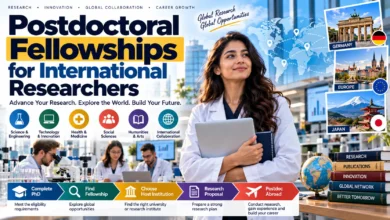
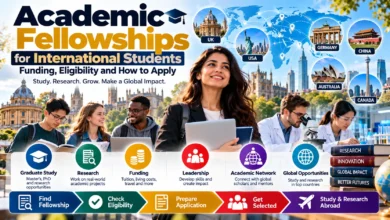
Fully funded fellowships can give international students, researchers and professionals an opportunity to study, conduct research, develop professional skills or participate in leadership programs abroad without carrying the full cost of the experience themselves.
However, “fully funded” does not mean the same thing in every program. One fellowship may cover tuition, living expenses and travel, while another may provide a stipend and other allowances for a specific research or professional placement. Eligibility can also vary by nationality, academic level, professional experience and field.
For international applicants, the key is to identify fellowships that genuinely match their profile and then verify the funding package directly through the official program.
What Is a Fully Funded Fellowship?
A fully funded fellowship is a program that provides substantial financial support for an approved academic, research or professional activity.
Depending on the fellowship, funding may include:
- Tuition or program fees
- Living allowance or stipend
- Accommodation
- Airfare or travel allowance
- Health insurance
- Research expenses
- Training costs
- Visa-related support
- Local transportation
- Conference or networking support
The exact package differs considerably.
For example, Chevening describes its scholarships and fellowships as fully funded programs supported by the UK Foreign, Commonwealth and Development Office and partner organizations.
By contrast, the Marie Skłodowska-Curie Actions (MSCA) Postdoctoral Fellowships provide support through living and mobility allowances, with additional allowances possible in certain circumstances, plus funding for research, training and networking activities.
Therefore, applicants should always read the official funding terms instead of assuming that every expense will be covered.
Who Can Apply for Fully Funded Fellowships?
Fully funded fellowships are available to different types of applicants.
Depending on the program, opportunities may be designed for:
- Undergraduate students
- Master’s students
- PhD candidates
- Postdoctoral researchers
- Early-career researchers
- Academics
- Journalists
- Public-sector professionals
- Nonprofit professionals
- Entrepreneurs
- Mid-career professionals
- Emerging leaders
There is no universal eligibility rule.
For example, MSCA Postdoctoral Fellowships are specifically aimed at researchers who hold a PhD or have successfully defended their doctoral thesis by the application deadline. The European Postdoctoral Fellowship is open to researchers of any nationality, subject to the program’s other requirements.
Chevening, meanwhile, offers different fellowships aimed at particular professional groups and areas of expertise. Its fellowship directory includes programs for mid-career professionals and academics.
What Does “International Applicants” Mean?
An international fellowship may be:
- Open to applicants from many countries.
- Restricted to citizens of specific countries.
- Open internationally but subject to regional eligibility rules.
- Designed for applicants from particular developing or partner countries.
- Open globally but with different requirements depending on nationality.
This distinction is important.
A fellowship appearing in a search for “international applicants” does not necessarily mean that every person worldwide is eligible.
Always look for the official Eligibility, Who Can Apply, or Nationality section.
Where to Find Fully Funded Fellowships
A good fellowship search starts with reliable sources rather than social media posts or unofficial lists.
1. Government Fellowship Programs
Government-funded programs can be strong options for international applicants.
Examples include:
- Chevening
- Fulbright programs
- Government-sponsored research schemes
- Bilateral exchange programs
- Cultural exchange fellowships
Chevening’s official website currently lists multiple fellowship programs and allows applicants to explore programs according to their circumstances.
The important point is to use the official government or program website to verify current eligibility and deadlines.
2. Universities
Universities are a major source of fellowships that don’t always appear on large scholarship websites.
Search:
- University fellowship programs
- Visiting fellowships
- Research fellowships
- Graduate fellowships
- International research programs
- Visiting scholar opportunities
- Departmental fellowships
Don’t limit your search to the university’s main scholarship page.
Individual departments and research centers may advertise opportunities independently.
3. Research Funding Programs
Researchers should investigate dedicated research funding organizations.
The European Union’s Marie Skłodowska-Curie Actions are an important example. MSCA includes Doctoral Networks, Postdoctoral Fellowships, COFUND and other funding actions.
The 2026 MSCA Postdoctoral Fellowship call attracted 21,627 applications, demonstrating how competitive major international research fellowships can be. The 2026 call’s indicative budget was €399.05 million and was expected to fund around 1,600 projects.
This is a useful reminder that even well-funded programs can be highly competitive.
4. International Organizations
International organizations and development institutions sometimes operate fellowship or professional-development programs.
Search their official websites for:
- Fellowship
- Research fellow
- Visiting fellow
- Leadership fellowship
- Professional fellowship
- Policy fellowship
- Emerging leaders
- Visiting researcher
5. Professional Associations
If you work or study in a specialized field, professional associations can be particularly useful.
Look for associations related to:
- Medicine
- Engineering
- Economics
- Public health
- Law
- Environmental science
- Education
- Journalism
- Technology
- International relations
Specialized fellowships can sometimes be a better match than broad international programs.
Search for Fellowships by Career Stage
One of the easiest ways to improve your search is to include your career stage.
Students
Try:
- Fully funded fellowships for undergraduate students
- International fellowships for master’s students
- Graduate fellowships abroad
- Student research fellowships
PhD Candidates
Try:
- International PhD fellowships
- Fully funded doctoral fellowships
- Research fellowships for PhD students
- Doctoral research funding abroad
Postdoctoral Researchers
Try:
- Fully funded postdoctoral fellowships
- International postdoc fellowships
- Postdoctoral research abroad
- European postdoctoral fellowships
MSCA Postdoctoral Fellowships, for example, offer European and Global routes under specific mobility and eligibility rules.
Professionals
Try:
- Fully funded professional fellowships
- International leadership fellowships
- Mid-career fellowships abroad
- Policy fellowships
- Professional exchange fellowships
Search by Field Instead of Using General Keywords
A search for:
fully funded fellowships abroad
can produce thousands of results.
A more focused search could be:
- Fully funded public policy fellowships
- International climate fellowships
- Fully funded engineering research fellowships
- International journalism fellowships
- Fully funded economics fellowships
- International development fellowships
- Research fellowships in artificial intelligence
- Fully funded education fellowships
This helps eliminate opportunities that don’t match your background.
Check the Funding Package Carefully
This is one of the most important steps.
Suppose a program says it provides a “full scholarship.”
That doesn’t automatically tell you whether it covers:
- Flights
- Visa costs
- Housing
- Meals
- Insurance
- Local transport
- Family expenses
- Research equipment
Read the official funding section carefully.
For example, MSCA Postdoctoral Fellowships specify living and mobility allowances and possible family, long-term leave and special-needs allowances, along with research, training and networking funding.
The terminology is different from one program to another, so compare the actual benefits rather than relying on the phrase “fully funded.”
Consider the Cost of Living
Even with substantial funding, your personal financial situation matters.
Before accepting an award, research the destination’s:
- Housing costs
- Food prices
- Public transportation
- Healthcare arrangements
- Visa costs
- Local taxes, where applicable
- Winter clothing or equipment requirements
- Travel costs
A fellowship with a generous stipend may work differently in an expensive city than in a lower-cost location.
Check Nationality Requirements
Nationality is often one of the first eligibility conditions.
Some fellowships are:
- Global
- Country-specific
- Region-specific
- Open to citizens of selected developing countries
- Restricted to specific partner countries
For example, the MSCA European Postdoctoral Fellowship is open to researchers of any nationality, while the Global Postdoctoral Fellowship has additional nationality or long-term-residency conditions.
Therefore, don’t assume that an international fellowship is automatically available to you.
Check Academic Requirements
Read the education requirements carefully.
A fellowship may require:
- Bachelor’s degree
- Master’s degree
- Current enrollment
- PhD
- Completed doctoral defense
- Specific academic discipline
- Academic achievement
Some programs also require a particular number of years of research or professional experience.
The right opportunity is one where your existing qualifications meet the stated criteria.
Check Work Experience Requirements
Professional fellowships frequently place greater emphasis on experience.
You may need evidence of:
- Professional employment
- Leadership
- Research
- Community involvement
- Policy work
- Organizational responsibility
- Project management
Don’t automatically exclude yourself because you haven’t worked for a famous organization.
Relevant experience can come from smaller employers, universities, nonprofits, research projects or community initiatives if it genuinely matches the fellowship’s criteria.
Prepare a Fellowship-Focused CV
A fellowship CV should emphasize what the selection committee is looking for.
Depending on the program, include:
- Education
- Research
- Publications
- Projects
- Employment
- Leadership
- Volunteer work
- Awards
- Presentations
- Professional memberships
- Technical skills
- Languages
For research fellowships, publications and research experience may be especially important.
For leadership programs, measurable responsibilities and community impact may be more relevant.
Write a Strong Personal Statement
A personal statement should answer more than:
Why do you want to go abroad?
A stronger structure is:
Background → current problem or goal → relevant experience → why this fellowship → expected contribution → future plans.
Explain why this specific fellowship makes sense for your career.
Avoid generic statements that could be sent to ten different organizations without changing a word.
Research Proposals for Research Fellowships
If you are applying for a research fellowship, the proposal can be one of the most important parts of the application.
A strong proposal should clearly communicate:
- Research question
- Problem
- Background
- Objectives
- Methodology
- Expected contribution
- Feasibility
- Why the host institution is appropriate
For MSCA Postdoctoral Fellowships, applicants develop their proposal jointly with a host organization, which can be a university, research institution, business, SME or another eligible organization.
That means researchers should begin identifying potential hosts before the application deadline rather than waiting until the final stage.
Find the Right Host Institution
For research-focused fellowships, the host institution can matter almost as much as the funding.
Look for researchers whose work aligns with your interests.
Search:
- University research groups
- Research laboratories
- Faculty profiles
- Research centers
- Published papers
- Current projects
Then determine whether your proposed research genuinely fits the host’s expertise.
This can make your application much more coherent.
Prepare Recommendation Letters Early
Many fellowships require references.
Potential referees may include:
- Professors
- Research supervisors
- Employers
- Academic advisors
- Professional supervisors
Choose people who can provide specific evidence about your abilities.
Give them sufficient notice and provide:
- Your CV
- Fellowship details
- Deadline
- Personal statement draft, if appropriate
- Key achievements they can discuss
Don’t wait until the last few days.
Apply Before the Deadline
Fellowship applications can involve multiple documents and complicated online systems.
Submit early when possible.
This gives you time to deal with:
- Technical problems
- Missing documents
- Reference delays
- Translation requirements
- Verification problems
- Time-zone differences
Always use the official deadline and time zone published by the program.
How Competitive Are Fully Funded Fellowships?
Some are extremely competitive.
The current MSCA Postdoctoral Fellowship cycle provides a useful example: the 2026 call received 21,627 applications and had an indicative budget expected to support around 1,600 projects.
The previous 2025 MSCA Postdoctoral Fellowship call selected 1,610 projects from 17,066 applicants, a reported success rate of about 9.6%.
This doesn’t mean every fellowship has a similar success rate.
It does mean applicants should avoid assuming that meeting the minimum requirements guarantees selection.
Build a Balanced Fellowship List
Don’t apply exclusively to the world’s most famous programs.
Create three groups:
High Competition
Programs where selection is likely to be particularly difficult.
Strong Match
Programs where your academic or professional profile closely matches the criteria.
Specialized Opportunities
Smaller or highly focused fellowships related directly to your field.
This creates a more realistic search strategy.
Beware of “Guaranteed Fully Funded” Offers
Be extremely cautious about anyone claiming:
- Guaranteed fellowship
- Guaranteed selection
- Guaranteed visa
- Guaranteed admission
- Guaranteed funding
Competitive fellowships generally have a formal selection process.
A person asking for money in exchange for “guaranteeing” selection should be treated as a major warning sign.
How to Spot a Fellowship Scam
Before applying, check:
Official website: Can you independently locate the program?
Organization: Is the organization real and verifiable?
Eligibility: Are requirements clearly published?
Deadline: Is there a legitimate application deadline?
Funding: Are financial benefits explained?
Application: Is there a formal application process?
Contact: Can you verify the contact details through the official website?
Be especially cautious if someone asks you to transfer money to a personal account or claims that you have won a fellowship you never applied for.
Can You Apply Without an Agent?
In many cases, yes.
Many fellowship programs have their own official application systems.
Applicants should first check the official program website to determine whether:
- Direct applications are accepted
- A university must nominate applicants
- A host researcher is required
- An authorized partner is involved
- Applications must be submitted through a government portal
For MSCA Postdoctoral Fellowships, researchers prepare their proposal with a host organization, while the host organization submits the application through the relevant EU system.
The correct application route depends on the fellowship.
A Practical 30-Day Fellowship Search Plan
Days 1–5: Define Your Profile
Write down:
- Academic qualification
- Current career stage
- Field
- Research interests
- Professional experience
- Target countries
- Funding requirements
Days 6–10: Research
Find at least 15 potentially suitable fellowships.
Don’t apply immediately.
First verify eligibility.
Days 11–15: Shortlist
Reduce the list to programs where:
- You meet the eligibility criteria
- Your field matches
- The funding works for your circumstances
- The timeline is realistic
Days 16–20: Prepare
Work on:
- CV
- Personal statement
- Research proposal
- References
- Academic documents
- Portfolio
Days 21–25: Review
Compare your application against the fellowship’s selection criteria.
Remove generic statements and unsupported claims.
Days 26–30: Submit
Complete applications through the official channel.
Save:
- Application confirmation
- Reference information
- Submitted documents
- Deadline
- Contact information
Fellowship Tracking Table
A simple spreadsheet can make the process much easier.
| Fellowship | Field | Country | Eligibility | Funding | Deadline | Status |
|---|---|---|---|---|---|---|
| Program A | Research | Germany | PhD | Full/varies | October | Preparing |
| Program B | Leadership | UK | Professionals | Official package | October | Researching |
| Program C | Policy | Europe | Graduates | Varies | November | Shortlisted |
Add an official website column so you can quickly return to the original source.
Frequently Asked Questions
What are fully funded fellowships?
They are fellowship programs that provide substantial financial support toward an approved academic, research or professional activity. The exact benefits vary by program and may include living support, tuition, travel or research costs.
Can international students apply for fully funded fellowships?
Yes, some fellowships are specifically open to international applicants. However, eligibility can be restricted by nationality, academic level, field or career stage.
Are fully funded fellowships completely free?
Not necessarily. “Fully funded” describes the program’s stated financial support, but applicants should check exactly which expenses are covered and whether they must pay any costs themselves.
Can undergraduate students get fully funded fellowships?
Some opportunities accept undergraduate students, although many major fellowship programs target graduate students, researchers or professionals. Search specifically for fellowships matching your academic level.
Are fully funded research fellowships available for international researchers?
Yes. Research-focused programs exist across many disciplines. MSCA Postdoctoral Fellowships, for example, are open to researchers of any nationality under the eligibility conditions of the European Fellowship route.
Do fully funded fellowships guarantee a job?
No. A fellowship can strengthen your academic or professional profile, but it does not guarantee employment afterward.
How can I find legitimate fully funded fellowships?
Start with official government, university, research organization and fellowship-provider websites. Verify the eligibility requirements, funding package and application process directly before submitting documents or making payments.
How to Apply for Fully Funded Fellowships
Although every fellowship has its own process, the general approach is:
- Define your academic or professional goal.
- Search for fellowships matching your profile.
- Check nationality and eligibility requirements.
- Review the complete funding package.
- Check the official deadline.
- Identify any required host institution or supervisor.
- Prepare your CV.
- Write your personal statement or research proposal.
- Request recommendation letters.
- Gather academic and professional documents.
- Complete the official application.
- Review all information carefully.
- Submit before the deadline.
- Save your confirmation.
- Prepare for interviews or further selection stages if required.
For research fellowships such as MSCA Postdoctoral Fellowships, applicants may need to develop the application together with a host organization before submission.
Final Thoughts
Fully funded fellowships can provide valuable opportunities for international applicants, but finding one requires a targeted and realistic approach.
Don’t search only for programs that advertise themselves as “fully funded.” Look at who can apply, what the fellowship actually funds, where the program takes place, what qualifications are required and how competitive the selection process is.
Start with official government programs, universities, research organizations and established fellowship providers. Prepare your documents early and maintain a spreadsheet of deadlines and requirements.
Most importantly, never pay someone simply because they promise guaranteed selection or a guaranteed fellowship. Verify every opportunity through its official source.
A successful fellowship application is usually built around a strong match between the applicant’s background, the program’s objectives and a clear explanation of what the applicant intends to accomplish.