Most Important Skills for the International Job Market: What Global Employers Look For

Finding a job internationally requires more than simply having a university degree or being willing to relocate.
Employers hiring across borders generally need candidates who can perform the job, communicate effectively, adapt to different working environments and continue learning as technology and industries change.
The exact skills required vary significantly by occupation. A software engineer, nurse, accountant, researcher, construction professional and marketing specialist will not need the same technical expertise.
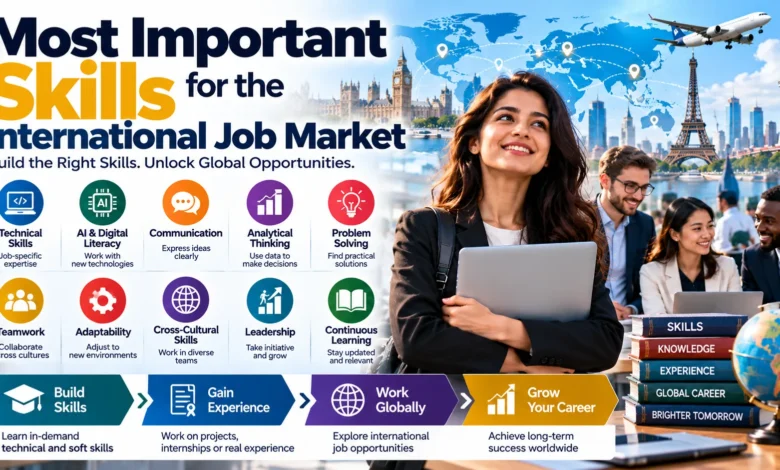
However, several capabilities appear across many international careers: digital literacy, communication, analytical thinking, adaptability, collaboration, problem-solving and occupation-specific expertise.
The World Economic Forum’s Future of Jobs Report 2025 identified analytical thinking as the most sought-after core skill among surveyed employers, while resilience, flexibility and agility, leadership and social influence, creative thinking, motivation and self-awareness, and technological literacy were also among the leading core skills. The report also highlighted AI and big data, networks and cybersecurity, and technological literacy among the fastest-growing skills.
This does not mean every international applicant needs to become an AI engineer or cybersecurity specialist.
It means that people planning international careers should understand both the specialist skills required by their occupation and the broader capabilities that help them work effectively in changing, international environments.
This guide explains some of the most important skills for the international job market and how to develop and demonstrate them.
Important International Career Skills at a Glance
| Skill Area | Why It Can Matter |
|---|---|
| Occupation-specific expertise | Demonstrates that you can perform the actual job |
| Communication | Helps you work with colleagues, clients and managers |
| Digital literacy | Supports work in increasingly technology-enabled workplaces |
| Analytical thinking | Helps evaluate information and solve problems |
| Adaptability | Helps when technologies, markets and responsibilities change |
| Teamwork | Important for cross-functional and international projects |
| AI literacy | Helps professionals understand and responsibly use emerging tools |
| Data literacy | Helps interpret information and make evidence-based decisions |
| Cross-cultural communication | Supports collaboration across countries and cultures |
| Language skills | Can expand opportunities where particular languages are required |
| Project management | Helps organize resources, deadlines and deliverables |
| Continuous learning | Helps maintain relevance as job requirements evolve |
No single candidate needs every skill at the same level.
The right combination depends on your profession.
1. Occupation-Specific Technical Skills
Before discussing communication, adaptability or leadership, there is a fundamental requirement:
You need to be able to perform the job.
International employers generally do not hire someone merely because the candidate wants to work abroad.
They hire people to solve particular problems.
For example:
Software Engineering
Relevant skills might include:
- Programming
- Software architecture
- Databases
- Testing
- Version control
- Cloud technologies
Accounting and Finance
Potential requirements include:
- Financial reporting
- Accounting systems
- Financial modelling
- Spreadsheet analysis
- Budgeting
Engineering
Technical requirements may include:
- CAD
- Engineering calculations
- Simulation
- Industry standards
- Project documentation
Healthcare
Depending on the occupation and jurisdiction:
- Clinical knowledge
- Patient care
- Medical documentation
- Specialist procedures
- Professional licensing
Digital Marketing
Potential skills include:
- Analytics
- SEO
- Advertising platforms
- Content strategy
- Email marketing
- Marketing automation
Technical requirements should therefore be the starting point of an international job-search strategy.
2. Communication Skills
Communication is valuable across many occupations.
International workplaces may involve colleagues, customers and managers from different professional and cultural backgrounds.
Good communication can include:
- Writing clear emails
- Explaining ideas
- Asking appropriate questions
- Listening carefully
- Giving and receiving feedback
- Presenting information
- Communicating technical concepts to non-specialists
- Documenting work accurately
Communication does not simply mean speaking frequently.
It means transferring information clearly and appropriately.
How to Improve Communication
Practice activities such as:
- Writing concise professional emails
- Giving presentations
- Participating in meetings
- Summarizing complex information
- Asking for feedback
- Explaining your work to someone outside your profession
Communication improves through practice rather than simply adding “excellent communication skills” to a CV.
3. English and Other Language Skills
English is widely used in international business, technology, research and many multinational workplaces.
However, language requirements depend on the job and destination.
For example, an international company may operate primarily in English while a customer-facing role requires the local language.
Healthcare, education, legal and public-sector occupations may have formal language requirements.
Therefore, investigate:
- Employer’s working language
- Local language requirements
- Professional licensing requirements
- Required proficiency level
- Whether a recognized language test is necessary
Knowing additional languages can be useful, but do not exaggerate proficiency on your CV.
Use accurate descriptions such as:
- Native
- Professional working proficiency
- Intermediate
- Basic
or the framework specifically requested by the employer.
4. Analytical Thinking
Analytical thinking involves examining information systematically and using evidence to reach useful conclusions.
It is relevant far beyond traditional data-analysis careers.
Examples include:
Marketing: determining why a campaign performed differently than expected.
Engineering: investigating why a system failed.
Finance: analyzing financial performance.
Operations: identifying a bottleneck.
Research: evaluating evidence and testing hypotheses.
Management: comparing possible solutions before making a decision.
The World Economic Forum’s Future of Jobs Report 2025 identified analytical thinking as the most commonly sought core skill among employers participating in its survey.
How to Develop Analytical Thinking
Practice:
- Defining the problem clearly.
- Gathering relevant information.
- Separating evidence from assumptions.
- Identifying patterns.
- Comparing possible explanations.
- Evaluating alternatives.
- Explaining your conclusion.
Working with real problems is usually more useful than memorizing definitions.
5. Problem-Solving
Employers need people who can deal with problems rather than simply identify them.
Problem-solving may involve both technical and interpersonal abilities.
A practical approach is:
Problem → Cause → Options → Evaluation → Action → Result
For example, imagine a website’s conversion rate suddenly falls.
A weak response would be:
“The website isn’t working properly.”
A stronger problem-solving process would investigate:
- When the decline started
- Which pages were affected
- Whether traffic sources changed
- Whether technical errors appeared
- Whether checkout behaviour changed
- Which explanation is supported by evidence
This approach can be applied across professions.
6. Digital Literacy
Digital literacy is increasingly relevant even outside traditional technology careers.
It can include the ability to:
- Use workplace software
- Collaborate online
- Manage digital documents
- Understand basic cybersecurity practices
- Work with spreadsheets
- Use cloud-based systems
- Communicate through digital platforms
- Evaluate online information
- Learn new software
The required level differs by occupation.
A receptionist does not need the same technical expertise as a cloud engineer, but both may work extensively with digital systems.
7. AI Literacy
Artificial intelligence is becoming relevant to a growing range of occupations.
AI literacy does not necessarily mean developing machine-learning models.
For many professionals, it means understanding:
- What AI tools can do
- Where they can fail
- How to evaluate outputs
- How to protect confidential information
- When human review is necessary
- How AI can support legitimate workflows
- Ethical and organizational limitations
The World Economic Forum’s 2025 employer survey identified AI and big data among the fastest-growing skills toward 2030.
That does not mean every employee must become an AI specialist.
Instead, professionals should understand how AI affects their particular occupation.
Examples
A marketer might use AI-assisted tools for research while independently verifying facts.
A programmer might use coding assistance while reviewing security and logic.
An analyst might use automation while validating the underlying data.
A researcher might use appropriate tools while following academic integrity and confidentiality requirements.
The important capability is not merely generating output.
It is knowing whether that output is trustworthy and appropriate.
8. Data Literacy
Organizations generate large amounts of information.
Employees who can understand and interpret data may be better equipped to support decisions.
Data literacy can include:
- Reading charts
- Understanding basic statistics
- Working with spreadsheets
- Recognizing misleading comparisons
- Interpreting trends
- Understanding data quality
- Asking appropriate questions about datasets
Advanced roles may additionally require:
- SQL
- Python
- R
- Power BI
- Tableau
- Statistical modelling
You do not need advanced programming for every career.
Start with the level appropriate to your occupation.
9. Adaptability and Flexibility
International careers often involve change.
You may encounter:
- New technology
- Different management styles
- New regulations
- Different customer expectations
- Remote or hybrid work
- Organizational restructuring
- Different professional cultures
Adaptability means being capable of learning and adjusting when circumstances change.
It does not mean agreeing with everything.
A professionally adaptable employee can evaluate new requirements, learn what is necessary and adjust their approach.
10. Cross-Cultural Communication
International workplaces can bring together people with different languages, communication styles and cultural expectations.
Cross-cultural competence can include:
- Avoiding unnecessary assumptions
- Listening carefully
- Asking clarifying questions
- Communicating respectfully
- Understanding that workplace norms differ
- Adjusting communication to the audience
- Learning local professional expectations
This does not require memorizing stereotypes about nationalities.
In fact, treating every person from a country as if they behave identically can create problems.
Focus on awareness, curiosity and professional respect.
11. Teamwork and Collaboration
Most modern organizations depend on teams.
International companies may have employees distributed across several countries and time zones.
Effective teamwork can involve:
- Sharing information
- Meeting deadlines
- Documenting work
- Helping colleagues
- Asking for help appropriately
- Giving constructive feedback
- Managing disagreement professionally
- Taking responsibility for your tasks
Remote teams may additionally require strong asynchronous communication.
For example, instead of writing:
“It’s not working.”
a useful remote update might explain:
- What is not working
- What you already tried
- What error appeared
- What you need from the other person
Clear communication reduces unnecessary delays.
12. Time Management and Prioritization
Being busy and being productive are not the same.
International professionals may need to manage:
- Multiple projects
- Meetings
- Deadlines
- Different time zones
- Client requests
- Administrative responsibilities
Useful time-management habits include:
- Identifying priorities
- Breaking large projects into smaller tasks
- Setting realistic deadlines
- Communicating delays early
- Protecting focused work time
- Reviewing progress regularly
Do not promise unrealistic deadlines simply to appear productive.
Reliability can be more valuable than repeatedly overpromising.
13. Project Management
Project-management ability can be useful even when “Project Manager” is not your job title.
Projects typically involve:
- Objectives
- Timelines
- Responsibilities
- Resources
- Risks
- Deliverables
Learning to manage these elements can help professionals move into roles with greater responsibility.
Depending on your career, useful technical project-management skills may include:
- Scheduling
- Budgeting
- Risk management
- Documentation
- Stakeholder management
- Project software
Project management also requires communication and organizational skills.
14. Leadership
Leadership is not limited to senior executives.
Employees can demonstrate leadership by:
- Taking ownership
- Helping solve problems
- Mentoring colleagues
- Improving processes
- Coordinating work
- Communicating clearly
- Making responsible decisions
Early-career professionals should focus on developing responsible behaviour before worrying about impressive titles.
Leadership becomes more credible when demonstrated through actual actions.
15. Creative Thinking
Creative thinking involves developing useful new approaches rather than simply artistic creativity.
It can matter in:
- Product development
- Marketing
- Engineering
- Research
- Business strategy
- Technology
- Entrepreneurship
Creative thinking often works best when combined with technical knowledge.
Understanding a problem deeply can make it easier to develop practical alternatives.
16. Continuous Learning
One of the most durable career strategies is maintaining the ability to learn.
Technologies change.
Regulations change.
Industries change.
Job descriptions change.
Professionals should periodically ask:
What has changed in my occupation during the past two years?
and:
Which skills are appearing in jobs I want next?
This prevents career development from becoming disconnected from the market.
Technical Skills in Growing International Fields
Different industries require different technical capabilities.
Technology
Common requirements may include:
- Programming
- Cloud computing
- Cybersecurity
- Data engineering
- AI and machine learning
- Software development
Engineering
Depending on specialization:
- CAD
- Simulation
- Technical standards
- Automation
- Project management
- Data analysis
Finance
Potential skills include:
- Financial modelling
- Accounting
- Spreadsheet analysis
- Data visualization
- Risk analysis
- Regulatory knowledge
Healthcare
Requirements can include:
- Clinical expertise
- Patient care
- Healthcare technology
- Documentation
- Language proficiency
- Professional registration
International applicants should pay particular attention to licensing requirements.
Marketing
Relevant capabilities can include:
- Analytics
- SEO
- Content strategy
- Paid advertising
- Marketing automation
- CRM systems
Supply Chain and Logistics
Skills may include:
- Inventory management
- Procurement
- Logistics planning
- ERP systems
- Data analysis
- Supply-chain optimization
Skills for Remote International Jobs
Remote work adds another set of requirements.
Useful capabilities can include:
- Written communication
- Self-management
- Digital collaboration
- Time-zone coordination
- Documentation
- Independent problem-solving
- Cybersecurity awareness
Remote employees often have fewer opportunities to ask informal questions immediately.
Clear documentation therefore becomes particularly important.
How to Find the Skills Employers Actually Want
Do not rely entirely on generic “top skills” articles—including this one.
Use actual job-market evidence.
Step 1: Select Your Target Role
For example:
Data Analyst
Step 2: Select Your Target Countries
For example:
- Germany
- Canada
- Australia
Step 3: Collect 20–30 Current Job Advertisements
Use employer career pages and reputable job platforms.
Step 4: Record Repeated Requirements
Create a table.
| Requirement | Frequency | Your Level | Priority |
|---|---|---|---|
| SQL | High | Basic | High |
| Excel | High | Advanced | Maintain |
| Power BI | Medium | Basic | Medium |
| Communication | High | Intermediate | High |
| Python | Medium | Beginner | Medium |
This gives you a personalized skills roadmap.
Build a Skills Portfolio
Employers often need evidence rather than a list.
Depending on your career, evidence could include:
- GitHub projects
- Design portfolio
- Data dashboards
- Research publications
- Writing samples
- Marketing case studies
- Engineering projects
- Financial models
- Certifications
- Professional references
Do not include confidential work without permission.
How to Present Skills on Your CV
Avoid an enormous keyword list.
A short skills section can be useful, but your experience should demonstrate those skills.
Instead of:
Skills: SQL, Excel, Power BI, Communication
you could accurately write:
Analyzed monthly sales data using SQL and Excel and developed Power BI dashboards used to summarize regional performance.
The second version provides evidence.
How to Demonstrate Soft Skills
Do not simply write:
Excellent leadership and teamwork skills.
Show what happened.
For example:
Coordinated a four-member research project, organized weekly progress reviews and delivered the final report by the project deadline.
Use examples that are genuinely yours.
Certifications: Are They Worth It?
Certifications can be useful when they:
- Are recognized in your profession
- Teach relevant knowledge
- Validate a specific technical skill
- Are requested by employers
- Support licensing requirements
But certifications should not become the entire career strategy.
Ten certificates with no practical ability may be less useful than one relevant qualification supported by strong project experience.
Research your target jobs before paying for training.
Create Your International Career Skills Plan
A practical six-month framework could look like this:
Month 1: Research
Analyze 20–30 target jobs.
Identify your five biggest skill gaps.
Months 2–3: Learn
Choose one major technical skill and one broader professional skill.
Study and practice both.
Month 4: Build
Create a practical project.
For example:
Data career: analyze a dataset and create a dashboard.
Software career: build an application.
Marketing career: develop a campaign case study.
Design career: create a portfolio project.
Month 5: Demonstrate
Improve your:
- CV
- Professional profile
- Portfolio
- Interview examples
Month 6: Apply and Review
Begin targeted applications.
Track which requirements repeatedly prevent you from qualifying.
Use that information to plan your next learning cycle.
Common Mistakes International Job Seekers Make
Learning Random Skills
A skill is valuable only in context.
Research your target occupation first.
Ignoring Local Requirements
International jobs can require:
- Professional licensing
- Language proficiency
- Specific qualifications
- Local certifications
Collecting Certificates Without Projects
Learning should lead to demonstrable ability.
Focusing Only on Technical Skills
Communication and collaboration can become increasingly important as responsibilities grow.
Focusing Only on Soft Skills
Excellent communication cannot substitute for essential technical competence.
Claiming Skills You Cannot Demonstrate
Interviewers may test them.
Keep your CV accurate.
Assuming One Skill Guarantees Visa Sponsorship
Having an in-demand skill does not automatically produce sponsorship.
Employers, occupations and immigration programmes have separate requirements.
Frequently Asked Questions
What skills are most important for international jobs?
There is no universal list. Occupation-specific expertise is fundamental, while communication, analytical thinking, digital literacy, adaptability, teamwork and problem-solving are broadly useful across many careers.
Which skills are growing because of AI?
Current employer research highlights AI and big data, cybersecurity-related capabilities and technological literacy among rapidly growing areas. Their importance varies by occupation.
Do international employers value soft skills?
Yes, although the importance and assessment method differ by employer and role. Communication, collaboration, adaptability and problem-solving can be particularly relevant in international teams.
Is English enough for an international career?
It depends on the job and country. Some international workplaces operate primarily in English, while other roles require the local language or a specific professional language qualification.
What skills should recent graduates develop?
Start with the technical skills repeatedly requested for your target entry-level roles, then develop communication, teamwork, problem-solving and digital skills through projects, internships and other practical experience.
What is the best skill to learn for working abroad?
There is no single best skill. The right skill depends on your occupation, target country, current abilities and career goals.
Can technical skills help me get visa sponsorship?
Relevant technical expertise may help you qualify for certain jobs, but it does not guarantee sponsorship. Employers and immigration systems have separate eligibility requirements.
Final Takeaway
The international job market does not reward a single universal skill.
Successful candidates generally need a combination of occupation-specific expertise and broader professional capabilities.
Your technical skills demonstrate that you can perform the job.
Communication helps you explain your work.
Analytical thinking helps you make better decisions.
Digital and AI literacy help you work with evolving technology.
Adaptability helps you respond to change.
Cross-cultural communication and teamwork help you operate effectively with people from different backgrounds.
The strongest strategy is therefore not to learn every trending skill.
Instead:
Choose a target career → Research real international vacancies → Identify repeated requirements → Build the relevant skills → Create evidence → Apply strategically.
That turns a generic skills list into a practical international career plan.