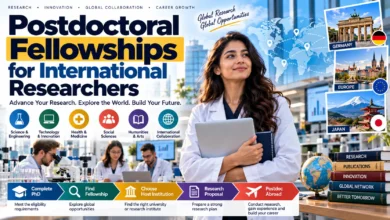
Research fellowships abroad can give researchers the opportunity to work at universities, laboratories, research institutes and other organizations outside their home country while developing specialized knowledge, international collaborations and academic experience.
These opportunities are available across fields ranging from science, engineering and medicine to social sciences, humanities, economics, environmental studies and technology.
Some fellowships provide substantial financial support, potentially including a living allowance, mobility support, travel expenses or research-related funding. Others provide only partial support.
For this reason, applicants should not assume that every international research fellowship is fully funded.
The most effective approach is to identify fellowships appropriate to your career stage, find a suitable host researcher or institution where required, develop a focused research proposal and verify all eligibility and funding conditions through official programme sources.
This guide explains the main types of research fellowships abroad, where to find them, common eligibility requirements, how funding works and how to prepare a competitive application.
Research Fellowships Abroad at a Glance
| Area | What Applicants Should Know |
|---|---|
| Career stages | PhD candidates, postdoctoral researchers and experienced researchers |
| Main destinations | Europe, Germany, Japan, North America and many other research destinations |
| Fields | STEM, medicine, social sciences, humanities and interdisciplinary research |
| Duration | From short research visits to multi-year fellowships |
| Funding | Varies significantly by programme |
| Host institution | Often required before or during the application |
| Research proposal | Commonly an important part of selection |
| Academic record | Usually considered alongside research achievements |
| Publications | Important for many postdoctoral and senior programmes |
| Mobility | Some programmes have specific international mobility requirements |
| Application | Through the official fellowship or host institution |
| Deadlines | Programme-specific and may change each cycle |
Always use the current official call for applications as the definitive source.
What Is a Research Fellowship Abroad?
A research fellowship abroad provides financial or institutional support for a researcher to undertake a defined period of research outside their usual academic or professional environment.
The researcher may work:
- At a university
- In a research institute
- In a laboratory
- With an international research group
- At a public research organization
- In some programmes, with an eligible private-sector or non-academic organization
Unlike a standard taught degree, a research fellowship generally focuses heavily on conducting research.
Depending on the programme, fellows may work independently or under the supervision of a host researcher.
The fellowship may involve:
- Conducting experiments
- Collecting or analyzing data
- Publishing research
- Developing new research methods
- Participating in conferences
- Collaborating with international researchers
- Completing fieldwork
- Developing a new research project
- Building academic networks
The exact structure depends on the programme.
Who Can Apply for International Research Fellowships?
There is no universal eligibility requirement.
Research fellowships exist for different stages of an academic career.
Doctoral Researchers
Some international programmes support current PhD candidates who want to spend part of their doctoral research at another institution.
These may involve:
- Laboratory visits
- Field research
- Archival research
- Collaborative projects
- Specialized training
- Access to research facilities
A doctoral research fellowship does not necessarily fund an entire PhD.
Some programmes support only a specific research period abroad.
Postdoctoral Researchers
Postdoctoral fellowships are among the most common international research opportunities.
Applicants normally need to have completed a PhD or successfully defended their doctoral thesis by a specified point in the application process.
Postdoctoral fellowships can allow researchers to:
- Develop independent research
- Publish new work
- Learn new methodologies
- Join an international laboratory
- Build collaborations
- Develop a stronger academic profile
Major international programmes can impose limits based on the number of years since completion of the PhD.
Experienced Researchers
International fellowships are not limited to newly qualified PhD holders.
Some programmes specifically support researchers who are further into their academic careers.
These opportunities may focus on:
- Independent research
- International collaboration
- Sabbatical research
- Advanced scientific projects
- Knowledge exchange
- Institutional partnerships
Eligibility may depend on academic achievements rather than simply age.
Research Fellowship vs Scholarship: What Is the Difference?
The terms are sometimes used interchangeably, but they often describe different types of support.
| Research Fellowship | Scholarship |
|---|---|
| Usually centered on research | Often supports formal study |
| May require a PhD | Frequently available at bachelor’s, master’s or PhD level |
| Research proposal can be central | Academic admission may be central |
| Often involves a host researcher | Usually linked to an academic programme |
| May be postdoctoral | Commonly degree-focused |
| Can involve independent research | Usually supports completion of a qualification |
Programme terminology varies.
Always examine what the funding actually supports rather than relying solely on whether it is called a fellowship or scholarship.
What Does “Fully Funded Research Fellowship” Mean?
“Fully funded” is widely used online, but applicants should verify exactly what a programme covers.
Funding may include some combination of:
- Monthly living allowance
- Salary or fellowship payment
- Travel expenses
- Mobility allowance
- Research costs
- Health insurance
- Family allowance
- Relocation support
- Conference expenses
- Visa-related assistance
A fellowship that provides a monthly stipend is not automatically fully funded.
For example, accommodation, dependants’ costs or research expenses might remain the fellow’s responsibility.
Always read the official funding conditions.
Major Research Fellowship Programmes to Explore
The following programmes illustrate the range of international research opportunities available.
Eligibility and calls can change, so they should be treated as starting points for research rather than a permanent list of open opportunities.
1. Marie Skłodowska-Curie Actions Postdoctoral Fellowships
The Marie Skłodowska-Curie Actions (MSCA) Postdoctoral Fellowships support researchers who already hold a PhD and want to undertake research abroad while developing new skills.
The programme includes two main routes.
European Postdoctoral Fellowships
These allow researchers to move within Europe or come to Europe from another part of the world.
Researchers of any nationality can apply, subject to the programme’s eligibility and mobility rules.
The fellowships generally last one to two years.
Global Postdoctoral Fellowships
These support eligible researchers connected to EU Member States or Horizon Europe Associated Countries in conducting an outgoing research phase in a non-associated third country followed by a mandatory return phase in Europe.
Global fellowships generally last two to three years.
Applicants must meet specific nationality or long-term residence requirements.
Important MSCA Eligibility Points
Applicants should generally:
- Hold a PhD by the application deadline, with certain successfully defended theses also recognized;
- Have no more than the programme’s permitted amount of post-PhD research experience;
- Meet the applicable mobility rule;
- Develop the proposal together with an eligible host organization.
MSCA funding includes support associated with living and mobility, with additional allowances available in qualifying circumstances.
Because mobility requirements are central to MSCA eligibility, applicants should check them before spending significant time developing a proposal.
2. Humboldt Research Fellowship in Germany
The Alexander von Humboldt Foundation offers the Humboldt Research Fellowship for highly qualified researchers from outside Germany.
The programme supports researchers across disciplines who want to conduct research in Germany in cooperation with a host at a German research institution.
It has routes for both:
- Postdoctoral researchers
- Experienced researchers
The official programme currently describes research stays ranging from 6 to 24 months depending on the researcher’s career stage and programme conditions.
Applicants need to identify an academic host in Germany.
The programme supports researchers from countries worldwide, subject to its eligibility conditions.
As of September 2026, the Foundation states that the maximum number of applications for the current call has been reached and that its next call is scheduled to open on November 15, 2026. Applicants should check the official programme page when preparing an application rather than relying on an old deadline.
3. JSPS Postdoctoral Fellowships for Research in Japan
The Japan Society for the Promotion of Science (JSPS) provides fellowship programmes that allow overseas researchers to conduct collaborative research at Japanese universities and research institutions.
Its Standard Postdoctoral Fellowship covers research across:
- Humanities
- Social sciences
- Natural sciences
The Standard programme currently provides fellowships lasting 12 to 24 months.
Applicants need an eligible host researcher and institution in Japan.
The application structure is particularly important: for the open-call route, applications are submitted to JSPS through the Japanese host institution rather than simply being submitted independently by the overseas researcher.
JSPS also operates shorter programmes for specified groups of researchers, so applicants should identify the exact programme matching their nationality, career stage and research circumstances.
4. Other University and Research-Institute Fellowships
Many international fellowships are not part of a single large government programme.
Universities and research institutes can advertise their own:
- Postdoctoral fellowships
- Visiting research fellowships
- Research associate positions
- Visiting scholar programmes
- Institute fellowships
- Laboratory fellowships
- Research residencies
These opportunities can sometimes be more closely aligned with a particular research topic than a large international programme.
Search the official websites of universities and institutes relevant to your field.
Which Countries Offer Research Fellowship Opportunities?
There is no single best country for every researcher.
Your best destination depends on your discipline, research question, host availability, facilities, funding and career goals.
Germany
Germany hosts universities, research institutes and major fellowship programmes.
Researchers may explore:
- Humboldt Foundation programmes
- University postdoctoral fellowships
- Research institute opportunities
- Project-funded postdoctoral positions
Germany can be particularly relevant when you can identify a research group closely aligned with your project.
Japan
Japan offers opportunities through JSPS and individual universities and research institutions.
Research fields can include humanities, social sciences and natural sciences.
Finding an appropriate Japanese host can be an important part of the fellowship process.
European Countries
European research mobility is supported through programmes such as MSCA alongside national and university-based opportunities.
Depending on the programme, researchers may work in:
- France
- Netherlands
- Sweden
- Denmark
- Finland
- Belgium
- Austria
- Spain
- Italy
- Ireland
- Other European countries
Do not assume that one application provides access to all European countries.
Host and mobility rules vary.
United States and Canada
Universities, research institutes, foundations and laboratories in North America advertise postdoctoral and visiting research opportunities.
Funding structures can vary significantly.
Some opportunities are fellowships awarded directly to researchers, while others are salaried postdoctoral appointments attached to a principal investigator’s funded project.
Understand which model applies before applying.
Australia and New Zealand
Universities and research institutions in Australia and New Zealand also recruit international researchers for postdoctoral and research positions.
Check university career portals and individual research centres for current opportunities.
Which Research Fields Are Supported?
International research funding exists across many disciplines.
Science and Engineering
Potential areas include:
- Physics
- Chemistry
- Biology
- Mathematics
- Materials science
- Mechanical engineering
- Electrical engineering
- Civil engineering
- Chemical engineering
Technology
Opportunities may cover:
- Artificial intelligence
- Machine learning
- Computer science
- Cybersecurity
- Robotics
- Data science
- Human-computer interaction
- Quantum technologies
Medicine and Health Research
Possible fields include:
- Public health
- Biomedical science
- Neuroscience
- Epidemiology
- Clinical research
- Global health
Professional licensing requirements may apply when research involves clinical practice.
Environmental Research
Potential areas include:
- Climate science
- Renewable energy
- Biodiversity
- Sustainability
- Environmental policy
- Marine science
- Conservation
Social Sciences
Research fellowships may support:
- Economics
- Sociology
- Political science
- International relations
- Development studies
- Public policy
- Education
- Psychology
Humanities
Opportunities also exist in:
- History
- Philosophy
- Literature
- Linguistics
- Cultural studies
- Archaeology
- Religious studies
Researchers in humanities and social sciences should not assume international fellowships are exclusively for laboratory-based STEM disciplines.
How to Find Research Fellowships Abroad
Finding the right programme requires more than searching “fully funded fellowship.”
Start With Your Research Topic
Define your research area as specifically as possible.
Instead of searching:
Research fellowship abroad
try:
Postdoctoral fellowship renewable energy Germany
or:
International fellowship computational biology Europe
or:
Visiting research fellowship political science
Specific searches are more likely to produce relevant opportunities.
Search Funding Organizations
Check the official websites of organizations that fund international research mobility.
Look for:
- Current calls
- Eligibility
- Research fields
- Mobility rules
- Funding
- Deadlines
- Host requirements
Bookmark relevant programme pages.
Search University Websites
Universities may advertise fellowships under:
- Careers
- Research
- Postdoctoral Opportunities
- Fellowships
- Vacancies
- Research Funding
Individual departments and laboratories may also advertise opportunities separately.
Search Research Institutes
Independent research institutes can provide opportunities that do not appear on general university job boards.
Identify the leading institutes working in your research area and monitor their official websites.
Follow Researchers in Your Field
Academic networking can help you discover:
- New projects
- Funded laboratories
- Upcoming fellowship calls
- Research collaborations
- Postdoctoral vacancies
The purpose is not to ask every researcher for a job.
Instead, build informed professional relationships within your field.
Finding a Host Researcher
Many prestigious international fellowships require or strongly depend on a host researcher.
Choosing a host should therefore be a research decision, not simply a search for someone willing to sign an application.
A suitable host should have expertise relevant to your proposed project.
Research:
- Their recent publications
- Current research projects
- Laboratory or research group
- Institution’s facilities
- Collaborators
- Previous fellows
- Research methodology
Ask yourself:
Can this host and institution genuinely support my project?
If the answer is unclear, continue researching.
How to Contact a Potential Research Host
A first email should usually be concise.
Include:
- Your name
- Current academic position
- Research field
- Relevant PhD or research background
- Specific reason you contacted that researcher
- Short explanation of your proposed project
- Fellowship programme you intend to target
- Why their group would be a suitable host
Attach a concise academic CV if appropriate.
Do not send an identical mass email to dozens of professors.
A personalized message demonstrating knowledge of the researcher’s work is more credible.
What Documents Are Commonly Required?
Requirements vary, but research fellowship applications may request:
- Academic CV
- Research proposal
- PhD certificate
- Degree transcripts
- Publication list
- Host statement or invitation
- Motivation statement
- Recommendation letters
- Research plan
- Career-development plan
- Ethics information
- Budget information
- Proof of language proficiency where applicable
Some programmes require the host institution to submit part or all of the application.
For example, JSPS’s open-call route requires submission through an eligible Japanese host institution.
Always read the programme instructions before preparing documents.
How to Write a Strong Research Proposal
The research proposal is often one of the most important components of a fellowship application.
A strong proposal should explain not only what you want to study but why the research matters and why the proposed host is suitable.
1. Define the Research Problem
Explain the specific question or problem your project addresses.
Avoid an excessively broad topic.
2. Establish the Research Gap
Show what existing research has already established.
Then explain what remains unknown or unresolved.
3. Present Clear Objectives
State what your project intends to achieve.
Objectives should be realistic within the fellowship period.
4. Explain Your Methodology
Describe how you will answer your research question.
Depending on your discipline, this might involve:
- Experiments
- Surveys
- Interviews
- Statistical analysis
- Computational modelling
- Archival research
- Fieldwork
- Comparative analysis
5. Explain Why the Host Matters
A fellowship proposal should make clear why the research needs to be conducted at the proposed institution.
This might involve:
- Specialized equipment
- Unique datasets
- Particular academic expertise
- Research infrastructure
- Existing collaboration
6. Provide a Realistic Timeline
Divide the research into logical phases.
For example:
| Phase | Activity |
|---|---|
| Months 1–3 | Literature review and research setup |
| Months 4–8 | Data collection or experimental work |
| Months 9–12 | Analysis |
| Months 13–16 | Additional research and validation |
| Months 17–20 | Manuscript preparation |
| Months 21–24 | Publication, dissemination and final outputs |
The exact timeline should match the project and fellowship duration.
7. Explain Expected Outcomes
Potential outputs could include:
- Journal articles
- Conference presentations
- Research datasets
- Software
- Policy recommendations
- New methodologies
- Future collaborations
Do not promise unrealistic results.
Publications and Research Record
For many postdoctoral fellowships, reviewers will consider your research track record.
This can include:
- Peer-reviewed publications
- Conference papers
- Research projects
- Thesis quality
- Awards
- Patents
- Software
- Datasets
- Other discipline-appropriate outputs
Publication expectations vary significantly between disciplines.
A humanities researcher should not necessarily be evaluated using the same publication pattern as a biomedical scientist.
Present your achievements accurately and in appropriate context.
Do You Need a Strong Publication Record?
Competitive postdoctoral fellowships generally value evidence of research potential.
However, this does not mean applicants need an enormous publication list.
Selection can also consider:
- Quality of research
- Independence
- Project originality
- Research fit
- Methodology
- Host environment
- Career potential
- Collaboration opportunities
Programme-specific selection criteria should guide your application strategy.
How to Apply for Research Fellowships Abroad
Step 1: Define Your Career Stage
Determine whether you need a:
- Doctoral research fellowship
- Postdoctoral fellowship
- Visiting researcher fellowship
- Experienced researcher fellowship
This immediately narrows your search.
Step 2: Choose Your Research Direction
Write a short description of your research question and objectives.
Step 3: Identify Suitable Programmes
Compare:
- Eligibility
- Career-stage requirements
- Nationality conditions
- Mobility rules
- Duration
- Funding
- Host requirements
Create a shortlist rather than applying randomly.
Step 4: Identify Potential Hosts
Research academics and institutions whose work aligns with your project.
Contact them well before the deadline.
Step 5: Develop the Proposal With Your Host
Where the programme expects host involvement, treat proposal development as a collaborative process.
Ask for feedback on:
- Research scope
- Methodology
- Facilities
- Timeline
- Feasibility
Step 6: Prepare Supporting Documents
Request recommendation letters early.
Obtaining academic documents can also take time.
Step 7: Follow the Application Instructions Exactly
Some applications are submitted by the researcher.
Others involve the host.
Still others require institutional submission.
Do not assume every fellowship uses the same process.
Step 8: Review Before Submission
Check:
- Eligibility
- Formatting
- Page limits
- Required attachments
- References
- Budget
- Host documentation
- Deadline and time zone
A strong research proposal can still become ineligible because of an administrative error.
How Early Should You Start?
Major fellowship applications can require substantial preparation.
Starting several months before the deadline can give you time to:
- Identify a host
- Develop the project
- Gather documents
- Obtain recommendation letters
- Refine methodology
- Complete institutional approvals
Some host institutions also set internal deadlines earlier than the funder’s deadline.
JSPS explicitly warns that Japanese host institutions may impose their own earlier submission deadlines.
Therefore, never rely only on the public final deadline.
Common Reasons Fellowship Applications Struggle
Poor Host Fit
A prestigious university is not automatically the best host.
The research environment needs to fit the proposed project.
An Overly Broad Proposal
Trying to solve a huge research problem within a short fellowship can make the proposal appear unrealistic.
Weak Research Gap
Reviewers need to understand why the research is necessary.
Generic Applications
Different fellowships have different objectives.
A proposal written for one programme may need substantial revision before being submitted elsewhere.
Ignoring Mobility Rules
Some international programmes specifically require researchers to move countries.
For example, MSCA Postdoctoral Fellowships have defined mobility requirements.
Missing Internal Deadlines
A university may need time to approve an application before external submission.
Assuming Funding Covers Everything
Verify every allowance and expense before accepting a fellowship.
How to Evaluate a Fellowship Offer
Receiving an offer is exciting, but researchers should evaluate the complete arrangement.
Check:
Financial Support
Is the funding sufficient for the destination’s living costs?
Research Expenses
Who pays for equipment, laboratory work, fieldwork and conference travel?
Family Support
If relocating with dependants, check whether family allowances exist.
Insurance
Determine what coverage is provided.
Visa and Immigration
Establish who provides supporting documentation and which expenses are covered.
Intellectual Property
Understand the institution’s rules regarding inventions, software, datasets and other research outputs.
Publication Rights
Confirm whether there are restrictions affecting publication.
Research Independence
Understand how much control you will have over the project.
Research Fellowship Scam Warning
Researchers should also be careful with fraudulent fellowship advertisements.
Warning signs can include:
- Guaranteed fellowship selection
- Requests for unusual application payments
- Unofficial email addresses
- Fake university websites
- Requests for bank information before legitimate selection
- Unverifiable supervisors
- Unrealistic funding claims
- Pressure to pay immediately
A legitimate fellowship should be verifiable through the official funder, university or research institution.
If a third-party website announces a fellowship, locate the original programme before applying.
A Practical Fellowship Search Strategy
Create a research-fellowship tracker.
| Fellowship | Country | Career Stage | Host Required | Funding | Deadline | Status |
|---|---|---|---|---|---|---|
| Programme A | Germany | Postdoc | Yes | Verify official terms | Date | Researching |
| Programme B | Japan | Postdoc | Yes | Verify official terms | Date | Host contacted |
| Programme C | Europe | Postdoc | Yes | Verify official terms | Date | Proposal drafting |
Update it whenever a programme announces a new call.
This prevents you from confusing deadlines and requirements between fellowships.
Frequently Asked Questions
Can international researchers apply for fellowships abroad?
Yes. Many research fellowships are specifically designed to promote international research mobility. Nationality, residence, career-stage and mobility requirements vary by programme.
Do I need a PhD for a research fellowship?
Not always.
Some fellowships support doctoral researchers, while postdoctoral fellowships generally require a PhD or an equivalent programme-specific status.
Are research fellowships abroad fully funded?
Some provide extensive financial support, but funding differs by programme. Check living allowances, travel, research costs, insurance and family support separately.
Can I apply without finding a supervisor first?
It depends on the programme.
Many fellowships require a host researcher or institution as part of the application. Some university programmes match selected fellows with supervisors differently.
Can researchers from any field apply?
Some programmes support a broad range of disciplines. For example, JSPS’s Standard Postdoctoral Fellowship covers humanities, social sciences and natural sciences, while MSCA Postdoctoral Fellowships are broadly open across research disciplines subject to programme rules.
Can I apply for several fellowships at the same time?
This depends on each programme’s rules. Applicants should check restrictions concerning simultaneous applications, duplicate funding and overlapping fellowship periods.
Is a fellowship guaranteed if a professor agrees to host me?
No.
Host support may be required, but the funding organization generally conducts its own competitive evaluation.
Final Takeaway
Research fellowships abroad can help doctoral, postdoctoral and experienced researchers develop their work in an international research environment.
The strongest starting point is not simply searching for the highest stipend or the most famous university.
Instead, identify:
- Your career stage
- Your research question
- Suitable countries and institutions
- Relevant fellowship programmes
- A strong host, where required
- The programme’s mobility and eligibility rules
- The exact funding package
Then build a research proposal that clearly explains the problem, research gap, methodology, host fit, timeline and expected outcomes.
Major programmes such as Marie Skłodowska-Curie Actions Postdoctoral Fellowships, the Humboldt Research Fellowship and JSPS Postdoctoral Fellowships for Research in Japan demonstrate how different international fellowship models can be. Their nationality rules, mobility requirements, application processes, duration and funding structures are not interchangeable.
Always verify the latest call on the official programme website before preparing or submitting an application.