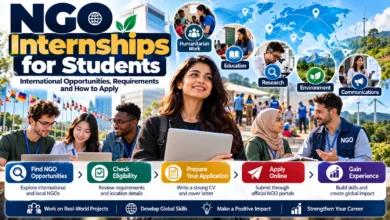
Graduating from university creates an unusual career problem. You may have the academic qualification employers want but not yet have the professional experience required for many entry-level jobs. For graduates hoping to build an international career, that gap can feel even wider.
International internships for recent graduates can provide one way to bridge it. Depending on the employer and program, graduates may work alongside international teams, develop practical skills, contribute to real projects, and learn how organizations operate outside their home country’s employment environment.
But there is an important complication: not every internship advertised internationally is available after graduation.
Some organizations accept recent graduates, others require applicants to remain enrolled at a university, and certain programs are designed exclusively for current students. Even within the same organization, eligibility can differ between internship schemes.
Recent graduates therefore need a more targeted strategy than simply searching for “internships abroad.”
This guide explains where to find legitimate international internships, how to determine whether you qualify, what employers may expect, how to prepare applications, and what to check before accepting an opportunity abroad.
Quick Guide for Recent Graduates
| Question | What to Check |
|---|---|
| Can graduates apply? | Check the exact internship eligibility rules |
| Degree requirement | Bachelor’s, master’s, PhD, or field-specific requirements may apply |
| Graduation window | Some programs define how recently you must have graduated |
| Experience | Requirements range from none to relevant previous experience |
| Payment | Paid and unpaid arrangements both exist |
| Location | In-person, hybrid and remote opportunities may be available |
| Visa/work authorization | Depends on the country and organization |
| Application | Usually through the employer’s official careers portal |
| Best time to search | Ideally before graduation and throughout the first year afterward |
Why Internships Can Still Make Sense After Graduation
Internships are often associated with university students, but graduate-focused opportunities can serve a different purpose.
For a student, an internship might primarily provide exposure to a profession. A recent graduate is more likely to use one as a transition into a specific career field.
That distinction should affect how you search.
Instead of applying to anything labeled “internship,” look for positions that help you develop experience relevant to the work you actually want to pursue.
For example, a graduate interested in international development could prioritize opportunities involving research, program management, economics, communications, monitoring and evaluation, or policy analysis.
Someone interested in technology might look for software engineering, data analysis, cybersecurity, product, or technical research internships.
A strong internship should move your professional profile in a useful direction rather than simply adding another line to your CV.
The Most Important Eligibility Question: Are Graduates Actually Accepted?
This should be the first thing you verify.
The word “internship” does not tell you whether graduates qualify.
Current official programs illustrate the difference clearly. The United Nations Careers portal describes internships as opportunities for students and recent graduates, while individual vacancies provide their own qualifications and conditions.
By contrast, the World Bank Group’s current Pioneers internship program is designed around students. Its postgraduate track requires candidates to be currently pursuing a master’s degree or PhD, while its undergraduate track targets final-year students.
This distinction is crucial.
A graduate could spend hours preparing an excellent application and still be automatically ineligible because enrollment is mandatory.
Before doing anything else, look for wording such as:
- “recent graduates may apply”;
- “graduated within the last 12 months”;
- “graduated within the last two years”;
- “currently enrolled students”;
- “must remain enrolled during the internship”;
- “final-year students”;
- “bachelor’s degree required”; or
- “graduate degree required.”
Do not assume eligibility when the advertisement is unclear. Verify it through the employer’s official information.
What Types of International Internships Should Graduates Consider?
Rather than organizing your search only by country, it is often more useful to search by career purpose.
International Organizations and Development
Graduates interested in economics, development, humanitarian affairs, public policy, communications, law, international relations, environmental issues, and related areas may investigate international organizations.
The United Nations Secretariat, for example, maintains internship opportunities through its official Careers portal. The same portal also provides other early-career pathways, so graduates should distinguish internships from employment programs rather than treating them as interchangeable.
The wider international-development sector includes multilateral institutions, development organizations, research institutions, nonprofits, foundations, and policy organizations.
Eligibility varies substantially between them.
Research Internships
Research experience can be especially useful for graduates considering postgraduate study or research-intensive careers.
Possible environments include:
- universities;
- research institutes;
- laboratories;
- policy centers;
- think tanks;
- development organizations; and
- corporate research teams.
Research internships can involve literature reviews, data collection, quantitative or qualitative analysis, laboratory work, research communication, or project support.
Graduates planning a master’s or PhD should consider whether an internship develops methods or subject knowledge relevant to their future academic direction.
Business and Finance Internships
International companies may recruit interns in areas such as:
- finance;
- accounting;
- marketing;
- operations;
- supply chain;
- consulting;
- business analysis;
- sales;
- human resources; and
- corporate strategy.
However, large-company internships are frequently structured around university recruitment cycles. Recent graduates should therefore check whether a company’s graduate program or entry-level analyst role is actually a better fit.
Do not assume that an internship is automatically easier to obtain than a graduate job.
Technology and Digital Careers
Technology provides opportunities across borders because many technical skills can be demonstrated through projects and portfolios.
Graduates might encounter internships involving:
- software development;
- data analytics;
- cloud computing;
- cybersecurity;
- product management;
- UX/UI design;
- machine learning;
- quality assurance; and
- technical support.
For these roles, practical evidence can matter significantly. A graduate with relevant projects, code samples, portfolio work, or technical certifications may be able to demonstrate capability even without extensive employment history.
Communications and Creative Work
International organizations and companies also recruit early-career candidates for communications-related work.
This can include digital communications, content production, public relations, graphic design, video production, social media, journalism, and multimedia.
A portfolio can be particularly valuable here because it gives recruiters direct evidence of what you can produce.
Internship or Graduate Job: Which Should You Target?
Recent graduates should search both.
This is an important point because concentrating exclusively on internships can unnecessarily restrict your opportunities.
You may already qualify for positions described as:
Graduate programme
Trainee
Junior analyst
Research assistant
Associate
Entry-level officer
Graduate scheme
Junior developer
Project assistant
Early-career programme
Some organizations deliberately use these categories instead of internships for people who have completed university.
For example, the United Nations points recent graduates with limited professional experience toward early-career pathways in addition to internships.
Your search should therefore be based on your career stage, not on a single job title.
Related: International Internships for Students: How to Find Opportunities Abroad
Where to Find Legitimate International Internships
Start as close to the original employer as possible.
Official Organization Career Pages
If you already know organizations you would like to work for, bookmark their career portals.
This is particularly effective for large employers that recruit throughout the year.
The United Nations Careers site, for instance, allows applicants to search openings by location and area of expertise, with applications handled through its official recruitment system.
University Career Services
Your university can remain useful even after graduation.
Some institutions provide alumni with career-platform access, employer events, vacancy databases, CV reviews, and recruitment support for a limited period or indefinitely.
Check before assuming that your access ended on graduation day.
Professional Associations
Professional organizations can be useful when you already know your field.
An engineering graduate should investigate engineering bodies and employers. A public-policy graduate may find more relevant opportunities through policy institutes and development organizations.
A focused search generally produces better results than browsing thousands of unrelated internships.
Employer Job Alerts
Create alerts on employers’ official career portals where available.
Recruitment windows can be short, and alerts reduce the need to repeatedly search the same websites manually.
How to Search More Effectively
Searching “international internship” is too broad.
Combine your profession, career stage, and target location.
Examples include:
“recent graduate data internship Europe”
“international development internship recent graduate”
“graduate research internship economics”
“entry level environmental internship international”
“recent graduate communications internship”
“graduate trainee international business”
Also try replacing “internship” with terms such as “trainee,” “graduate programme,” “junior,” and “entry level.”
This can reveal opportunities you would otherwise miss.
Build a Shortlist Instead of Applying Everywhere
More applications do not automatically mean better results.
Create a spreadsheet and record:
- organization;
- position;
- country;
- eligibility;
- graduation requirement;
- required skills;
- paid/unpaid status;
- work arrangement;
- visa information;
- deadline;
- official application link; and
- application status.
Then evaluate opportunities based on eligibility and career relevance.
A position that matches your education and skills deserves more preparation than an internship where you meet only the minimum requirements.
Skills Employers May Look For
Requirements vary by profession, but several capabilities are useful across international workplaces.
Communication
International teams often involve people with different professional and cultural backgrounds.
Clear written and verbal communication can therefore be important even in technical positions.
Digital Skills
Depending on the field, useful skills could include spreadsheets, presentation software, statistical tools, programming languages, project-management platforms, design software, or specialized research applications.
List only skills you can actually demonstrate.
Research and Analytical Ability
Research does not belong exclusively to academic careers.
Organizations may need interns who can gather information, evaluate evidence, analyze datasets, summarize findings, or prepare reports.
University assignments, dissertations, research projects, and capstones can provide relevant examples.
Teamwork
Recent graduates sometimes underestimate university teamwork.
A substantial group project can demonstrate planning, coordination, problem-solving, conflict management, and accountability when explained properly.
Language Skills
Language requirements depend on the organization.
For example, UN career information states that English and French are its working languages and that excellent command of either is required for UN employment, while additional languages can be an asset. Individual internship requirements should still be checked separately.
How to Build a CV Without Much Work Experience
A graduate CV does not need to look empty simply because you have not held a full-time professional position.
Relevant evidence can come from:
- academic projects;
- dissertations;
- research;
- part-time work;
- previous internships;
- volunteering;
- student organizations;
- competitions;
- independent projects;
- portfolios; and
- technical work.
The key is relevance.
Suppose you completed a university research project involving 5,000 survey responses. Instead of writing:
“Completed university research project”
explain the actual work: designed or cleaned data, performed analysis, interpreted findings, collaborated with a team, and presented results.
That tells the recruiter what you can do.
Never invent experience to make your CV appear stronger.
Write a Different Application for Each Serious Opportunity
A generic cover letter usually says:
“I recently graduated and would like to gain international experience.”
That tells an employer very little.
A stronger application answers three questions:
Why this role?
Identify specific responsibilities that fit your skills or direction.
Why this organization?
Demonstrate that you understand what the organization does.
Why you?
Connect relevant academic projects, technical abilities, research, volunteering, previous experience, or portfolio work to the internship requirements.
The United Nations’ application guidance follows a similar principle: applicants are instructed to understand the requirements and use their motivation statement to explain how their qualifications, experience, and competencies fit the position.
Paid vs. Unpaid International Internships
Never assume an internship is paid because it is offered by a large or well-known organization.
Compensation policies differ between organizations and programs.
Before accepting an international internship, calculate the real financial impact:
Income
- salary or stipend;
- travel allowance;
- housing support;
- meal allowance; and
- other confirmed assistance.
Costs
- airfare;
- accommodation;
- local transportation;
- visa fees;
- insurance;
- food;
- deposits; and
- other living expenses.
A prestigious internship can still be financially impractical if you must fund several months in an expensive city without adequate compensation.
Likewise, do not assume all international-organization internships are unpaid. The current World Bank Group Pioneers program, for example, describes its internships as paid with an hourly salary, although its current eligibility is primarily structured around enrolled students.
Always verify the specific vacancy.
Visa and Work Authorization: Check Before Making Plans
Being selected for an internship does not automatically grant permission to enter or work in another country.
Requirements depend on factors such as:
- your nationality;
- destination;
- internship duration;
- compensation;
- employer;
- immigration category; and
- whether the organization provides visa assistance.
The internship advertisement may explain whether sponsorship or assistance is available.
If it does not, ask the employer and independently check the relevant government’s official immigration information.
Do not buy non-refundable flights or make major relocation commitments based solely on assumptions about visa eligibility.
How to Recognize Suspicious Internship Offers
International applicants can be attractive targets for recruitment scams because relocation and visa processes are unfamiliar.
Be cautious if someone:
- guarantees selection without a proper recruitment process;
- requests money in exchange for a job offer;
- demands payment through an unusual personal account;
- uses an email domain unrelated to the organization;
- promises a guaranteed visa;
- refuses to provide written terms;
- pressures you to send money immediately; or
- advertises an opportunity you cannot verify on the claimed employer’s official channels.
Also be careful with websites that copy legitimate vacancies but replace the real application link.
Whenever possible, locate the employer independently and apply through its official recruitment portal.
How to Apply
There is no universal application system for international internships.
A practical process is:
- Identify organizations related to your career field.
- Check whether the specific opportunity accepts recent graduates.
- Read the complete vacancy on the official employer website.
- Confirm location, duration, compensation, and visa conditions where stated.
- Tailor your CV to the position.
- Prepare a targeted cover letter or motivation statement when required.
- Gather transcripts, references, portfolio items, or other requested documents.
- Submit through the official application system before the stated deadline.
- Keep a record of your application.
- Continue applying elsewhere rather than waiting for one result.
Applicants should check the official organization or program website for the current application instructions.
For UN Secretariat opportunities, the official Careers portal provides searchable openings and application guidance.
Frequently Asked Questions
Can I apply for international internships after graduating?
Yes, some programs explicitly accept recent graduates. Others require current university enrollment. Always check the eligibility section of the specific vacancy.
How long after graduation am I considered a recent graduate?
There is no universal definition. Employers may use different graduation windows, while some do not use a fixed period at all. Follow the definition stated by the individual program.
Do I need previous work experience?
Not always. Internships are often designed for early-career applicants, but relevant academic projects, research, volunteering, portfolios, and previous internships may strengthen an application.
Can I get an international internship without a master’s degree?
Yes. Many opportunities accept bachelor’s graduates, while others require graduate-level study. The required degree depends on the role.
Are international internships always paid?
No. Compensation differs between organizations and sometimes between programs within the same organization. Verify the specific vacancy before applying.
Can an internship lead to a permanent job?
It can provide experience and professional contacts that may help future applications, but an internship should never be treated as a guarantee of employment.
Should I apply for internships or entry-level jobs after graduation?
Usually both. Recent graduates may qualify for internships, graduate schemes, trainee positions, junior roles, research assistantships, and other entry-level opportunities. Searching across these categories gives you a broader view of the market.
Final Takeaway
International internships for recent graduates can be valuable when they solve a specific early-career problem: you have education and potential but need an opportunity to turn those foundations into practical professional experience.
The most important part of the search is not finding the largest number of internships. It is finding opportunities for which graduates are actually eligible and where the work contributes meaningfully to your intended career.
Search beyond the word “internship.” Include graduate programs, trainee positions, junior roles, research opportunities, and other early-career pathways. Build a focused shortlist, adapt serious applications to the position, and use academic projects as evidence of skills when professional experience is limited.
For opportunities abroad, evaluate compensation and relocation costs carefully and verify immigration requirements through official sources. Most importantly, confirm eligibility, deadlines, application procedures, and employment conditions directly with the organization before applying.