Postdoctoral Fellowships for International Researchers: Funding, Eligibility and How to Apply

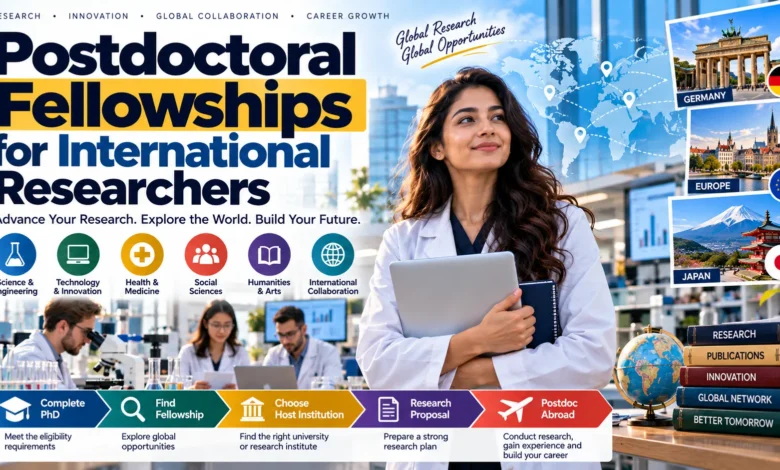
Completing a PhD is a major academic milestone, but for many researchers it is also the beginning of the next stage of their research career.
Postdoctoral fellowships allow researchers to continue developing their expertise after completing a doctorate, often at a university, laboratory or research institute outside their home country.
For international researchers, these fellowships can provide opportunities to join leading research groups, access specialized facilities, develop independent projects, publish new research and build collaborations across countries.
Major programmes exist in Europe, Germany, Japan and many other research destinations. Funding structures vary considerably: some programmes provide a fellowship or salary plus mobility and other allowances, while others offer a different package.
The application process can also be highly competitive.
A successful application generally requires more than a strong academic record. Researchers may need an appropriate host, a well-developed research proposal, evidence of previous research achievements and a clear explanation of how the fellowship contributes to their future career.
This guide explains how international postdoctoral fellowships work, major programmes to explore, typical eligibility requirements, funding considerations and how to prepare a competitive application.
Postdoctoral Fellowships at a Glance
| Area | What Researchers Should Know |
|---|---|
| Typical qualification | PhD or equivalent research doctorate |
| Career stage | Usually early postdoctoral, although limits vary |
| Main purpose | Advanced research and career development |
| Duration | Commonly several months to multiple years |
| Host | Often required |
| Funding | Programme-specific |
| Research fields | STEM, medicine, social sciences, humanities and more |
| Nationality | Many programmes accept international applicants |
| Mobility | Some programmes impose specific mobility rules |
| Research proposal | Frequently central to selection |
| Publications | Often considered as evidence of research potential |
| Application | Researcher, host or institution depending on programme |
Always use the current official programme call when determining eligibility.
What Is a Postdoctoral Fellowship?
A postdoctoral fellowship is a research opportunity intended primarily for people who have completed doctoral-level research.
A postdoctoral researcher may work on:
- An independent research project
- A host researcher’s larger project
- Laboratory experiments
- Field research
- Data analysis
- Academic publications
- New research methodologies
- International collaborations
- Conference presentations
- Teaching or mentoring, where applicable
- Knowledge transfer
- Research commercialization
The exact arrangement depends on the fellowship.
Some fellowships give researchers substantial independence to design their own projects.
Others support a researcher joining an existing laboratory or research programme.
Fellowship vs Postdoctoral Job
Not every postdoctoral opportunity is structured in the same way.
Postdoctoral Fellowship
Funding may be awarded through a competitive fellowship programme.
The researcher may propose a project together with a host institution.
Examples include major international mobility fellowships.
Postdoctoral Research Position
A university or principal investigator may recruit a researcher directly to work on an already funded project.
In this situation, the researcher may be an employee of the institution rather than an externally funded fellow.
Both routes can provide valuable international research experience.
Researchers should therefore search for both:
Postdoctoral fellowships
and
Postdoctoral research positions
rather than limiting themselves to one term.
Who Can Apply for Postdoctoral Fellowships?
Eligibility differs between programmes.
The most common requirement is a completed PhD or equivalent doctoral qualification.
However, programmes can also specify:
- Maximum years of postdoctoral research experience
- Date of PhD completion
- Nationality
- Country of residence
- Mobility history
- Research discipline
- Publication record
- Host institution
- Career interruptions
- Previous residence in the destination country
Read these rules before developing a full proposal.
Does Your PhD Need to Be Completed Before Applying?
Not always.
Some programmes allow researchers who have successfully defended their doctoral thesis but have not yet formally received the degree to apply under specified conditions.
Other fellowships require the doctorate to have been officially awarded before the application deadline or fellowship start.
For example, current MSCA Postdoctoral Fellowship guidance allows applicants who have successfully defended their doctoral thesis by the application deadline even when the formal doctoral degree has not yet been awarded.
Programme rules can change between calls, so always verify the current requirements.
Major Postdoctoral Fellowships for International Researchers
Several major programmes illustrate the types of opportunities available internationally.
1. Marie Skłodowska-Curie Actions Postdoctoral Fellowships
The Marie Skłodowska-Curie Actions Postdoctoral Fellowships, commonly called MSCA Postdoctoral Fellowships, are major European research mobility opportunities.
They support researchers who hold a PhD and want to develop their careers through international research experience.
The programme includes two main types.
European Postdoctoral Fellowships
European Postdoctoral Fellowships are open to researchers of any nationality.
They support research undertaken in an EU Member State or Horizon Europe Associated Country.
The fellowship generally lasts between 12 and 24 months.
Applicants must comply with the applicable mobility rule.
Global Postdoctoral Fellowships
Global Postdoctoral Fellowships include an outgoing research phase outside Europe followed by a mandatory return phase in Europe.
Specific nationality or long-term residence requirements apply.
These fellowships generally last between 24 and 36 months.
Research Experience
Current MSCA rules generally limit applicants to a maximum of eight years of research experience after obtaining the PhD, with certain periods potentially excluded under programme rules.
Examples can include qualifying career breaks or periods spent outside research.
Research Fields
MSCA Postdoctoral Fellowships are open across research disciplines.
Potential fields include:
- Engineering
- Computer science
- Artificial intelligence
- Physics
- Chemistry
- Biology
- Medicine
- Environmental science
- Economics
- Social sciences
- Humanities
The project is developed with a host organisation.
Applicants should carefully check the current call’s mobility, experience and host requirements before preparing a proposal.
2. Humboldt Research Fellowship in Germany
The Alexander von Humboldt Foundation offers the Humboldt Research Fellowship to researchers from around the world who want to conduct research in Germany.
The programme covers researchers across disciplines.
Postdoctoral Route
For the postdoctoral route, current official guidance targets researchers who completed their doctorate or equivalent academic qualification within the previous four years, subject to the complete programme requirements.
Postdoctoral fellows can conduct research in Germany with a host at a German research institution.
The fellowship can last 6 to 24 months.
Current Funding
The Humboldt Foundation currently states a monthly fellowship amount of €3,000 for postdoctoral researchers, plus additional benefits that may apply.
These can include certain family, insurance and travel-related support depending on eligibility and programme conditions.
Current Application Status
As of September 2026, the Humboldt Foundation says it has reached the maximum number of applications for the current call.
Its official programme page states that the next call will open on November 15, 2026.
Researchers planning to apply should use the official page to confirm the next application window and current requirements rather than relying on an older deadline.
3. JSPS Postdoctoral Fellowships for Research in Japan
The Japan Society for the Promotion of Science (JSPS) provides Postdoctoral Fellowships for Research in Japan.
The programme allows researchers from other countries to undertake cooperative research with leading research groups at Japanese universities and research institutions.
Standard Programme
The Standard programme is designed for postdoctoral researchers from overseas.
The fellowship generally lasts 12 to 24 months.
Current programme information states that applicants should generally have received their doctorate within the specified eligibility period or be scheduled to receive it before the fellowship begins.
A Host in Japan Is Essential
For the open-call route, the application is not simply submitted independently by the foreign researcher.
A Japanese host researcher submits the application through the host institution.
This means identifying a suitable research host well before the deadline can be critical.
Research Areas
JSPS supports research across areas including:
- Humanities
- Social sciences
- Natural sciences
Researchers should check the Standard programme rather than assuming that one of JSPS’s nationality-restricted short-term programmes applies to them.
Other Postdoctoral Opportunities Worth Exploring
Large international programmes are only part of the postdoctoral landscape.
Researchers should also investigate:
University Fellowships
Universities may fund their own postdoctoral fellowship schemes.
These can be:
- University-wide
- Department-specific
- Discipline-specific
- Research-centre based
- Donor-funded
Research Institutes
Independent institutes may recruit postdoctoral researchers directly.
Potential areas include:
- Biomedical research
- Artificial intelligence
- Climate science
- Physics
- Engineering
- Economics
- Public policy
- Humanities
Government Research Organizations
National research agencies and laboratories may operate fellowship or visiting-researcher programmes.
Eligibility for international researchers varies.
Principal Investigator-Funded Positions
A professor may have research-grant funding to recruit postdoctoral researchers.
These positions are frequently advertised as jobs rather than fellowships.
For that reason, search both fellowship databases and university vacancy portals.
Which Countries Should International Postdocs Explore?
The right destination depends primarily on research fit.
Germany
Germany offers opportunities through universities, research institutes and programmes such as the Humboldt Research Fellowship.
Researchers should investigate the specific groups working in their field rather than choosing Germany solely because a fellowship is available.
Japan
Japan can be attractive for researchers whose projects align with Japanese universities or research institutes.
JSPS provides a structured route for international postdoctoral collaboration.
European Research Area
MSCA makes Europe particularly important for internationally mobile researchers.
Potential destinations can include:
- France
- Germany
- Netherlands
- Belgium
- Sweden
- Denmark
- Finland
- Ireland
- Austria
- Spain
- Italy
- Other eligible European destinations
The relevant host and mobility conditions depend on the fellowship.
United States
US universities and research institutions regularly advertise postdoctoral opportunities.
Many are direct university appointments rather than a single nationwide fellowship programme.
Canada
Canadian universities and research institutions recruit international postdoctoral researchers across numerous disciplines.
Funding can come from universities, supervisors, research grants or external programmes.
Australia
Australian universities and research institutes advertise postdoctoral research fellowships and research positions.
International eligibility varies by position.
Research Fields With Postdoctoral Opportunities
Postdoctoral research is not limited to laboratory science.
Science
Opportunities may include:
- Physics
- Chemistry
- Biology
- Mathematics
- Astronomy
- Materials science
Engineering
Possible areas include:
- Mechanical engineering
- Electrical engineering
- Civil engineering
- Chemical engineering
- Aerospace engineering
- Energy systems
Technology
Rapidly developing areas include:
- Artificial intelligence
- Machine learning
- Data science
- Robotics
- Cybersecurity
- Quantum computing
- Computer vision
Health and Medicine
Potential research areas include:
- Biomedical sciences
- Neuroscience
- Public health
- Epidemiology
- Global health
- Pharmaceutical research
Clinical work can involve additional professional licensing requirements.
Environment and Sustainability
Researchers may find projects involving:
- Climate change
- Renewable energy
- Environmental science
- Biodiversity
- Conservation
- Sustainable development
Social Sciences
Opportunities exist in:
- Economics
- Political science
- Sociology
- International relations
- Public policy
- Education
- Psychology
Humanities
Postdoctoral fellowships also support:
- History
- Philosophy
- Literature
- Linguistics
- Cultural studies
- Archaeology
- Other humanities disciplines
How to Find Postdoctoral Fellowships Abroad
A good search begins with your research topic rather than the word “postdoc.”
Instead of:
Postdoctoral fellowship abroad
try:
Postdoctoral fellowship artificial intelligence Germany
or:
Postdoc climate science Europe
or:
Postdoctoral fellowship political science Japan
This reduces irrelevant results.
Search Official Fellowship Websites
Create a list of major programmes relevant to your career stage.
Track:
- Opening date
- Deadline
- PhD eligibility window
- Mobility requirements
- Host requirements
- Fellowship duration
- Funding
- Required documents
Programme rules can change between cycles.
Always use the current official call.
Search University Career Portals
Universities advertise many postdoctoral opportunities directly.
Search sections such as:
- Academic Vacancies
- Research Careers
- Postdoctoral Opportunities
- Research Jobs
- Fellowships
- Faculty and Research Positions
Set alerts where available.
Search Research Groups
If you know the leading laboratories or scholars in your field, check their research-group websites.
A newly funded research project may create postdoctoral vacancies before they become widely known.
How to Choose a Host Institution
The most famous university is not automatically the best host.
Research fit matters more.
Evaluate:
- Supervisor expertise
- Recent publications
- Research facilities
- Available datasets
- Laboratory equipment
- Existing projects
- International collaborations
- Publication environment
- Previous postdocs
- Mentoring structure
Your proposed research should logically benefit from being conducted there.
How to Contact a Potential Postdoctoral Host
Keep the first email focused.
Include:
- Your current position
- PhD field
- Main research expertise
- One or two relevant achievements
- Proposed research direction
- Fellowship you are considering
- Why you specifically selected their group
Attach a concise academic CV where appropriate.
Avoid generic messages such as:
“Dear Professor, I have read your excellent research and want a postdoc in your university.”
Instead, demonstrate that you understand the researcher’s work.
Documents Commonly Required
A postdoctoral fellowship application may request:
- Academic CV
- Research proposal
- PhD certificate
- Publication list
- Degree documents
- Host statement
- Recommendation letters
- Motivation statement
- Career-development plan
- Research ethics information
- Data-management plan
- Budget
- Proof of eligibility
Requirements vary.
Never prepare an application solely from an old template without checking the current instructions.
Building a Strong Academic CV
A postdoctoral CV differs from a standard corporate resume.
Useful sections can include:
Academic Profile
A short summary of your research expertise.
Education
Include:
- PhD
- Institution
- Research topic
- Completion date
- Relevant previous degrees
Research Experience
Describe your contribution rather than simply listing project names.
Publications
Organize publications clearly.
Do not claim papers as published when they are merely submitted.
Conference Contributions
Include relevant:
- Presentations
- Posters
- Invited talks
Research Methods
Identify genuine technical or methodological expertise.
Awards and Funding
Include verified research awards, grants and scholarships.
Teaching and Supervision
Where relevant, include teaching and student-supervision experience.
Professional Service
Peer review, conference organization and other academic service may also be relevant.
How to Write a Competitive Postdoctoral Research Proposal
1. Start With a Clear Research Question
A reviewer should quickly understand what you want to investigate.
Avoid vague proposals covering an entire discipline.
2. Explain the Research Gap
Show what existing literature has established and what remains unresolved.
3. Demonstrate Originality
Explain what your project adds.
Originality may involve:
- A new research question
- New methodology
- New dataset
- New theoretical approach
- New application
- New interdisciplinary connection
4. Provide a Credible Methodology
Explain how the research will actually be conducted.
Include appropriate methods such as:
- Experiments
- Computational modelling
- Statistical analysis
- Surveys
- Interviews
- Fieldwork
- Archival research
- Comparative analysis
5. Explain Host Fit
This can be crucial.
Explain why the host’s:
- Expertise
- Equipment
- Research group
- Data
- Infrastructure
- Networks
make the institution appropriate for your project.
6. Create a Realistic Timeline
For a two-year fellowship, a simplified structure might look like:
| Period | Research Activity |
|---|---|
| Months 1–3 | Project setup and literature refinement |
| Months 4–9 | Main data collection or experimental work |
| Months 10–14 | Analysis and validation |
| Months 15–18 | Additional research and collaboration |
| Months 19–21 | Manuscript preparation |
| Months 22–24 | Publication, dissemination and next-stage planning |
Adapt the timeline to your actual research.
7. Explain Expected Outcomes
Potential outcomes may include:
- Peer-reviewed papers
- Datasets
- Software
- New methodology
- Conference presentations
- Policy recommendations
- Patents
- Future collaborations
Keep outcomes realistic.
Why Career Development Matters
Some fellowship programmes assess more than the immediate research project.
They may also consider how the fellowship will develop you as a researcher.
Possible development goals include:
- Learning a new methodology
- Developing leadership skills
- Building international collaborations
- Working across disciplines
- Learning research management
- Improving communication
- Developing industry experience
- Supervising junior researchers
Explain how the fellowship moves your career forward rather than merely changing your physical location.
How Important Are Publications?
Publications can be important evidence of research capability.
However, raw publication count should not be your only focus.
Reviewers may consider:
- Quality
- Relevance
- Research contribution
- Independence
- Career stage
- Discipline
- Authorship role
Publication practices differ substantially between disciplines.
A strong humanities applicant and a biomedical researcher may have very different publication profiles.
What If You Have Few Publications?
Do not invent or exaggerate publications.
Instead, accurately present:
- Published papers
- Accepted papers
- Preprints where appropriate
- Thesis research
- Conference work
- Research software
- Datasets
- Patents
- Other recognized outputs
Then concentrate on demonstrating the quality and potential of your proposed research.
How to Apply: Step by Step
Step 1: Determine Your Eligibility
Check:
- PhD completion date
- Years of research experience
- Nationality
- Residence
- Mobility rules
Do this before contacting potential hosts.
Step 2: Select Suitable Programmes
Shortlist fellowships based on your actual profile.
Step 3: Identify the Host
Find researchers whose work aligns closely with your project.
Step 4: Contact the Host Early
Major fellowship proposals can require substantial collaboration.
Do not contact a potential host two days before the deadline.
Step 5: Develop the Research Proposal
Incorporate feedback from the host where appropriate.
Step 6: Prepare Supporting Documents
Request recommendation letters early.
Collect degree certificates and other required evidence.
Step 7: Check Institutional Deadlines
The institution may have an earlier internal deadline.
This is particularly important where the host institution submits the application.
For example, JSPS warns that Japanese host institutions may set deadlines more than a month before the official JSPS deadline.
Step 8: Submit Through the Correct Route
Depending on the fellowship, submission may be handled by:
- The researcher
- The host researcher
- The host institution
- A joint application
Follow the official instructions exactly.
Common Postdoctoral Application Mistakes
Applying Without Checking Mobility Rules
This can make an otherwise excellent application ineligible.
Choosing a Host Only for Reputation
Research compatibility is more important than university name alone.
Writing an Unrealistic Proposal
A two-year fellowship cannot reasonably solve every major problem in your field.
Weak Host Justification
Explain why your research needs this particular environment.
Reusing the Same Proposal Everywhere
Each fellowship has different objectives and evaluation criteria.
Missing Internal Deadlines
Your host institution may need to review and approve the application.
Exaggerating Publications
Academic records should be completely accurate.
Ignoring Career Development
Show how the fellowship develops both the research project and the researcher.
How Competitive Are Postdoctoral Fellowships?
Major international programmes can be highly competitive.
As one concrete example, JSPS reports that its FY2026 Standard open-call rounds received thousands of applications, with published selection rates of 7.8% in the first round and 5.6% in the second round.
Those figures apply specifically to that JSPS programme and cycle; they should not be generalized to every international postdoctoral fellowship.
The practical lesson is to build a strong application rather than assume that meeting minimum eligibility requirements is sufficient.
Evaluating a Fellowship Offer
Before accepting an offer, investigate more than the headline funding figure.
Financial Package
Check:
- Monthly fellowship or salary
- Tax treatment
- Travel support
- Relocation allowance
- Family support
- Insurance
- Research expenses
Cost of Living
Compare the funding with realistic costs in the host city.
Research Funding
Determine whether laboratory, fieldwork, computing and conference costs are separate from your personal fellowship.
Visa and Immigration
Understand:
- Required visa
- Host support
- Processing timeline
- Dependants’ requirements
- Associated costs
Employment Status
Determine whether you will be:
- An employee
- A fellowship recipient
- Another institutional category
This can affect tax, social security and benefits.
Avoiding Fake Postdoctoral Opportunities
Researchers can also encounter fraudulent academic advertisements.
Be cautious if someone:
- Guarantees fellowship selection
- Requests payment for an award
- Uses an unrelated email domain
- Claims to represent a university but cannot be found on its website
- Offers unusually high funding without formal documentation
- Requests banking information before legitimate selection
- Provides a fake acceptance letter
- Pressures you to pay visa or processing fees to an individual
Verify the programme through the official university, research institution or funding organization.
A Practical 6-Month Application Strategy
| Period | Main Goal |
|---|---|
| Month 1 | Identify fellowship programmes |
| Month 2 | Research and contact potential hosts |
| Month 3 | Develop project concept |
| Month 4 | Draft proposal and obtain feedback |
| Month 5 | Prepare documents and references |
| Month 6 | Final review and submission |
Actual timelines vary.
Some complex programmes should be started even earlier.
Frequently Asked Questions
Can international researchers apply for postdoctoral fellowships?
Yes. Many programmes specifically support international research mobility. Nationality and residence requirements vary by fellowship.
Do I need a PhD?
Postdoctoral fellowships generally require a PhD or equivalent doctorate. Some programmes allow applicants who have successfully defended their thesis but have not yet received the formal degree.
Are postdoctoral fellowships fully funded?
Many provide substantial financial support, but there is no universal definition of fully funded. Check salary or stipend, mobility support, research costs, insurance, travel and family benefits separately.
Can I apply immediately after my PhD?
Yes, many postdoctoral fellowships are specifically designed for early-career researchers after doctoral completion.
Can I apply from any country?
It depends on the programme. MSCA European Postdoctoral Fellowships can accept researchers of any nationality subject to programme requirements, while other fellowship routes may have specific nationality or residence restrictions.
Do I need a host professor?
Many major fellowships require a host researcher or host organisation. The application structure differs between programmes.
Can I change my research field after my PhD?
Interdisciplinary and career-development moves can be possible, but the proposal should demonstrate that you have the background needed to conduct the proposed research and explain the logic behind the transition.
Does a fellowship guarantee a permanent academic position?
No. A fellowship can strengthen research experience, publications and professional networks, but future employment requires separate recruitment.
Final Takeaway
Postdoctoral fellowships can provide international researchers with an opportunity to move from doctoral training toward greater research independence.
Major programmes such as MSCA Postdoctoral Fellowships, the Humboldt Research Fellowship and JSPS Postdoctoral Fellowships for Research in Japan offer different models of international research mobility.
But their rules are not interchangeable.
Before applying, determine:
- Whether your PhD date qualifies
- Whether nationality restrictions apply
- Whether you meet mobility requirements
- Whether a host is required
- How long the fellowship lasts
- Exactly what funding is provided
- Which documents are required
- Whether the host institution has an internal deadline
Then concentrate on the elements that can make an application convincing: a focused research question, credible methodology, strong host fit, realistic outcomes and a clear career-development plan.
International postdoctoral research should not simply be about going abroad.
The stronger goal is to choose an environment where the fellowship can meaningfully advance your research, develop new expertise and create collaborations that support the next stage of your academic or professional career.