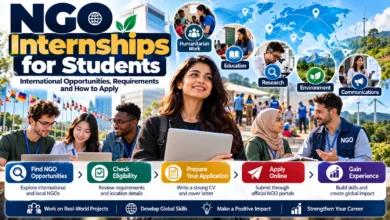
The United Nations offers internship opportunities that allow eligible students and recent graduates to gain practical experience in an international working environment. Depending on the organization and position, interns may contribute to research, human rights, sustainable development, communications, humanitarian affairs, data analysis, administration or other areas of work.
For international students, a UN internship can provide exposure to global issues and help develop professional skills relevant to future careers.
However, there is an important distinction: the United Nations is part of a wider system of agencies, funds and programmes, and their internship arrangements are not identical.
For example, United Nations Secretariat internships are unpaid, while UNICEF provides stipends to its interns. Eligibility requirements, application procedures, internship duration and remote-work options can also differ.
This guide explains how UN internships work, who can apply, where to find opportunities and how to prepare an application that accurately demonstrates your qualifications.
UN Internships at a Glance
| Area | What Applicants Should Know |
|---|---|
| Main applicants | Eligible university students and recent graduates |
| International eligibility | Depends on the organization and vacancy |
| Education | Requirements vary by programme and academic stage |
| Work experience | Not generally required for UN Secretariat internships |
| Internship duration | Often a few months; exact duration varies |
| Compensation | Secretariat internships are unpaid; some other UN organizations provide stipends |
| Work arrangement | In-person, remote or hybrid, depending on the vacancy |
| Common fields | Development, research, communications, human rights, technology and administration |
| Application | Through the official careers website of the relevant organization |
| Recruitment fees | The United Nations does not charge recruitment fees |
Applicants should always read the complete vacancy announcement before applying.
What Is a United Nations Internship?
A United Nations internship is a temporary opportunity designed to provide eligible students and recent graduates with practical exposure to the work of a UN organization.
Interns may work alongside professional staff, support research and administrative activities, participate in meetings and contribute to projects relevant to their academic background.
An internship is not the same as a permanent staff appointment.
It does not automatically provide a future job, a professional staff grade or a guaranteed pathway to international employment.
The specific learning experience depends on the department, supervisor, assignment and organization.
UN Secretariat vs Other UN Organizations
One of the most important things to understand is that the wider UN system includes multiple organizations with their own recruitment arrangements.
For internship purposes, applicants may encounter opportunities advertised by:
- United Nations Secretariat departments and offices
- United Nations Development Programme (UNDP)
- United Nations Children’s Fund (UNICEF)
- United Nations Educational, Scientific and Cultural Organization (UNESCO)
- United Nations Population Fund (UNFPA)
- United Nations High Commissioner for Refugees (UNHCR)
- Other UN agencies, funds and programmes
These organizations can have different eligibility rules, compensation policies, application platforms and internship structures.
Do not assume that information about one organization applies automatically to every other UN internship.
Who Can Apply for UN Secretariat Internships?
The UN Secretariat internship programme generally accepts applicants who meet the relevant university education requirements.
Applicants typically need to be:
- Enrolled in a graduate degree programme, such as a master’s or doctoral programme;
- Enrolled in the final academic year of a first university degree programme, at least bachelor’s level or equivalent; or
- Eligible recent graduates under the applicable programme rules.
Recent graduates should pay particular attention to the graduation-date requirements in the vacancy.
UN Secretariat internship guidance has included a requirement for eligible graduates to begin the internship within one year of graduation.
The current administrative instructions and individual vacancy should be checked to establish the precise eligibility conditions for a particular application.
Can Undergraduate Students Apply?
Yes, eligible undergraduate students can apply for some UN internships.
For the UN Secretariat programme, students in the final academic year of a first university degree programme may meet the general academic eligibility requirement.
This means a student who has just started a bachelor’s degree should not assume that they already qualify for every Secretariat internship.
However, other UN organizations may have different rules.
For example, UNICEF’s internship programme accepts eligible students enrolled in undergraduate, graduate or doctoral programmes.
Always check the requirements of the specific organization.
Can Recent Graduates Apply?
Yes, some UN internship programmes accept recent graduates.
However, the permitted period after graduation varies.
For example, the UN Secretariat has specific recent-graduate eligibility rules, while UNICEF’s internship programme accepts eligible applicants who graduated within the past two years.
Applicants should verify the graduation window and any requirement to begin the internship within a specified period.
Do not assume that every UN organization uses the same definition of a recent graduate.
Are UN Internships Open to All Nationalities?
Many UN internship opportunities are open to applicants from different countries.
However, individual programmes and vacancies can have additional restrictions.
Eligibility may depend on:
- Nationality
- Academic enrollment
- Graduation date
- Field of study
- Language proficiency
- Duty station
- Immigration requirements
- Programme-specific conditions
Some internships may also be associated with particular countries, partner institutions or funding arrangements.
The vacancy announcement is the definitive source for eligibility.
Do You Need Previous Work Experience?
Professional work experience is not generally required for the UN Secretariat internship programme.
However, applicants are expected to demonstrate that their education, training, academic work or skills are relevant to the internship.
For example, a communications internship may benefit from writing, editing or digital content experience.
A data-related internship may require familiarity with spreadsheets, statistical software or programming tools.
A research internship may value experience with academic research methods and report writing.
Even without previous employment, applicants can demonstrate their abilities through academic projects, university activities, volunteering and independent work.
What Subjects Can Lead to UN Internships?
UN internship opportunities cover a broad range of academic disciplines.
The most relevant subject depends on the department and vacancy.
International Relations and Political Science
Students may explore opportunities involving political affairs, peacebuilding, international cooperation and policy research.
Law and Human Rights
Relevant assignments may involve legal research, human rights documentation, policy analysis and related work.
Economics and Development Studies
Potential work areas include economic research, development policy, programme analysis and sustainable development.
Computer Science and Information Technology
Some internships involve software development, information systems, cybersecurity, digital transformation and technical support.
Data Science and Statistics
Relevant assignments may involve data cleaning, analysis, visualization, statistical research and reporting.
Communications and Journalism
Internships may include writing, editing, social media, public information, multimedia production and communications research.
Business, Finance and Administration
Students may find opportunities involving financial analysis, administrative support, human resources, procurement and programme operations.
Environmental Science
Relevant work may involve climate research, environmental policy, sustainability and natural-resource management.
Students should search for opportunities that match their actual academic background and skills rather than assuming that every UN internship is limited to international relations.
Where Can UN Interns Work?
Internship duty stations vary by organization and vacancy.
Opportunities may be associated with headquarters, regional offices, country offices and other locations.
Examples of major UN duty stations include:
- New York
- Geneva
- Vienna
- Nairobi
- Bangkok
- Addis Ababa
- Other regional and country-office locations
Not every office offers internships in every field or at every time of year.
Applicants should search current official listings rather than rely on an outdated list of locations.
Are UN Internships Paid?
Compensation depends on the organization.
This is one of the most important details to verify before applying.
United Nations Secretariat
UN Secretariat internships are unpaid.
Interns or their sponsoring institutions are generally responsible for applicable living, travel, accommodation and insurance expenses.
An applicant considering an in-person Secretariat internship should evaluate the financial implications before accepting an offer.
UNICEF
UNICEF provides interns with a stipend as a contribution toward living expenses.
Depending on available funding and programme conditions, additional contributions toward travel or visa expenses may also be available.
Other UN Organizations
Other agencies, funds and programmes may use different arrangements.
Some provide stipends or allowances, while others have separate funding conditions.
Always check the official programme page and individual vacancy for current compensation details.
Do not assume that every UN internship is paid or that every UN internship is unpaid.
Can You Get a Fully Funded UN Internship?
The term “fully funded” should be used carefully.
A programme offering a stipend does not necessarily cover every expense.
Applicants should separately verify:
- Monthly stipend or allowance
- Travel costs
- Visa-related costs
- Accommodation
- Health insurance
- Local transportation
- Other living expenses
If the official programme does not explicitly cover an expense, do not assume that it will be reimbursed.
Are Remote UN Internships Available?
Some UN internship vacancies permit remote or hybrid participation.
However, remote work is not available for every position.
The arrangement may depend on the department, assignment, duty station and supervisor’s requirements.
A vacancy may specify:
- In-person internship
- Fully remote internship
- Hybrid arrangement
- Flexible working arrangement subject to approval
Remote participation should never be assumed simply because the application process is online.
Applicants should read the Work Location and Special Notice sections carefully.
Do International Students Need a Visa?
If an internship requires travel to another country, applicants may need an appropriate visa or other authorization.
The exact requirements depend on the destination, nationality, internship arrangement and applicable immigration rules.
For UN Secretariat internships, applicants should not assume that the organization will pay their visa or relocation costs.
Other UN organizations may provide supporting documents or assistance under their own programme arrangements.
Before accepting an overseas internship, confirm:
- Required visa or entry permission
- Who provides supporting documentation
- Whether work or internship authorization is necessary
- Application processing time
- Travel and insurance requirements
- Who is responsible for related expenses
If the internship is fully remote and completed from your home country, relocation-related requirements may differ, but local legal and programme conditions can still apply.
How Long Do UN Internships Last?
Internship duration varies by organization.
UN Secretariat internships commonly last between two and six months.
UNICEF internships generally last between six and twenty-six weeks.
Other organizations may use different arrangements.
Always confirm the exact start date, end date, weekly working hours and any possibility of extension before accepting an offer.
How to Find UN Internship Opportunities
The most reliable approach is to search the official career website of the organization offering the internship.
UN Careers
The official UN Careers portal is the starting point for UN Secretariat internships.
Applicants can search for vacancies in the Internship category and review individual descriptions.
UNICEF Careers
UNICEF maintains an internship programme page and advertises available opportunities through its official recruitment system.
UNDP Careers
Applicants interested in development-related internships should check UNDP’s official career pages and internship information.
Other UN Organizations
For UNESCO, UNFPA, UNHCR and other organizations, use their official careers websites.
Do not assume that every UN-system internship appears on the UN Secretariat’s careers portal.
How to Search for Internships That Match Your Background
Searching for “UN internships” alone may produce many irrelevant results.
Use your academic discipline and preferred work area to narrow the search.
Useful search phrases include:
- United Nations communications internship
- UN human rights internship
- UN research internship
- United Nations data analysis internship
- UN development internship
- UN information technology internship
- UN environmental internship
- UN remote internship
- UNICEF internship for international students
- UNDP internship programme
After discovering an opportunity, open the official vacancy to verify whether it is currently accepting applications.
How to Apply for UN Internships: Step by Step
Step 1: Identify the Relevant Organization
Choose the UN organization whose work matches your academic background and career interests.
For example, a student interested in child development may investigate UNICEF, while a student interested in development policy may explore UNDP opportunities.
This is a starting point for research, not a guarantee that a suitable vacancy is available.
Step 2: Search Current Vacancies
Use the official careers website.
Check the application deadline, location, duration, work arrangement and internship responsibilities.
Do not rely solely on social-media posts or third-party job advertisements.
Step 3: Confirm Your Eligibility
Review all essential requirements, including:
- Academic enrollment
- Graduation date
- Field of study
- Language proficiency
- Nationality restrictions, if any
- Required technical skills
- Availability
- Location and visa conditions
Do not apply based only on the internship title.
Step 4: Prepare Your Application Documents
Depending on the organization, you may need:
- CV or resume
- Cover letter or motivation statement
- Academic transcript
- Proof of university enrollment
- Graduation certificate
- Portfolio or writing sample
- References
- Other documents specified in the vacancy
Prepare accurate documents and follow the instructions provided.
Step 5: Complete the Official Online Application
UN Secretariat internship applications are generally submitted through the official online recruitment system, Inspira.
Other UN organizations may use different platforms.
Complete all required sections carefully.
An incomplete application may not be considered.
Step 6: Tailor Your Motivation Statement
Explain why you are interested in the specific internship and how your education and skills relate to its responsibilities.
Avoid sending the same generic statement to every organization.
Step 7: Submit Before the Deadline
Review your application before submission.
Check your contact details, academic information, graduation dates, work history and uploaded documents.
Submit through the official channel before the advertised closing date.
Step 8: Prepare for Further Assessment
Depending on the vacancy, shortlisted candidates may be contacted for an interview, written exercise or other assessment.
The selection process varies by organization and position.
How to Write a Strong UN Internship Motivation Statement
A motivation statement should connect your academic background and skills to the work described in the vacancy.
A practical structure includes four elements.
1. Introduction
Identify the internship and explain your current academic or professional stage.
2. Relevant background
Discuss coursework, research, projects or experience related to the position.
3. Skills and contribution
Explain how your abilities could support the team’s work.
4. Motivation
Describe your interest in the organization’s specific activities and what you hope to learn.
For example, a student applying for a research internship could discuss relevant coursework, research methods, data analysis and experience preparing academic reports.
Do not claim professional experience or achievements you do not have.
How to Build a Strong Application Without Work Experience
Students can demonstrate relevant abilities through several forms of experience.
Academic Research
Include research papers, dissertations, fieldwork or analytical assignments that relate to the internship.
University Projects
Describe relevant group projects and explain your individual contribution.
Volunteer Activities
Relevant volunteering may demonstrate communication, teamwork, community engagement or organizational skills.
Technical Skills
Include software and tools you can genuinely use.
Examples may include spreadsheets, statistical software, programming languages, design tools or digital communication platforms.
Writing and Communication
If the internship involves communications or research, provide evidence of your ability to prepare clear, accurate written material.
The goal is to demonstrate suitability through genuine evidence rather than exaggerating your experience.
Preparing for a UN Internship Interview
Not every applicant will receive an interview invitation.
If selected for further consideration, prepare by reviewing the vacancy and the work of the relevant department.
Potential interview themes include:
- Why are you interested in this internship?
- How does your academic background relate to the position?
- Tell us about a relevant university project.
- How do you organize competing deadlines?
- Describe a time you worked with people from different backgrounds.
- What technical skills can you contribute?
- How would you approach an unfamiliar research assignment?
Prepare specific examples from your studies, volunteering and other relevant activities.
For remote interviews, test your internet connection, microphone and camera beforehand.
What Happens After Selection?
If you receive an internship offer, review its terms carefully before accepting.
Confirm the following:
| Item | What to Verify |
|---|---|
| Organization | Exact UN entity and department |
| Duration | Start and end dates |
| Location | In-person, remote or hybrid |
| Hours | Expected weekly schedule |
| Compensation | Stipend, allowance or unpaid arrangement |
| Travel | Who arranges and pays for travel |
| Visa | Required authorization and supporting documents |
| Insurance | Coverage requirements and responsibility |
| Supervisor | Reporting and communication arrangements |
| Documents | Enrollment proof, certificates or other onboarding requirements |
Keep copies of official correspondence and relevant programme documents.
Can a UN Internship Lead to a Permanent Job?
A UN internship can provide practical experience and help participants understand international organizations.
However, it does not guarantee a future UN job.
Recruitment for staff positions follows separate eligibility and selection procedures.
Some UN Secretariat internship arrangements also include restrictions affecting eligibility for certain staff appointments immediately after an internship.
Applicants should check the current internship terms and relevant staff recruitment rules rather than assuming they can move directly into a Professional-category position.
If your long-term goal is a UN career, use the internship to develop relevant skills and learn about the qualifications required for future vacancies.
Common Mistakes International Students Should Avoid
Assuming Every UN Internship Is Paid
Compensation varies across organizations.
Check the official policy before making financial commitments.
Ignoring Graduation Requirements
Some programmes limit eligibility based on academic stage or time since graduation.
Applying Without Reading the Vacancy
A general interest in the United Nations is not enough if you do not meet the position’s requirements.
Assuming Remote Work Is Available
The vacancy must explicitly permit remote participation or provide an approved flexible arrangement.
Sending Generic Motivation Statements
Explain how your actual academic background matches the specific assignment.
Overlooking Travel and Living Costs
An unpaid in-person internship may involve substantial personal expenses.
Paying for Guaranteed Placement
Legitimate UN recruitment does not require payment to secure selection.
How to Avoid Fake UN Internship Advertisements
Fraudulent advertisements may misuse the names and branding of international organizations.
Be cautious if someone:
- Guarantees selection in exchange for payment
- Requests an application or interview fee
- Uses an unofficial email address
- Refuses to provide an official vacancy reference
- Asks for sensitive financial information during initial recruitment
- Pressures you to transfer money immediately
Verify every opportunity through the official careers website of the organization.
Do not send money to someone claiming they can guarantee a UN internship.
A Practical Internship Search Plan
| Stage | Main Activity |
|---|---|
| Research | Identify UN organizations relevant to your field |
| Eligibility | Check academic, language and location requirements |
| Preparation | Update CV, motivation statement and supporting documents |
| Applications | Apply through official portals before deadlines |
| Assessment | Prepare relevant academic and practical examples |
| Offer review | Verify compensation, work arrangement and expenses |
Maintain a simple application tracker containing the organization, internship title, duty station, deadline, application date and current status.
This can help you manage multiple applications without confusing their requirements.
Frequently Asked Questions
Can international students apply for UN internships?
Yes, eligible international students can apply for many UN internship opportunities. Requirements vary by organization and vacancy, so nationality, academic status, language and location conditions must be checked individually.
Are UN internships paid?
UN Secretariat internships are unpaid. Some other UN organizations provide stipends; UNICEF, for example, provides interns with a stipend toward living expenses.
Can undergraduate students apply?
Yes. The UN Secretariat generally accepts eligible students in the final academic year of a first university degree programme. Other UN organizations may have different undergraduate eligibility rules.
Can recent graduates apply for UN internships?
Yes, some programmes accept recent graduates. The permitted time since graduation varies, so applicants should check the official eligibility requirements.
Are remote UN internships available?
Some vacancies allow remote or hybrid participation. However, not every UN internship can be completed remotely, and the individual vacancy determines the work arrangement.
Do I need previous professional experience?
Professional work experience is not generally required for UN Secretariat internships, but applicants should demonstrate relevant education, training and skills. Other organizations and individual positions may have additional requirements.
Does a UN internship guarantee a job?
No. Internships and staff appointments have separate recruitment requirements. Completing an internship does not guarantee future employment.
Final Takeaway
UN internships can provide international students and recent graduates with practical exposure to global development, human rights, research, communications, technology and many other fields.
The key is to identify an opportunity that matches your academic background and circumstances.
Before applying, verify the specific organization’s eligibility rules, compensation policy, work arrangement, duration and application procedure.
For an overseas internship, consider the financial and immigration requirements carefully. For a remote internship, confirm that applicants from your location are eligible.
Prepare a targeted application that demonstrates your genuine skills and academic experience, use official recruitment channels and avoid anyone promising guaranteed selection.
A UN internship can be a valuable learning experience, but it should be evaluated as a specific professional development opportunity rather than a guaranteed route to permanent international employment.